



Begin of page section:
Page sections:

  • Go to contents (Accesskey 1)
  • Go to position marker (Accesskey 2)
  • Go to main navigation (Accesskey 3)
  • Go to sub navigation (Accesskey 4)
  • Go to additional information (Accesskey 5)
  • Go to page settings (user/language) (Accesskey 8)
  • Go to search (Accesskey 9)

End of this page section. Go to overview of page sections

Begin of page section:
Page settings:

English en
Deutsch de
Search
Login

End of this page section. Go to overview of page sections

Begin of page section:
Search:

Search for details about Uni Graz
Close

End of this page section. Go to overview of page sections


Search

Begin of page section:
Main navigation:

Page navigation:

  • University

    University
    • About the University
    • Organisation
    • Faculties
    • Library
    • Working at University of Graz
    • Campus
    Developing solutions for the world of tomorrow - that is our mission. Our students and our researchers take on the great challenges of society and carry the knowledge out.
  • Research Profile

    Research Profile
    • Our Expertise
    • Research Questions
    • Research Portal
    • Promoting Research
    • Research Transfer
    • Ethics in Research
    Scientific excellence and the courage to break new ground. Research at the University of Graz creates the foundations for making the future worth living.
  • Studies

    Studies
    • Prospective Students
    • Students
    • Welcome Weeks for First Year Students
  • Community

    Community
    • International
    • Location
    • Research and Business
    • Alumni
    The University of Graz is a hub for international research and brings together scientists and business experts. Moreover, it fosters the exchange and cooperation in study and teaching.
  • Spotlight
Topics
  • Sustainable University
  • Researchers answer
  • Work for us
Close menu

End of this page section. Go to overview of page sections

Begin of page section:
You are here:

University of Graz News Democracy in lecture hall and lab

End of this page section. Go to overview of page sections

Monday, 29 April 2024

Democracy in lecture hall and lab

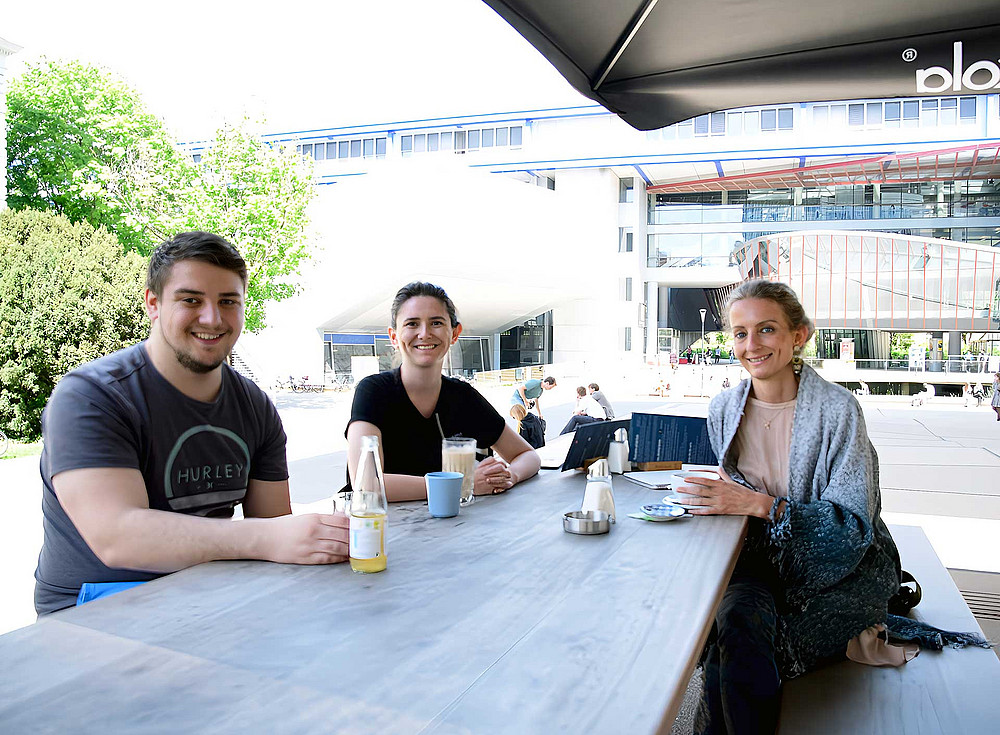
ÖH-Vorsitzender Stefan Zeiringer, ÖH-Vize Maja Höggerl und Senatsvorsitzende Ehrke-Rabel (v. l.) Foto: Uni Graz/Tzivanopoulos

Chairman of the Students' Union Stefan Zeiringer, Vice-Chairwoman Maja Höggerl and Senate Chairwoman Tina Ehrke-Rabel (v. l.) Photo: Uni Graz/Tzivanopoulos

The University of Graz shows how democracy works in everyday research, study and work life. From participation in the Senate to curricula and student representation: all members of the university have the opportunity to help shape teaching, research and the university.

At the University of Graz, members of all areas experience how democracy works in everyday research, study and work life. The legally guaranteed independence of research and self-administration make universities independent democratic units in which students and teaching staff have a say.

The most important body is the 26-member Senate. "We are something like the National Council of the university," says Senate Chair Tina Ehrke-Rabel. And in this function, they have a direct influence on the decisions of the Rectorate.

The Senate is made up of representatives from academia (senior and intermediate faculty), general staff and the Austrian Students' Union (ÖH), which, as an elected body of students, is another pillar of democracy at universities. "Much of what is discussed in the Senate has to do with studies," says Maja Höggerl, deputy ÖH chairwoman and member of the Senate. "Student input is particularly important here. At the end of the day, we directly experience everyday study life, which is why we are best placed to give feedback."

This participation is particularly important in the curriculum commissions, says ÖH Chair Stefan Zeiringer. The principle of democracy is also upheld here. A third of the members are students. "They know the current problems with the curriculum best and are actively committed to solving them." For Höggerl, this type of co-determination is an important motivation. "It's a great feeling to know that you've been able to contribute to this curriculum and perhaps ensure that one or two outdated courses no longer take place."

For Senate Chair Ehrke-Rabel, the curriculum committees are a central component of a university. "We exist primarily because we have students. We are not just a research institution, but also a teaching and educational institution." Criticism and suggestions from students are therefore particularly valuable. "After all, the quality of teaching and the curriculum has a direct influence on students' career progression."

This is also important for the strategic direction of the university. "We want to be an attractive place for young people where they feel they can help shape the future," says Ehrke-Rabel. For the student representatives, the topic of sustainability is a priority, says Zeiringer: "As a university, we want to be a pioneer in society." At the same time, the group of students is becoming increasingly diverse, says Höggerl. "The university has to ask itself current questions. How do you deal with the many different views and different backgrounds in the student body?"

Voluntary work takes up a lot of time, but it also brings a lot of life experience, says ÖH Chair Zeiringer. "Even if you don't complete major projects during your own term of office, your successors take over. After 20 years, you can see that the university is in a better position than before and that you were part of it. That's something to be proud of."

But it doesn't always have to be the big hit. "Even small improvements that benefit a few students can make a big difference for them," explains Höggerl. "That's a good thing." For Senate Chairwoman Ehrke-Rabel, self-administration is a privilege. "We can shape things. We should take that seriously and enjoy it."

created by Roman Vilgut

Related news

Electricity consumption reduced: University of Graz well on track

This year, the University of Graz has once again received EMAS certification. Since the introduction of this environmental management system in 2016, the seal of approval has been renewed every three years after successful audits. As an EMAS-certified organisation, the university is committed to systematically improving its environmental performance and contributing to sustainable development at all levels. Progress is documented in the annual environmental statement. The statement for 2024 was recently published. Particularly pleasing: electricity consumption was the lowest since EMAS records began.

Four universities, one degree: first certificates awarded in pioneering Arqus consortium

The European University Alliance Arqus has been in existence since 2018, with the University of Graz collaborating with eight partner institutions at various levels. The first joint master's programme began in 2023. Twenty-one graduates recently celebrated their graduation in Graz.

University of Graz study shows: public money for climate adaptation pays off

In order to plug the budget gap, the state is currently pinching pennies. However, when it comes to adapting to climate change, investing helps to save money. This is shown by a recently published study by the Wegener Centre at the University of Graz. "Our analyses show that protective measures more than pay off in the medium term," summarises lead author Eva Preinfalk.

Studying at the University of Graz: Registration for admission procedures in March

Ready for a new chapter in your life with the start of your studies at the University of Graz in the winter semester 2026/27? Here you will find information on deadlines, admission procedures, registration, and everything else you need to successfully start your studies in the fall.

Begin of page section:
Additional information:

University of Graz
Universitaetsplatz 3
8010 Graz
Austria
  • Contact
  • Web Editors
  • Moodle
  • UNIGRAZonline
  • Imprint
  • Data Protection Declaration
  • Accessibility Declaration
Weatherstation
Uni Graz

End of this page section. Go to overview of page sections

End of this page section. Go to overview of page sections

Begin of page section:

End of this page section. Go to overview of page sections