Begin of page section:
Page sections:

  • Go to contents (Accesskey 1)
  • Go to position marker (Accesskey 2)
  • Go to main navigation (Accesskey 3)
  • Go to sub navigation (Accesskey 4)
  • Go to additional information (Accesskey 5)
  • Go to page settings (user/language) (Accesskey 8)
  • Go to search (Accesskey 9)

End of this page section. Go to overview of page sections

Begin of page section:
Page settings:

English en
Deutsch de
Search
Login

End of this page section. Go to overview of page sections

Begin of page section:
Search:

Search for details about Uni Graz
Close

End of this page section. Go to overview of page sections


Search

Begin of page section:
Main navigation:

Page navigation:

  • University

    University
    • About the University
    • Organisation
    • Faculties
    • Library
    • Working at University of Graz
    • Campus
    Developing solutions for the world of tomorrow - that is our mission. Our students and our researchers take on the great challenges of society and carry the knowledge out.
  • Research Profile

    Research Profile
    • Our Expertise
    • Research Questions
    • Research Portal
    • Promoting Research
    • Research Transfer
    • Ethics in Research
    • Commission for Scientific Integrity
    Scientific excellence and the courage to break new ground. Research at the University of Graz creates the foundations for making the future worth living.
  • Studies

    Studies
    • Prospective Students
    • Students
    • Registration for Study Programme (Winter semester 2026/27)
  • Community

    Community
    • International
    • Location
    • Research and Business
    • Alumni
    The University of Graz is a hub for international research and brings together scientists and business experts. Moreover, it fosters the exchange and cooperation in study and teaching.
Topics
  • Sustainable University
  • Researchers answer
  • Work for us
Close menu

End of this page section. Go to overview of page sections

Begin of page section:
You are here:

University of Graz News Tackling Liver Fat: Solveigh Koeberle’s Research on New Therapeutic Approaches

End of this page section. Go to overview of page sections

Friday, 28 February 2025

Tackling Liver Fat: Solveigh Koeberle’s Research on New Therapeutic Approaches

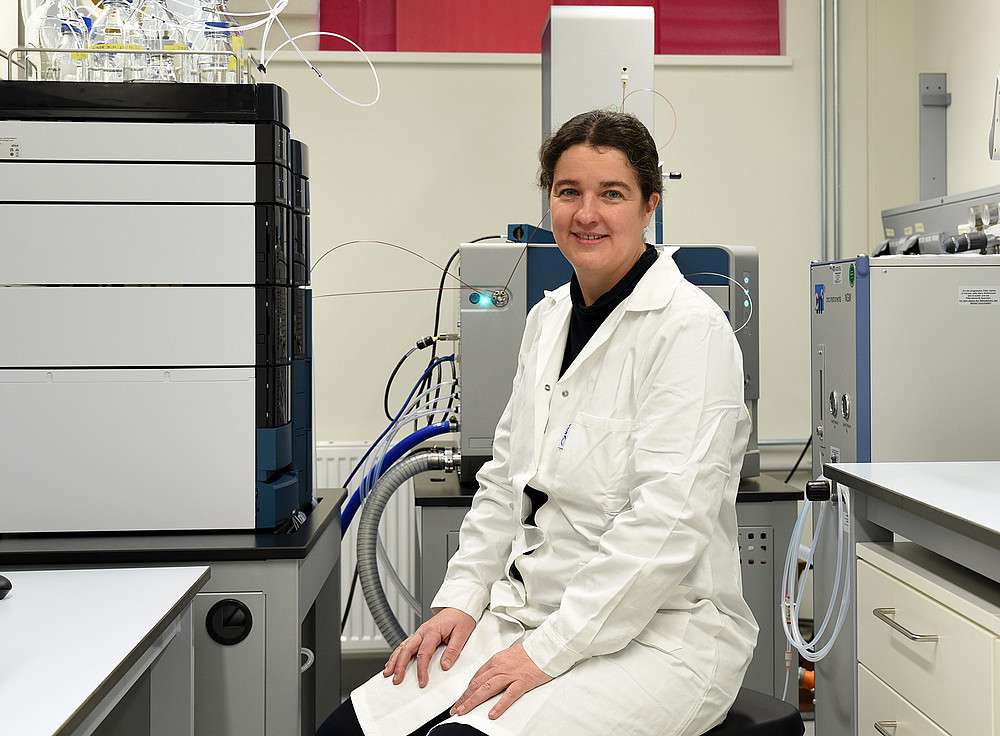
Pharmacist Solveigh Koeberle sits in front of a piece of equipment in the laboratory.

Understanding cell functions in order to prevent diseases: that is the aim of pharmacist Solveigh Koeberle. She is being funded by the Austrian Science Fund's Elise Richter Programme for her research into liver fat. Photo: University of Graz/Eklaude

Pharmacognosist Solveigh Koeberle is investigating novel bioactive compounds for the prevention of degenerative diseases as part of the prestigious Elise Richter Programme, funded by the Austrian Science Fund (FWF).

When cells malfunction, they initiate a process of self-destruction to protect the organism from damage. However, when this mechanism becomes dysregulated, it can contribute to the development of diseases. This is particularly true for a recently discovered form of cell death known as ferroptosis, which is closely linked to degenerative liver diseases and associated with elevated iron levels. Solveigh Koeberle is researching protective compounds that can slow down cell degradation, potentially preventing or even reversing disease progression. For this work, she has awarded funding from the Austrian Science Fund's prestigious Elise Richter Programme.

Regenerative Radical Scavengers

Highly reactive oxygen molecules can damage cells. Antioxidants, such as vitamin E, can neutralize these radicals, but only to a certain extent. "Reactive oxygen molecules also play a signaling role," explains Koeberle. “If they are completely deactivated, cells respond by reducing their own antioxidant defenses, which in turn promotes ferroptosis.”
Koeberle and her team have already identified a promising natural compound that acts as an antioxidant without interfering with essential cellular processes. "It enters the cell at a specific site and is only activated by an enzyme," she explains. Unlike other substances, this compound does not disrupt metabolism and can be continuously regenerated by the enzyme. "This means that much lower doses are needed, which is a huge advantage," she adds.

Optimal Research Environment

At the University of Graz, Koeberle benefits from ideal research conditions. "Lipid metabolism is a major focus of pharmacognosy research here. We have state-of-the-art equipment to analyze tens of thousands of different lipids in detail," she says.

Liver disease is responsible for 3.5 per cent of deaths worldwide, and unhealthy lifestyles are often the underlying cause. Effective treatments remain scarce, making Koeberle's research into new therapeutic strategies all the more important. "Through various studies, we now have a solid understanding of how cells protect themselves. This knowledge is helping us to develop targeted therapies," she concludes.
created by Dagmar Eklaude

Related news

Sport beyond the World Cup: the TV channel “Welt der Wunder” features diabetes research from the University of Graz

Keeping blood sugar levels in check during physical exertion is a particular challenge for people with type 1 diabetes. Othmar Moser examines how those affected manage to balance physical activity, sport and their metabolic disorder.

"Mathematics explains the world"

How can life be quantified? And what can science reveal that remains hidden from the naked eye? The 14th European Conference on Mathematical and Theoretical Biology at the University of Graz is dedicated to these questions. From 13 to 17 July, around 1,300 researchers from all over the world will gather on campus to discuss models, biological processes and the future of data-driven medicine. Klemens Fellner, Dean of the Faculty of Natural Sciences and Mathematics and a mathematician, talks about the language that explains the world

Internationally up-to-date: University of Graz offers new degree programmes in art studies

From the Old Masters to AI art – three newly designed degree programmes offer students at the University of Graz fresh perspectives on artistic production. In addition to historical art, the programmes place a greater emphasis on contemporary and global developments. The registration period is open.

Researchers decode substance from milk thistle to combat liver diseases

Solveigh Koeberle from the Department of Pharmaceutical Sciences and her team have come one step closer to treating liver diseases. The results of their latest study have just been published.

Begin of page section:
Additional information:

University of Graz
Universitaetsplatz 3
8010 Graz
Austria
  • Contact
  • Web Editors
  • Moodle
  • UNIGRAZonline
  • Imprint
  • Data Protection Declaration
  • Accessibility Declaration
Weatherstation
Uni Graz

End of this page section. Go to overview of page sections

End of this page section. Go to overview of page sections

Begin of page section:

End of this page section. Go to overview of page sections