Begin of page section:
Page sections:

  • Go to contents (Accesskey 1)
  • Go to position marker (Accesskey 2)
  • Go to main navigation (Accesskey 3)
  • Go to sub navigation (Accesskey 4)
  • Go to additional information (Accesskey 5)
  • Go to page settings (user/language) (Accesskey 8)
  • Go to search (Accesskey 9)

End of this page section. Go to overview of page sections

Begin of page section:
Page settings:

English en
Deutsch de
Search
Login

End of this page section. Go to overview of page sections

Begin of page section:
Search:

Search for details about Uni Graz
Close

End of this page section. Go to overview of page sections


Search

Begin of page section:
Main navigation:

Page navigation:

  • University

    University
    • About the University
    • Organisation
    • Faculties
    • Library
    • Working at University of Graz
    • Campus
    Developing solutions for the world of tomorrow - that is our mission. Our students and our researchers take on the great challenges of society and carry the knowledge out.
  • Research Profile

    Research Profile
    • Our Expertise
    • Research Questions
    • Research Portal
    • Promoting Research
    • Research Transfer
    • Ethics in Research
    • Commission for Scientific Integrity
    Scientific excellence and the courage to break new ground. Research at the University of Graz creates the foundations for making the future worth living.
  • Studies

    Studies
    • Prospective Students
    • Students
    • Post-registration Law
  • Community

    Community
    • International
    • Location
    • Research and Business
    • Alumni
    The University of Graz is a hub for international research and brings together scientists and business experts. Moreover, it fosters the exchange and cooperation in study and teaching.
Topics
  • Sustainable University
  • Researchers answer
  • Work for us
Close menu

End of this page section. Go to overview of page sections

Begin of page section:
You are here:

University of Graz News Researchers decode substance from milk thistle to combat liver diseases

End of this page section. Go to overview of page sections

Wednesday, 15 January 2025

Researchers decode substance from milk thistle to combat liver diseases

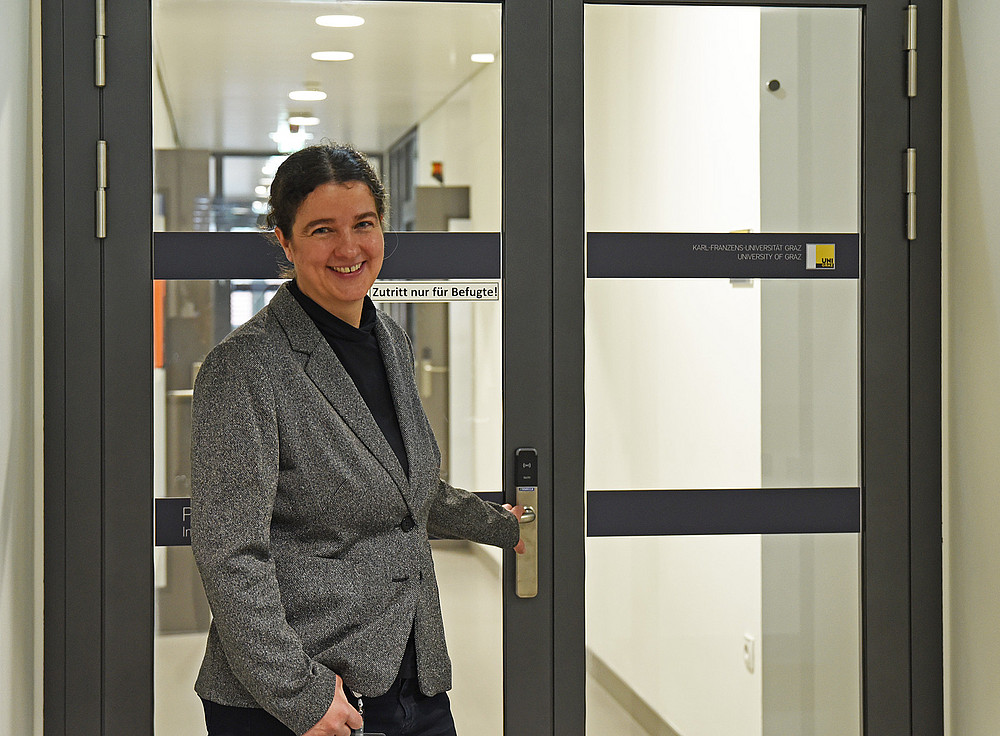
Pharmacognosist Solveigh Koeberle in front of a door in her department

Opening a new door in the fight against fatty liver: Solveigh Koeberle and her team have decoded the effect of a natural substance from milk thistle. Photo: University of Graz/Eklaude

Solveigh Koeberle from the Department of Pharmaceutical Sciences and her team have come one step closer to treating liver diseases. The results of their latest study have just been published.

We've all been there: cosy get-togethers, sumptuous meals and the odd glass of champagne to toast. However, if you consume too many calories not only during celebrations, but all the time, you run the risk of damaging your liver. Pharmacists at the University of Graz have now discovered the mechanism of action of a natural substance contained in milk thistle to combat the most common disease of this organ. Silybin A specifically influences the liver's fat metabolism and helps to render toxic substances harmless. The study results were published in the journal Theranostics.

"We were able to prove in the laboratory that silybin A reduces the content of storage fats in the liver both in healthy individuals and in early stages of the disease, while at the same time increasing the content of phospholipids, which are found in the cell membranes," explains Solveigh Koeberle, first author of the publication. This mechanism protects the liver cells from an overload of fat. At the same time, the storage of phospholipids in the membranes improves the ability to metabolise toxins. "It has long been observed that milk thistle extract may help against liver diseases. We have now deciphered the mode of action," explains Koeberle. The international team, led by pharmacognosist Andreas Koeberle, has thus gained important insights that will enable the development of new, targeted therapeutic approaches against metabolic-associated fatty liver disease.

Publication:
Solveigh C. Koeberle, Maria Thürmer, Fengting Su, Markus Werner, Julia Grander, Laura Hofer, André Gollowitzer, Loc Le Xuan, Felix J. Benscheid, Ehsan Bonyadi Rad, Armando Zarrelli, Giovanni Di Fabio, Oliver Werz, Valeria Romanucci, Amelie Lupp, Andreas Koeberle: "Silybin A from Silybum marianum reprograms lipid metabolism to induce a cell fate-dependent class switch from triglycerides to phospholipids", Theranostics 2025; 15(5):2006-2034. doi: 10.7150/thno.99562

created by Dagmar Eklaude

Related news

Record of reported species: Styria wins the global City Nature Challenge

Observers in Styria recorded 4,660 different animals, plants and fungi as part of the international City Nature Challenge between 24 and 27 April 2026. This saw the region take first place in the "species" category. Ostrava in the Czech Republic made the most observations, with just under 140,000, whilst the San Francisco Bay Area had the highest number of participants, namely 3,019.

Studying at the University of Graz: How to enrol

Ready for a new chapter in your life with the start of your studies at the University of Graz in the winter semester 2026/27? Here you will find information on deadlines, admission procedures, registration, and everything else you need to successfully start your studies in the fall.

Europe Day: Strengthening international expertise with Arqus

On 9 May, the spotlight will be on Europe. At the University of Graz, European cooperation is also a tangible part of everyday student life – not least through the Arqus university alliance. Master’s and PhD students can currently register for the Arqus micro-credential in ‘Advanced Creative Thinking and Communication’.

A substantial community: the key role of soil crusts in the earth system

They are often overshadowed by the plant world: lichens, fungi, mosses and bacteria, which form unique communities on rocks and trees or as soil crusts. Bettina Weber from the University of Graz is bringing this biological alliance into the research spotlight. Her research shows that these communities form an essential part of the Earth’s critical zone and play a key role in the interactions between land and atmosphere. Bettina Weber was honoured by the European Geosciences Union for her groundbreaking research at the beginning of May.

Begin of page section:
Additional information:

University of Graz
Universitaetsplatz 3
8010 Graz
Austria
  • Contact
  • Web Editors
  • Moodle
  • UNIGRAZonline
  • Imprint
  • Data Protection Declaration
  • Accessibility Declaration
Weatherstation
Uni Graz

End of this page section. Go to overview of page sections

End of this page section. Go to overview of page sections

Begin of page section:

End of this page section. Go to overview of page sections