



Begin of page section:
Page sections:

  • Go to contents (Accesskey 1)
  • Go to position marker (Accesskey 2)
  • Go to main navigation (Accesskey 3)
  • Go to sub navigation (Accesskey 4)
  • Go to additional information (Accesskey 5)
  • Go to page settings (user/language) (Accesskey 8)
  • Go to search (Accesskey 9)

End of this page section. Go to overview of page sections

Begin of page section:
Page settings:

English en
Deutsch de
Search
Login

End of this page section. Go to overview of page sections

Begin of page section:
Search:

Search for details about Uni Graz
Close

End of this page section. Go to overview of page sections


Search

Begin of page section:
Main navigation:

Page navigation:

  • University

    University
    • About the University
    • Organisation
    • Faculties
    • Library
    • Working at University of Graz
    • Campus
    Developing solutions for the world of tomorrow - that is our mission. Our students and our researchers take on the great challenges of society and carry the knowledge out.
  • Research Profile

    Research Profile
    • Our Expertise
    • Research Questions
    • Research Portal
    • Promoting Research
    • Research Transfer
    • Ethics in Research
    • Commission for Scientific Integrity
    Scientific excellence and the courage to break new ground. Research at the University of Graz creates the foundations for making the future worth living.
  • Studies

    Studies
    • Prospective Students
    • Students
  • Community

    Community
    • International
    • Location
    • Research and Business
    • Alumni
    The University of Graz is a hub for international research and brings together scientists and business experts. Moreover, it fosters the exchange and cooperation in study and teaching.
  • Spotlight
Topics
  • Sustainable University
  • Researchers answer
  • Work for us
Close menu

End of this page section. Go to overview of page sections

Begin of page section:
You are here:

University of Graz News Climate protection needs broad acceptance

End of this page section. Go to overview of page sections

Tuesday, 30 April 2024

Climate protection needs broad acceptance

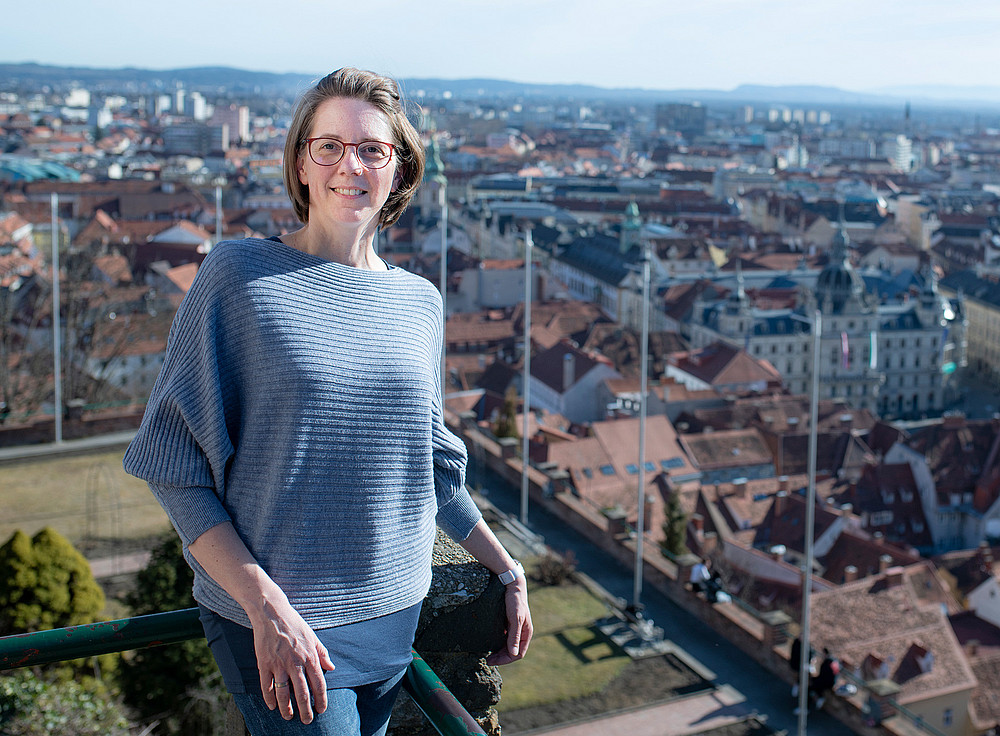
Birgit Bednar-Friedl on the Schlossberg in Graz, in the background below the city with the town hall ©Uni Graz/Tzivanopoulos

Birgit Bednar-Friedl supported the Climate Council with scientific input. Photo: University of Graz/Tzivanopoulos

What do we have to do today to live in a climate-friendly future tomorrow? In January 2022, 100 citizens from all parts of the population came together in the Austrian Climate Council to answer this question. Six months later, they presented their 93 recommendations to the federal government. "Even if many of them have not yet been taken up, the Climate Council was an enormously important project that continues to have an impact," says Birgit Bednar-Friedl, environmental economist at the University of Graz. Together with Georg Kaser from the University of Innsbruck, she chaired the scientific committee that accompanied the citizens on the Climate Council.

The future affects us all. That is why we should all be involved in shaping it. In this sense, the Climate Council was a prime example of democracy in action. "It was characterised above all by the fact that its composition represented society as a whole," says Birgit Bednar-Friedl, explaining why this is so important: "Climate protection needs broad acceptance. With the support of excellent moderation, the Climate Council succeeded in getting people with very different circumstances, experiences and views to agree on measures to reduce CO2 emissions."

Finding a voice and having a say
The committee also included people for whom climate-friendly behaviour was previously not an issue. Bednar-Friedl explains that the discussion about this has had an impact on some of them, such as eating more consciously or not travelling by plane. The fact that they are now prepared to make an active contribution themselves is probably also due to the fact that the Climate Council has given them the opportunity to have an equal democratic say. "Here, people from social groups who otherwise receive little attention have learnt that they are heard, that they are trusted to come up with sensible solutions and that they can make a difference," explains the scientist.

Acquiring knowledge and becoming effective
They learnt a lot about climate change at their meetings over six weekends. This enabled them to have their say and pass on their knowledge. And they are doing just that. Many of them are still active in the "Austrian Climate Council of Citizens Association", particularly at local and regional level. Their involvement ranges from lobbying for climate protection at government offices and authorities to regional projects such as the establishment of energy communities and raising awareness among the population. For example, the association has organised seminars in cooperation with the Graz Adult Education Centre, in which the participants work together to develop proposals for CO2 reduction, as in the Climate Council. However, Bednar-Friedl points out that networking with politicians at a national level would have to increase in order to extend the scope of the organisation's impact.

Showing the way
Some of the Climate Council's recommendations have been taken up by the government. These include the extension of the repair bonus and measures to promote the revitalisation of old buildings. The Last Generation Austria activists are now calling for the implementation of further proposals.
"There is still a lot to do. Austria still has no climate protection law and continues to subsidise fossil fuels," says Birgit Bednar-Friedl, pointing out the urgent need for action. At the same time, she emphasises once again: "The Climate Council was definitely a door opener. Its recommendations set the direction we need to take."

created by Gudrun Pichler

Related news

Higher Education Strategy 2040: Austria’s universities on course for the future

Austria has 77 higher education institutions, which is above the EU average – but does this really make sense? The new Higher Education Strategy 2040 focuses on cooperation rather than mergers. As one of the six largest universities in Austria, the University of Graz plays a central role in this.

Climate research in Greenland: Old data provides new insights

The polar explorer and University of Graz professor Alfred Wegener left behind a unique collection of climate data from Greenland. A research team from the University of Graz is now analysing this 100-year-old treasure trove of data and comparing it with current measurements.

Diversity in nature and science: How we talk about plants and each other

Ginkgo, kiwi, hemp: they exist as male and female plants. Anyone who paid attention in biology class will confirm this. But is this categorisation, established by Carl von Linné almost 300 years ago, still valid today? An interdisciplinary team at the University of Graz is questioning these attributions and using this as a starting point to provide food for thought for gender-sensitive interaction between students, scientific and teaching staff.

Around the world in eight stops: the Long Night of Research at the University of Graz

On 24 April from 5 pm, you can take a short trip around the globe at the University of Graz, discovering pecularities of foreign countries or new local features in the entrance hall of the University Library. The itinerary takes you through introduced animal species, political attitudes and the omnipotence of algorithms. There will also be a programme in the historic reading hall, as well as at the UniGraz@Museum and the University Archive.

Begin of page section:
Additional information:

University of Graz
Universitaetsplatz 3
8010 Graz
Austria
  • Contact
  • Web Editors
  • Moodle
  • UNIGRAZonline
  • Imprint
  • Data Protection Declaration
  • Accessibility Declaration
Weatherstation
Uni Graz

End of this page section. Go to overview of page sections

End of this page section. Go to overview of page sections

Begin of page section:

End of this page section. Go to overview of page sections