Begin of page section:
Page sections:

  • Go to contents (Accesskey 1)
  • Go to position marker (Accesskey 2)
  • Go to main navigation (Accesskey 3)
  • Go to sub navigation (Accesskey 4)
  • Go to additional information (Accesskey 5)
  • Go to page settings (user/language) (Accesskey 8)
  • Go to search (Accesskey 9)

End of this page section. Go to overview of page sections

Begin of page section:
Page settings:

English en
Deutsch de
Search
Login

End of this page section. Go to overview of page sections

Begin of page section:
Search:

Search for details about Uni Graz
Close

End of this page section. Go to overview of page sections


Search

Begin of page section:
Main navigation:

Page navigation:

  • University

    University
    • About the University
    • Organisation
    • Faculties
    • Library
    • Working at University of Graz
    • Campus
    Developing solutions for the world of tomorrow - that is our mission. Our students and our researchers take on the great challenges of society and carry the knowledge out.
  • Research Profile

    Research Profile
    • Our Expertise
    • Research Questions
    • Research Portal
    • Promoting Research
    • Research Transfer
    • Ethics in Research
    • Commission for Scientific Integrity
    Scientific excellence and the courage to break new ground. Research at the University of Graz creates the foundations for making the future worth living.
  • Studies

    Studies
    • Prospective Students
    • Students
  • Community

    Community
    • International
    • Location
    • Research and Business
    • Alumni
    The University of Graz is a hub for international research and brings together scientists and business experts. Moreover, it fosters the exchange and cooperation in study and teaching.
Topics
  • Sustainable University
  • Researchers answer
  • Work for us
Close menu

End of this page section. Go to overview of page sections

Begin of page section:
You are here:

University of Graz News Chemical Christmas show at the University of Graz: An explosive evening at the Schauspielh

End of this page section. Go to overview of page sections

Friday, 05 December 2025

Chemical Christmas show at the University of Graz: An explosive evening at the Schauspielh

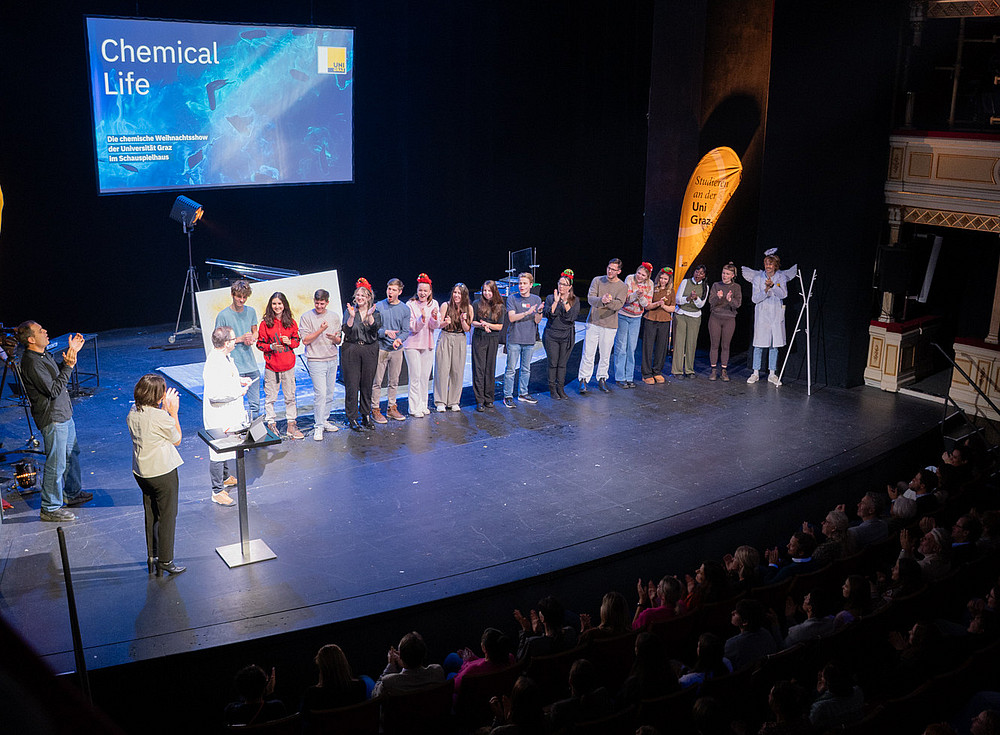
A group of people are standing next to each other on a stage, some are clapping, others are wearing red hats; on the left is a screen with the words “Chemical Life” and underneath it “The University of Graz's Chemical Christmas Show at the Schauspielhaus.” On the right is a yellow banner with the words “Studium an der Uni Graz”

Students became the stars of the University of Graz's Christmas chemistry show. Photo: University of Graz/Angele

At the beginning of December, the University of Graz transformed the theater into a laboratory: as part of “Chemical Life,” teacher training students staged a chemical Christmas show for Styrian school classes—complete with ethanol rockets, nitrogen snow, and glowing effects. An evening designed to inspire interest in studying chemistry.

Advent is a peaceful and contemplative time, but there was no sign of a silent night at the Schauspielhaus theater on December 4, 2025. The atmosphere on stage was explosive, in the truest sense of the word. Under the motto “Chemical Life,” the University of Graz invited Styrian school classes to a chemical Christmas show, where chemistry teacher training students showed what they were capable of. Their experiments demonstrated how hot and cold nature can be.

Cathrine Walter-Laager, Vice Rector for Studies and Teaching, welcomed the school classes and thanked the Schauspielhaus theater for its cooperation. “This is a successful example of how we can bring our research to the public. And who knows, maybe we'll see one of the students back at the University of Graz soon.” Andrea Vilter, director of the Schauspielhaus theater, was unfortunately unable to attend in person. Her message of greeting was delivered by presenter Eva Pölzl. Finally, Philipp Spitzer, Professor of Chemistry Education and organizer of the Christmas chemistry show, thanked the many employees of the Schauspielhaus who made this performance possible and, above all, the theater's fire department, for whom this performance is always a particularly precarious experience.

PET rockets

Because chemical components were used as rocket propellants on several occasions. For example, the show demonstrated how aluminum foil can be used to build small launch pads. Ethanol was also used. To produce a loud “whoosh” sound, students mixed the alcohol with air in a large water canister and ignited the mixture. For the next stage of the experiment, Professor Spitzer himself had to step in. Using this alcohol-air mixture as propellant, he catapulted a PET bottle several meters through the air.

This was surpassed by physicist Bernhard Weingartner, who is also known from the ORF show “Fakt oder Fake” (Fact or Fake). His PET “rocket” was powered by a mixture of ice-cold liquid butane (-0.5 degrees Celsius!) and normal water. With a bang, the bottle disappeared somewhere behind the stage.

With so much heat and explosions, a cool-down is needed in between. How about -200 degrees, or rather, liquid nitrogen? When this element comes into contact with normal water, a thick fog with light snowfall immediately forms. When the students poured the remaining nitrogen onto the stage, there was a moment of shock in the front row, but the drops evaporated before they even reached the floor.

But it's not just chemistry that offers exciting experiments, as sports scientists Gerhard Tschakert and Othmar Moser demonstrated. On stage, they performed a sports performance test. Numerous vital signs were recorded live, from heart rate and respiratory rate to blood sugar and lactate levels. This allowed the researchers to show how performance gradually declines as the resistance on the ergometer increases.

Christ Child

There was also a reunion with a participant from the 2023 Christmas show. Doctoral student Jan Kriegl once again took on the role of the Christ Child, who had lost his way after the theater suddenly fell into darkness. With bright fire from magnesium and red flames from strontium nitrate, he was finally able to find his way onto the stage.

The finale was a science hack that anyone can replicate at home. It involves the bark of the horse chestnut tree, which contains the element aesculin. So if you peel a branch of the tree and put the bark in a container of water, this substance disperses. If you then illuminate the container with a UV lamp, the result is an almost magical scene. But as with all the experiments of the evening, this was pure science.

Ethanol rockets, nitrogen snow, glowing liquids, and burning metals: you can learn all this and much more by studying chemistry or teaching chemistry.
created by Roman Vilgut

Related news

Europe Day: Strengthening international expertise with Arqus

On 9 May, the spotlight will be on Europe. At the University of Graz, European cooperation is also a tangible part of everyday student life – not least through the Arqus university alliance. Master’s and PhD students can currently register for the Arqus micro-credential in ‘Advanced Creative Thinking and Communication’.

A substantial community: the key role of soil crusts in the earth system

They are often overshadowed by the plant world: lichens, fungi, mosses and bacteria, which form unique communities on rocks and trees or as soil crusts. Bettina Weber from the University of Graz is bringing this biological alliance into the research spotlight. Her research shows that these communities form an essential part of the Earth’s critical zone and play a key role in the interactions between land and atmosphere. Bettina Weber was honoured by the European Geosciences Union for her groundbreaking research at the beginning of May.

The digital world of tomorrow: University of Graz works with people to shape the future

Digitalisation is supposed to make everything better: artificial intelligence that even organises travel. The car that drives itself. Robots that care for us in our old age. But what kind of future do people actually want? What role should technology play in this? The University of Graz is exploring these questions through a new research facility. At the Graz Sociodigital and Participatory Futures Studio – or GraSP Futures Studio for short – young and old work together with researchers to design visions of the future that also critically examine technical innovations.

Eurovision: Why the Song Contest is always political

The 2026 Eurovision Song Contest sits at the intersection of music, geopolitics and culture. Josef Mühlbauer from the University of Graz explains why the ESC has always been a reflection of European politics, and how this major event highlights cultural affinities and social change.

Begin of page section:
Additional information:

University of Graz
Universitaetsplatz 3
8010 Graz
Austria
  • Contact
  • Web Editors
  • Moodle
  • UNIGRAZonline
  • Imprint
  • Data Protection Declaration
  • Accessibility Declaration
Weatherstation
Uni Graz

End of this page section. Go to overview of page sections

End of this page section. Go to overview of page sections

Begin of page section:

End of this page section. Go to overview of page sections