From 12 to 16 May, millions of people will be tuning in to the Eurovision Song Contest (ESC). Whether on a mobile phone, a laptop or on the telly: the ESC is THE music event of the year. This makes the song contest one of the most significant cross-border and cross-cultural events. The organisers emphasise that the ESC is all about music, never about politics.
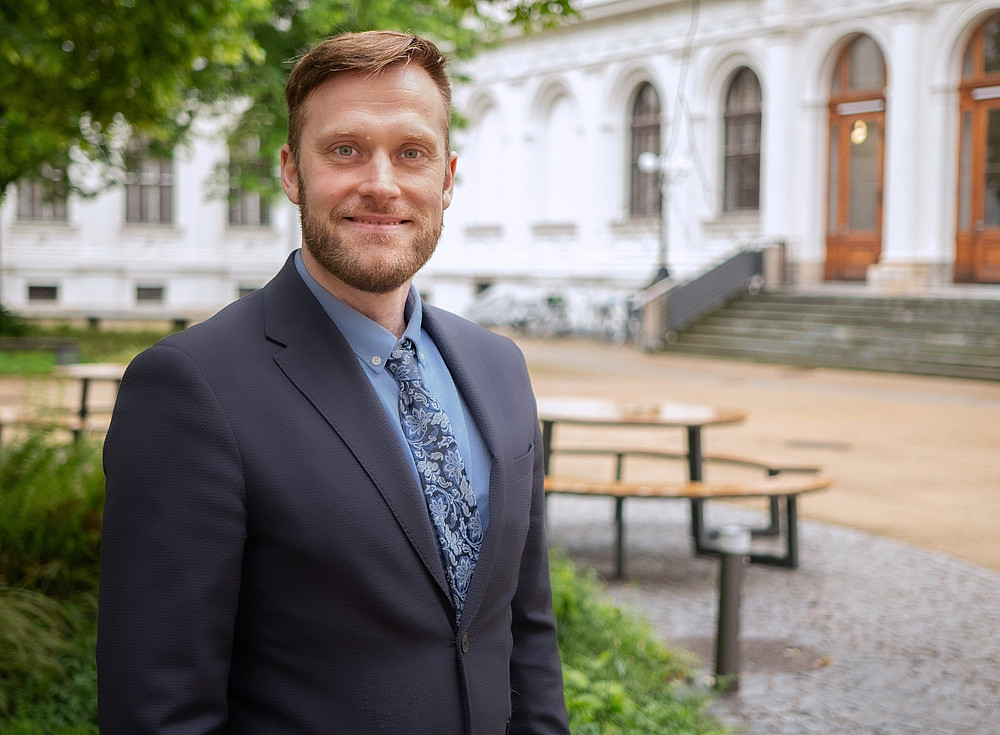
Yet this year, the contest is facing particular criticism: because Israel is taking part despite the Gaza war, Ireland, Iceland, the Netherlands, Slovenia and Spain are boycotting the contest. Can the claim of being ‘apolitical’ still be upheld? ‘Not really,’ says peace researcher Josef Mühlbauer from the Institute for Legal Foundations at the University of Graz.
“The Eurovision Song Contest is actually always a reflection of the current political situation in Europe,” explains the researcher. Political conflicts and cultural affinity have shaped the contest from the very beginning. For instance, a Scandinavian and a Balkan bloc are discernible. “But that has nothing to do with nationalism. Countries often award points to one another if they are culturally, geographically or aesthetically close,” says Mühlbauer. Large immigrant groups also influence voting behaviour in the countries.
Politics sings along
And time and again, political conflicts have played a part in the contest, be it the Cold War, the violent break-up of Yugoslavia or, most recently, Russia’s war of aggression in Ukraine. Russia has since been barred from participating. “The fact that Israel was not excluded this year is seen by many as a double standard. After all, there is an international arrest warrant out for Israel’s Prime Minister Netanyahu.” Incidentally, Austria too once set an example: when Spain took part in the contest in 1969, the ORF boycotted the ESC in protest against the Franco dictatorship.
But it is not only the question of participation that has a political dimension. Artists often use the ESC to convey messages: in the 1990s, bands from the former Yugoslavia frequently sang about the war. During the performance by the Russian group t.A.T.u. in 2003, the ESC organisers even threatened to cut the live broadcast if the group’s singers kissed on stage. Eleven years later, Conchita Wurst’s victory was a show of support for the LGBTQ+ community.
This diversity has long been a hallmark of the Song Contest, says the peace researcher. Yet there is also criticism that the competition is becoming increasingly commercialised. “As a result, the subtle nuances that make the performances special are often lost.” For Mühlbauer, this is understandable on the part of the artists. The ESC is often the only chance to become known worldwide.
The much-discussed question of language must be viewed from this perspective. The singers face a decision: do they sing in their own language and thereby demonstrate greater cultural autonomy – or do they opt for English to be more easily understood across Europe? “We mustn’t forget, however, that English is understood by millions of people across Europe and is therefore a unifying element,” says the peace researcher. Yet it is precisely this blend of pop show, platform for newcomers and stage for cultural diversity and political discourse that makes the ESC so special.
For anyone keen to explore how music, art and culture shape our society, the University of Graz offers the perfect course in Musicology. And Master’s students wishing to delve deeper into peace and politics can gain valuable additional training through the Master’s module “International Peacebuilding and Conflict Transition”.