Begin of page section:
Page sections:

  • Go to contents (Accesskey 1)
  • Go to position marker (Accesskey 2)
  • Go to main navigation (Accesskey 3)
  • Go to sub navigation (Accesskey 4)
  • Go to additional information (Accesskey 5)
  • Go to page settings (user/language) (Accesskey 8)
  • Go to search (Accesskey 9)

End of this page section. Go to overview of page sections

Begin of page section:
Page settings:

English en
Deutsch de
Search
Login

End of this page section. Go to overview of page sections

Begin of page section:
Search:

Search for details about Uni Graz
Close

End of this page section. Go to overview of page sections


Search

Begin of page section:
Main navigation:

Page navigation:

  • University

    University
    • About the University
    • Organisation
    • Faculties
    • Library
    • Working at University of Graz
    • Campus
    Developing solutions for the world of tomorrow - that is our mission. Our students and our researchers take on the great challenges of society and carry the knowledge out.
  • Research Profile

    Research Profile
    • Our Expertise
    • Research Questions
    • Research Portal
    • Promoting Research
    • Research Transfer
    • Ethics in Research
    • Commission for Scientific Integrity
    Scientific excellence and the courage to break new ground. Research at the University of Graz creates the foundations for making the future worth living.
  • Studies

    Studies
    • Prospective Students
    • Students
  • Community

    Community
    • International
    • Location
    • Research and Business
    • Alumni
    The University of Graz is a hub for international research and brings together scientists and business experts. Moreover, it fosters the exchange and cooperation in study and teaching.
  • Spotlight
Topics
  • Sustainable University
  • Researchers answer
  • Work for us
Close menu

End of this page section. Go to overview of page sections

Begin of page section:
You are here:

University of Graz News Best of REWI

End of this page section. Go to overview of page sections

Monday, 22 December 2014

Best of REWI

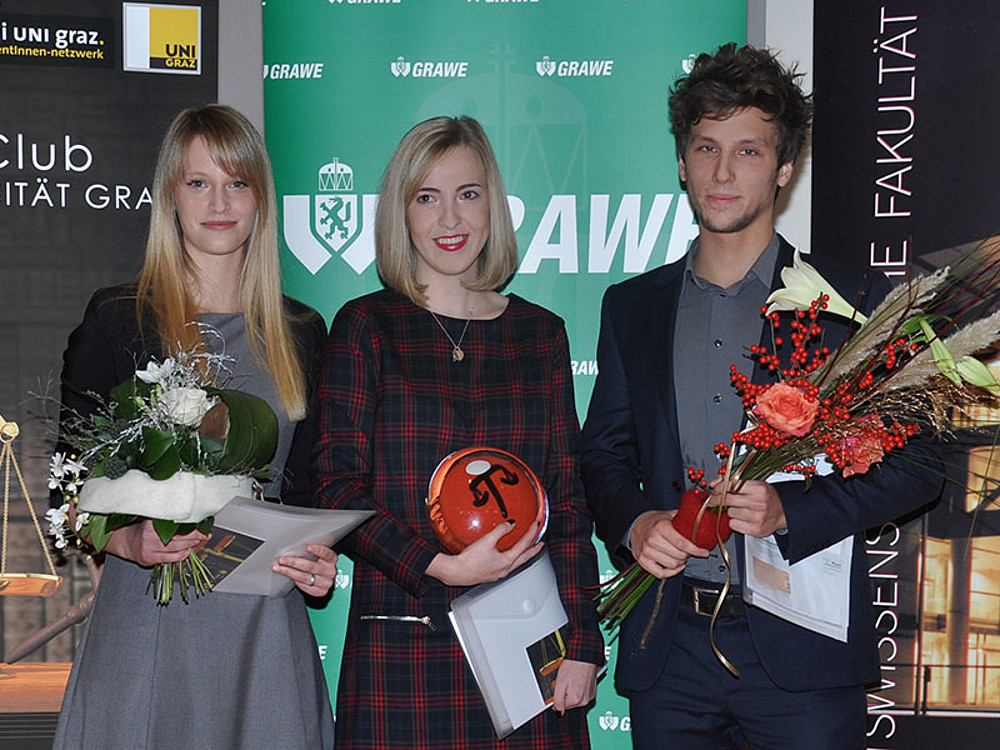
Die Top 3 REWI-AbsolventInnen des Studienjahres 2013/14 (v.l.): Katrin Reichmann (3.), Isabella Fank (1.) und Thomas Metesch (2.) ...

Die Top 3 REWI-AbsolventInnen des Studienjahres 2013/14 (v.l.): Katrin Reichmann (3.), Isabella Fank (1.) und Thomas Metesch (2.) ...

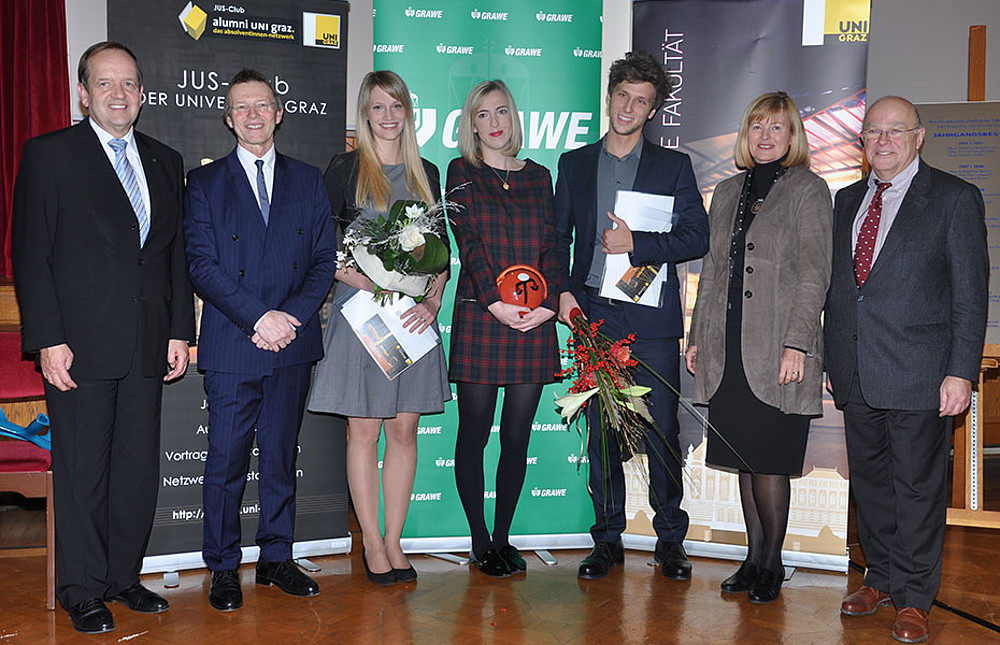
... mit GRAWE-Generaldirektor Othmar Ederer, Best-of-REWI-Kommissionsvorsitzendem Günther Löschnigg, Rektorin Christa Neuper und Dekan Joseph Marko (v.l.). Fotos: Uni Graz/Pichler

... mit GRAWE-Generaldirektor Othmar Ederer, Best-of-REWI-Kommissionsvorsitzendem Günther Löschnigg, Rektorin Christa Neuper und Dekan Joseph Marko (v.l.). Fotos: Uni Graz/Pichler

Die Rechtswissenschaftliche Fakultät prämierte die besten AbsolventInnen und Abschlussarbeiten

Alljährlich zeichnet die Rechtswissenschaftliche Fakultät ihre 15 Top-AbsolventInnen sowie die 15 besten Diplomarbeiten und Dissertationen aus. Am 19. Dezember 2014 wurden im Rahmen der Veranstaltung „Best of REWI“ die herausragenden Leistungen des vergangenen Studienjahres prämiert. Das Ranking 2013/14 führt Mag. Isabella Fank an, gefolgt von Mag. Thomas Metesch und Mag. Katrin Reichmann.


Dekan Joseph Marko begrüßte die AbsolventInnen und ihre Angehörigen in der Aula der Uni Graz und beglückwünschte die Studierenden zu ihrem Erfolg. Rektorin Christa Neuper betonte: „Die Universität ist bestrebt, Spitzenleistungen anzuerkennen und sichtbar zu machen.“

Univ.-Prof. DDr. Günther Löschnigg, Vorsitzender der Best-of-REWI-Kommission, gab Einblick in die Statistik der Jus-AbsolventInnen und ihrer Abschlussarbeiten. Voraussetzung für eine Aufnahme ins Ranking ist, das Studium innerhalb von 12 Semestern abgeschlossen zu haben. 2013/14 ist dies 138 von insgesamt 282 AbsolventInnen gelungen. Die durchschnittliche Dauer des Diplomstudiums der Rechtswissenschaften beträgt 13,7 Semester. Ausschlaggebend für die Reihung ist neben der Studiendauer der Notendurchschnitt, der diesmal zwischen 1,27 und 1,88 lag. Unter den Top 15 finden sich elf Frauen und vier Männer.

Zehn Diplomarbeiten wurden im Rahmen von Best of REWI ausgezeichnet. Von insgesamt 111 mit „Sehr gut“ benoteten waren 19 nominiert worden. Die fünf prämierten Dissertationen gingen aus acht nominierten hervor. 25 DoktorandInnen hatten im Studienjahr 2013/14 ein „Sehr gut“ auf ihre Arbeit bekommen.

Gesponsert werden die Veranstaltung und die Preise für die Ausgezeichneten von der Grazer Wechselseitige Versicherung. Generaldirektor Dr. Othmar Ederer unterstrich die Bedeutung von High Potentials mit fundiertem juristischem Wissen. „AbsolventInnen der Universität Graz haben auch uns im Unternehmen immer wieder begleitet“, so Ederer.


created by Gudrun Pichler

Related news

Building biological bridges: Chemist discovers an ecological tool for the pharmaceutical industry

Building a relationship on a solid foundation is also important in chemistry. To produce medicines, disinfectants or plant protection products, stable bonds between carbon atoms must be formed. Conventional chemical methods rely on environmentally harmful reagents and solvents to carry out the desired reaction. This process also produces unusable by-products. Chemist Lilla Gal has discovered an enzyme that enables the same process to take place efficiently and sustainably. The results of her research were recently published in the prestigious journal Angewandte Chemie.

Higher Education Strategy 2040: Austria’s universities on course for the future

Austria has 77 higher education institutions, which is above the EU average – but does this really make sense? The new Higher Education Strategy 2040 focuses on cooperation rather than mergers. As one of the six largest universities in Austria, the University of Graz plays a central role in this.

Climate research in Greenland: Old data provides new insights

The polar explorer and University of Graz professor Alfred Wegener left behind a unique collection of climate data from Greenland. A research team from the University of Graz is now analysing this 100-year-old treasure trove of data and comparing it with current measurements.

Diversity in nature and science: How we talk about plants and each other

Ginkgo, kiwi, hemp: they exist as male and female plants. Anyone who paid attention in biology class will confirm this. But is this categorisation, established by Carl von Linné almost 300 years ago, still valid today? An interdisciplinary team at the University of Graz is questioning these attributions and using this as a starting point to provide food for thought for gender-sensitive interaction between students, scientific and teaching staff.

Begin of page section:
Additional information:

University of Graz
Universitaetsplatz 3
8010 Graz
Austria
  • Contact
  • Web Editors
  • Moodle
  • UNIGRAZonline
  • Imprint
  • Data Protection Declaration
  • Accessibility Declaration
Weatherstation
Uni Graz

End of this page section. Go to overview of page sections

End of this page section. Go to overview of page sections

Begin of page section:

End of this page section. Go to overview of page sections