



Begin of page section:
Page sections:

  • Go to contents (Accesskey 1)
  • Go to position marker (Accesskey 2)
  • Go to main navigation (Accesskey 3)
  • Go to sub navigation (Accesskey 4)
  • Go to additional information (Accesskey 5)
  • Go to page settings (user/language) (Accesskey 8)
  • Go to search (Accesskey 9)

End of this page section. Go to overview of page sections

Begin of page section:
Page settings:

English en
Deutsch de
Search
Login

End of this page section. Go to overview of page sections

Begin of page section:
Search:

Search for details about Uni Graz
Close

End of this page section. Go to overview of page sections


Search

Begin of page section:
Main navigation:

Page navigation:

  • University

    University
    • About the University
    • Organisation
    • Faculties
    • Library
    • Working at University of Graz
    • Campus
    Developing solutions for the world of tomorrow - that is our mission. Our students and our researchers take on the great challenges of society and carry the knowledge out.
  • Research Profile

    Research Profile
    • Our Expertise
    • Research Questions
    • Research Portal
    • Promoting Research
    • Research Transfer
    • Ethics in Research
    • Commission for Scientific Integrity
    Scientific excellence and the courage to break new ground. Research at the University of Graz creates the foundations for making the future worth living.
  • Studies

    Studies
    • Prospective Students
    • Students
  • Community

    Community
    • International
    • Location
    • Research and Business
    • Alumni
    The University of Graz is a hub for international research and brings together scientists and business experts. Moreover, it fosters the exchange and cooperation in study and teaching.
  • Spotlight
Topics
  • Sustainable University
  • Researchers answer
  • Work for us
Close menu

End of this page section. Go to overview of page sections

Begin of page section:
You are here:

University of Graz News ASTRA Awards: FWF funds researchers at the University of Graz with two million euros

End of this page section. Go to overview of page sections

Thursday, 26 June 2025

ASTRA Awards: FWF funds researchers at the University of Graz with two million euros

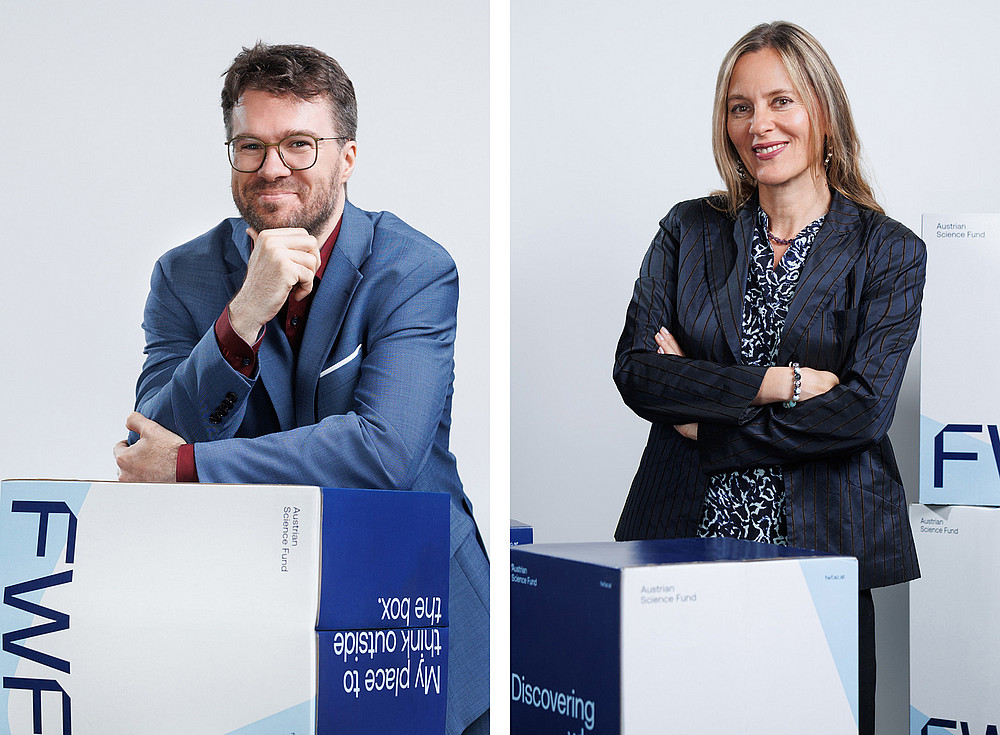
Philipp Berghofer and Bojana Radovanović in front of the FWF backdrop ©FWF / Der Knopfdrücker

Philipp Berghofer and Bojana Radovanović each receive around one million euros from the FWF for their research projects. Photos: FWF/Der Knopfdrücker

Philipp Berghofer develops a philosophy for quantum mechanics. Bojana Radovanović is investigating transitions between religious traditions and history in Southeastern Europe. Both have already produced internationally recognised academic work and will continue their research as postdocs at the University of Graz. In order to support their promising projects, the FWF has awarded them each an ASTRA Award endowed with one million euros each.


"Excellent research transcends borders, in thinking as well as between countries and cultures. The University of Graz thrives on international exchange and is taking targeted measures to offer even more academics from all over the world an attractive research environment. Highly endowed grants such as the FWF's ASTRA Awards make a decisive contribution to this," says Rector Peter Riedler, emphasising their importance.
"The University of Graz competes internationally for the best minds. The ASTRA Awards give particularly talented researchers the opportunity to pursue their innovative projects and thus establish themselves at the forefront of the scientific community," says Joachim Reidl, Vice-Rector for Research.

A philosophy to explain the inexplicable
One hundred years ago, physicists Werner Heisenberg, Max Born and Pascual Jordan formulated the first foundations of quantum mechanics. To this day, this theory determines our understanding of the nature of matter. Nevertheless, it is still regarded as mysterious or even incomprehensible. The philosopher Philipp Berghofer aims to provide a phenomenological-epistemological foundation for understanding quantum mechanics. "According to this approach, quantum mechanical probabilities are not real properties of nature. Rather, they describe what a subject can reasonably expect to experience next. Quantum mechanics is therefore not to be understood as a theory about external processes, but as an epistemological project," explains Berghofer.

Exploring hidden religious traditions in Southeastern Europe
From counter-clockwise dance and ash-filled cressets - Southeastern Europe is home to lesser-known religious traditions and rituals, some of which have their origins in pre-Christian beliefs or heresies. Historian Bojana Radovanović tracks them and takes a look at the region's complex past. "I am investigating the little-researched interfaces between popular religion, heresy and pagan remnants and want to show the transitions between faith, folklore and history in a geographical context," says Radovanović. In addition, she connects local religious dynamics to wider European and global developments in order to bridge divides between Eastern and Western Europe and make the shared cultural heritage visible.

Austrian Science Fund FWF

Zero Emissions Award for Katalin Barta Weissert

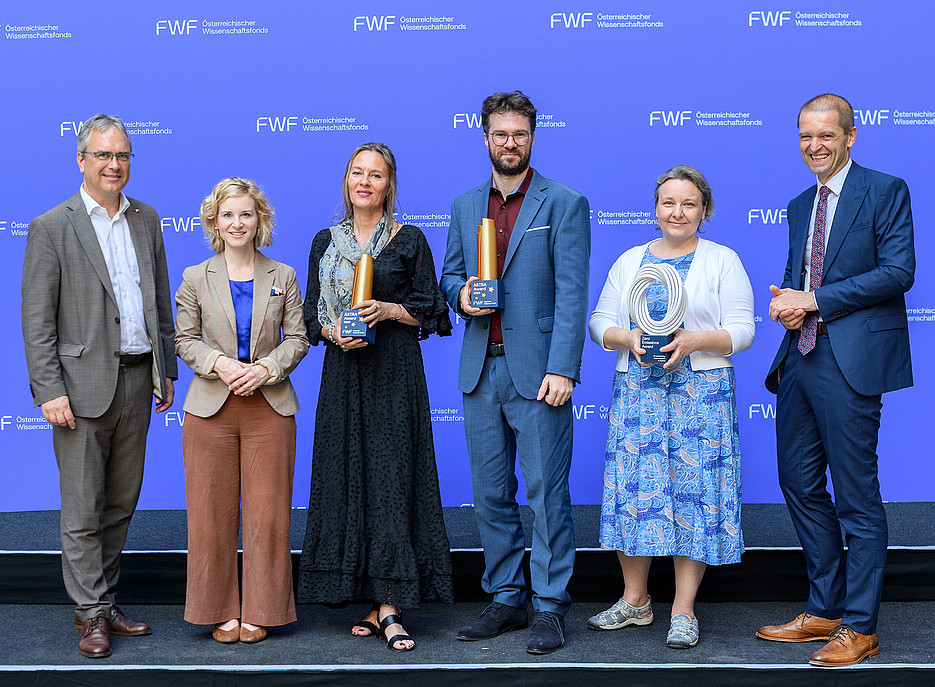
University of Graz Rector Peter Riedler, Minister of Science Eva-Maria Holzleitner, ASTRA Award winners Bojana Radovanović and Philipp Berghofer, chemist Katalin Barta Weissert, winner of the Zero Emissions Award, and FWF President Christof Gattringer at the FWF Awards Ceremony on 25 June 2025 in Vienna ©FWF/Klaus Ranger
©FWF/Klaus Ranger
FWF awards for researchers of the University of Graz: Rector Peter Riedler, Minister of Science Eva-Maria Holzleitner, ASTRA award winners Bojana Radovanović and Philipp Berghofer, chemist Katalin Barta Weissert, winner of the Zero Emissions Award, and FWF President Christof Gattringer (from left) at the award ceremony on 25 June 2025 in Vienna. Photo: FWF/Klaus Ranger
empty picture, white
created by Gudrun Pichler

Related news

Higher Education Strategy 2040: Austria’s universities on course for the future

Austria has 77 higher education institutions, which is above the EU average – but does this really make sense? The new Higher Education Strategy 2040 focuses on cooperation rather than mergers. As one of the six largest universities in Austria, the University of Graz plays a central role in this.

Climate research in Greenland: Old data provides new insights

The polar explorer and University of Graz professor Alfred Wegener left behind a unique collection of climate data from Greenland. A research team from the University of Graz is now analysing this 100-year-old treasure trove of data and comparing it with current measurements.

Diversity in nature and science: How we talk about plants and each other

Ginkgo, kiwi, hemp: they exist as male and female plants. Anyone who paid attention in biology class will confirm this. But is this categorisation, established by Carl von Linné almost 300 years ago, still valid today? An interdisciplinary team at the University of Graz is questioning these attributions and using this as a starting point to provide food for thought for gender-sensitive interaction between students, scientific and teaching staff.

Around the world in eight stops: the Long Night of Research at the University of Graz

On 24 April from 5 pm, you can take a short trip around the globe at the University of Graz, discovering pecularities of foreign countries or new local features in the entrance hall of the University Library. The itinerary takes you through introduced animal species, political attitudes and the omnipotence of algorithms. There will also be a programme in the historic reading hall, as well as at the UniGraz@Museum and the University Archive.

Begin of page section:
Additional information:

University of Graz
Universitaetsplatz 3
8010 Graz
Austria
  • Contact
  • Web Editors
  • Moodle
  • UNIGRAZonline
  • Imprint
  • Data Protection Declaration
  • Accessibility Declaration
Weatherstation
Uni Graz

End of this page section. Go to overview of page sections

End of this page section. Go to overview of page sections

Begin of page section:

End of this page section. Go to overview of page sections