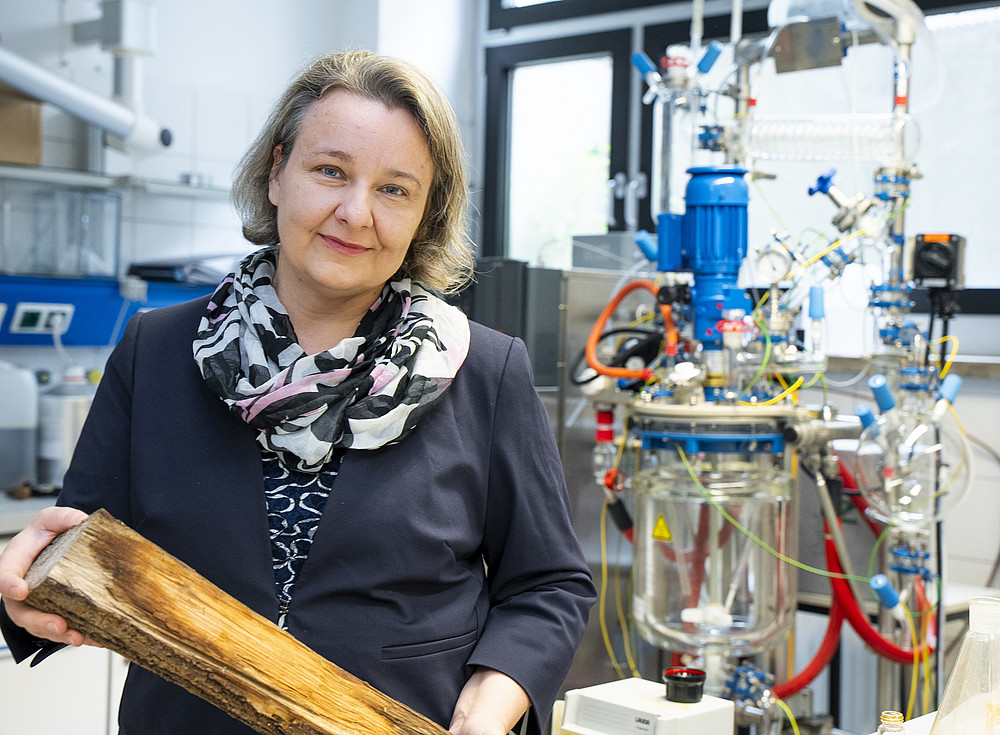
Lignin is one of the key components that make wood so stable. It is also the field of research of the group led by Katalin Barta Weissert, professor at the Institute of Chemistry at the University of Graz. Lignin can be used in numerous chemical processes to replace raw materials from fossil sources. The chemist has now been honoured with a prestigious award: the FWF's Zero Emissions Award.
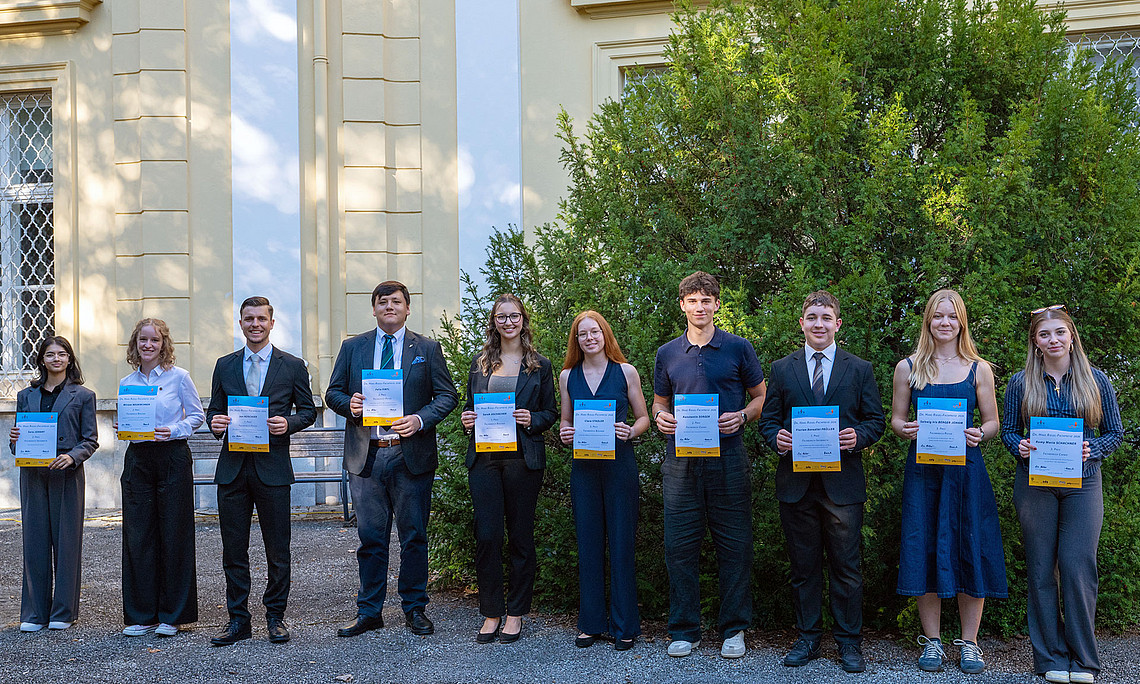
With the annual Zero Emissions Awards, the alpha+ Foundation funds outstanding basic research projects that will help us achieve the goal of a climate-neutral future – projects that are not only scientifically excellent and technologically innovative, but whose findings will also have an ecological impact in the future. The funded projects for the second round of awards have now been announced: Rajesh B. Jethwa from the Institute of Science and Technology (ISTA) was awarded €375,000 for research into sustainable battery technologies, Eva Maria Prem will receive €407,000 to pursue new approaches for generating energy from waste materials, and Katalin Barta Weissert from the University of Graz is receiving €378,000 in funding to explore replacing petrochemicals in the pharmaceutical industry with renewable alternatives. All three awards are made possible by a donation from US entrepreneur Patrick S. Dumont to the alpha+ Foundation of the Austrian Science Fund (FWF).
Wood as a basis for medicines
Chemist Katalin Barta Weissert from the University of Graz is researching new ways of using components of wood in chemical processes in medicine. Her research focuses on environmentally friendly methods for obtaining pharmaceutically relevant molecules from lignin-containing biomass. Her newly developed process converts lignin – one of the main components of wood – to a substance that can be used in the chemical industry. This work’s contribution to a zero-emissions future is two-fold: It replaces petrochemical source materials with renewable resources and supports the pharmaceutical industry on its way to a circular bioeconomy. The chemist received a Zero Emissions Award in the amount of 378,000 Euro for her research.
"I am delighted for Katalin Barta Weissert on her well-deserved Zero Emissions Award. Her work is an impressive example of how basic research paves the way for a climate-friendly world. This award once again recognises the research work carried out at the University of Graz and motivates us to continue on this path. Especially now, when climate change and social responsibility are moving down the agenda," congratulates Peter Riedler, Rector of the University of Graz.
“Katalin Barta Weissert is using plant biomass to develop new ways of producing medicines more sustainably. This research combines creativity with in-depth knowledge, leading to technological progress. With excellent research and examples like these, the University of Graz is setting the course for the future. And this is also being noticed internationally,” says Joachim Reidl, Vice-Rector for Research at the University of Graz, delighted with the research success.
Award for diverse solutions for the climate
“This year's projects once again show basic research’s key role in achieving the goal of a sustainable future. This research provides today’s foundations for the innovations and solutions of tomorrow.”, said Georg Winckler, Chair of the alpha+ Foundation, at the announcement of the Zero Emissions Awards.
“Philanthropy can provide an important stimulus in science and research, where many social achievements begin. The Zero Emissions Award makes a valuable contribution and enables promising research projects whose results will make an impact far beyond the realm of science. Our thanks go to Patrick Dumont, whose commitment has once again made this award possible,” says Ursula Jakubek, Deputy Chair of the alpha+ Foundation and Executive Vice-President of the FWF.
“It is impressive to see the outstanding research being carried out in Austria, especially in a field that is so crucial for the future of our planet. This year, for the second time, the presentation of the Zero Emissions Award highlights how diverse and innovative solutions in the areas of climate, energy, and the environment can be. I wholeheartedly congratulate the award winners, whose projects exemplify truly pioneering approaches in innovation. My thanks go to the Austrian Science Fund, whose support makes this scientific excellence possible in the first place. To me and my family, it is very important to continue supporting science and climate-friendly achievements in Austria,” says Patrick S. Dumont, who is impressed by the research projects.
Eco-friendly batteries
Renewable energies such as wind and solar power are not always available when we need them, which is why improved, scalable batteries for energy storage are crucial. But today’s batteries often depend on rare or unethically sourced materials, which makes them unsafe, environmentally harmful, and geopolitically problematic. In his project, chemist Rajesh B. Jethwa at the Institute of Science and Technology Austria (ISTA) is investigating new battery materials made from sustainably available elements. The advantages of organic materials (adaptable and potentially recyclable) are combined with those of metal-based materials (current industry standards with high stability). The aim is to develop new types of battery electrodes that can store energy in both metallic and organic components. By analyzing material structures and performance, the aim is to design high-performance, long-lasting, and sustainable batteries that are less dependent on critical raw materials. This could be an important step towards safe and environmentally friendly energy storage solutions. The chemist received a Zero Emissions Award in the amount of 375,000 Euro for his project.
Energy from waste
With her basic research project, microbiologist Eva Maria Prem at the University of Innsbruck is investigating the role of extracellular polymers during the anaerobic fermentation of poorly degradable substrates and their influence on the resilience of microorganisms in biogas processes. The utilization of biogas already plays an important role in climate protection and the supply of sustainable energy. The fermentation of organic waste produces a climate-neutral energy source that has not yet been sufficiently exploited. Biogas not only contributes to reducing greenhouse gas emissions, but also helps to recycle waste in a meaningful way and recycle fermentation residues as valuable fertilizer. The aim of the research project is to understand the complex microbial dependencies in biogas reactors and to investigate the resistance of microorganisms to contaminants in order to ensure a stable degradation cascade and continuous biogas production. The microbiologist will receive a Zero Emissions Award in the amount of €407,000 for her research in 2025.