



Begin of page section:
Page sections:

  • Go to contents (Accesskey 1)
  • Go to position marker (Accesskey 2)
  • Go to main navigation (Accesskey 3)
  • Go to sub navigation (Accesskey 4)
  • Go to additional information (Accesskey 5)
  • Go to page settings (user/language) (Accesskey 8)
  • Go to search (Accesskey 9)

End of this page section. Go to overview of page sections

Begin of page section:
Page settings:

English en
Deutsch de
Search
Login

End of this page section. Go to overview of page sections

Begin of page section:
Search:

Search for details about Uni Graz
Close

End of this page section. Go to overview of page sections


Search

Begin of page section:
Main navigation:

Page navigation:

  • University

    University
    • About the University
    • Organisation
    • Faculties
    • Library
    • Working at University of Graz
    • Campus
    Developing solutions for the world of tomorrow - that is our mission. Our students and our researchers take on the great challenges of society and carry the knowledge out.
  • Research Profile

    Research Profile
    • Our Expertise
    • Research Questions
    • Research Portal
    • Promoting Research
    • Research Transfer
    • Ethics in Research
    • Commission for Scientific Integrity
    Scientific excellence and the courage to break new ground. Research at the University of Graz creates the foundations for making the future worth living.
  • Studies

    Studies
    • Prospective Students
    • Students
  • Community

    Community
    • International
    • Location
    • Research and Business
    • Alumni
    The University of Graz is a hub for international research and brings together scientists and business experts. Moreover, it fosters the exchange and cooperation in study and teaching.
  • Spotlight
Topics
  • Sustainable University
  • Researchers answer
  • Work for us
Close menu

End of this page section. Go to overview of page sections

Begin of page section:
You are here:

University of Graz News Abgeschoben

End of this page section. Go to overview of page sections

Tuesday, 27 November 2018

Abgeschoben

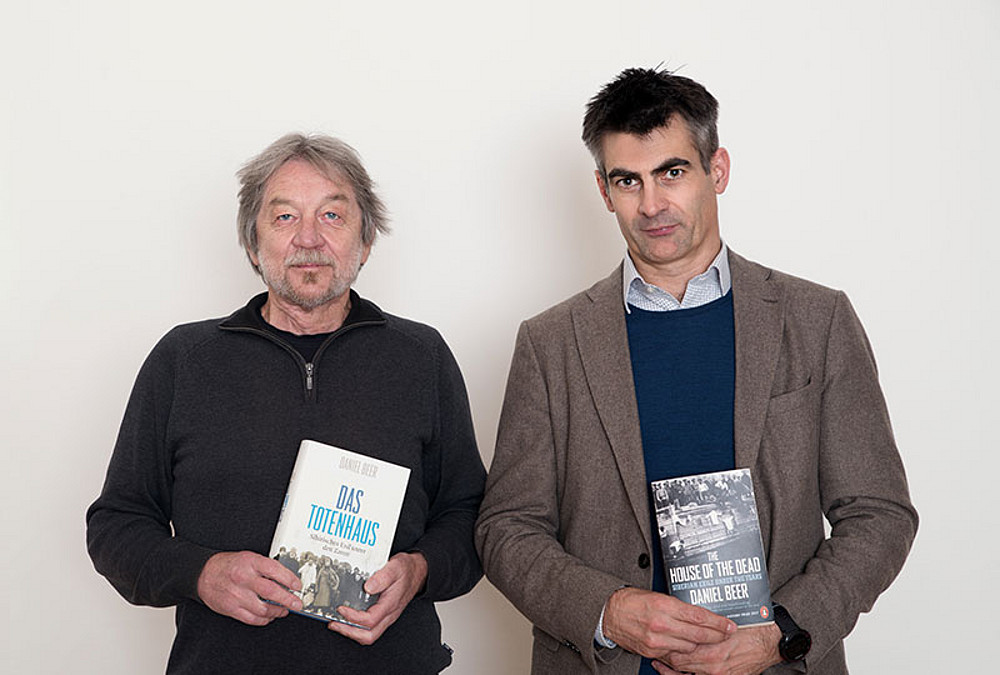
Daniel Beer (r.) präsentierte auf Einladung von Karl Kaser sein Buch "Das Totenhaus". Foto: Alexander Leljak.

Daniel Beer (r.) präsentierte auf Einladung von Karl Kaser sein Buch "Das Totenhaus". Foto: Alexander Leljak.

Historiker Daniel Beer referierte zum sibirischen Exil unter den Zaren

Verbannung ans „Ende der Welt“ auf unbestimmte Zeit, körperliche Schwerstarbeit, mentale Verrohung: Wer zu Zeiten des russischen Zarenreichs in das sibirische Exil geschickt wurde, verschwand nicht nur – oft für immer – aus der Zivilgesellschaft. In den Arbeitslagern schufteten sich Männer und Frauen zu Tode, falls sie den über 3.500 Kilometer langen Fußmarsch bis ins äußerste Sibirien überhaupt überstanden hatten. Der britische Historiker Daniel Beer, Experte für moderne russische Geschichte, zeichnet in seinem aktuellen Buch „The House of the Dead“ den Alltag der Häftlinge nach, ihre Verzweiflung und ihre Überlebensstrategien. Am Freitag, 23. November 2018, präsentierte der Forscher der Royal Holloway University of London an der Universität Graz die deutsche Ausgabe des Buches auf Einladung von Karl Kaser vom Fachbereich Südosteuropäische Geschichte. „Das Totenhaus“ ist im Fischer-Verlag erschienen.

In den Arbeitslagern rund um die Region des Baikalsees oder auf der Insel Sachalin am östlichsten Ende des Zarenreichs wurde nicht nur mit den wenigen Habseligkeiten, die die Sträflinge besaßen, reger Handel betrieben, sondern auch mit Identitäten. Da es keine schriftlichen Aufzeichnungen über die Verbannten gab, konnte man – mit etwas Glück, mit Gewalt oder durch Zufall – die eigene Haftstrafe reduzieren, oder, durch Pech, verlängern. Für die einem Todesurteil gleichkommende Abschiebung nach Sibirien brauchte es übrigens keine Gerichtsverhandlung und keine Beweise. Ohne die Möglichkeit eines Rechtsschutzes wurden daher oft auch politisch Unbequeme, KritikerInnen oder QuerdenkerInnen kurzerhand deportiert. Darunter befanden sich auch Intellektuelle wie Fjodor Michailowitsch Dostojewski, der seine Zeit der Verbannung in „Aufzeichnungen aus einem Totenhaus“ verewigte. Der Titel des Werks lieferte Anleihen für Daniel Beers Publikation, die die Entwicklung Sibiriens vom gefürchteten Gefängnis bis zum „Kalifornien“ Russlands nachzeichnet. Die im Oktober 1916 fertiggestellte Transsibirische Eisenbahn trug wesentlich zu dieser Transformation bei.

Für „Das Totenhaus“ wurde Daniel Beer vergangenes Jahr mit dem mit 75 000 US-Dollar dotierten Cundill History Prize 2017 ausgezeichnet, einer der weltweit am höchsten dotierten Auszeichnungen für geschichtliche Sachliteratur.


 

created by Gerhild Leljak

Related news

Higher Education Strategy 2040: Austria’s universities on course for the future

Austria has 77 higher education institutions, which is above the EU average – but does this really make sense? The new Higher Education Strategy 2040 focuses on cooperation rather than mergers. As one of the six largest universities in Austria, the University of Graz plays a central role in this.

Climate research in Greenland: Old data provides new insights

The polar explorer and University of Graz professor Alfred Wegener left behind a unique collection of climate data from Greenland. A research team from the University of Graz is now analysing this 100-year-old treasure trove of data and comparing it with current measurements.

Diversity in nature and science: How we talk about plants and each other

Ginkgo, kiwi, hemp: they exist as male and female plants. Anyone who paid attention in biology class will confirm this. But is this categorisation, established by Carl von Linné almost 300 years ago, still valid today? An interdisciplinary team at the University of Graz is questioning these attributions and using this as a starting point to provide food for thought for gender-sensitive interaction between students, scientific and teaching staff.

Around the world in eight stops: the Long Night of Research at the University of Graz

On 24 April from 5 pm, you can take a short trip around the globe at the University of Graz, discovering pecularities of foreign countries or new local features in the entrance hall of the University Library. The itinerary takes you through introduced animal species, political attitudes and the omnipotence of algorithms. There will also be a programme in the historic reading hall, as well as at the UniGraz@Museum and the University Archive.

Begin of page section:
Additional information:

University of Graz
Universitaetsplatz 3
8010 Graz
Austria
  • Contact
  • Web Editors
  • Moodle
  • UNIGRAZonline
  • Imprint
  • Data Protection Declaration
  • Accessibility Declaration
Weatherstation
Uni Graz

End of this page section. Go to overview of page sections

End of this page section. Go to overview of page sections

Begin of page section:

End of this page section. Go to overview of page sections

