Begin of page section:
Page sections:

  • Go to contents (Accesskey 1)
  • Go to position marker (Accesskey 2)
  • Go to main navigation (Accesskey 3)
  • Go to sub navigation (Accesskey 4)
  • Go to additional information (Accesskey 5)
  • Go to page settings (user/language) (Accesskey 8)
  • Go to search (Accesskey 9)

End of this page section. Go to overview of page sections

Begin of page section:
Page settings:

English en
Deutsch de
Search
Login

End of this page section. Go to overview of page sections

Begin of page section:
Search:

Search for details about Uni Graz
Close

End of this page section. Go to overview of page sections


Search

Begin of page section:
Main navigation:

Page navigation:

  • University

    University
    • About the University
    • Organisation
    • Faculties
    • Library
    • Working at University of Graz
    • Campus
    Developing solutions for the world of tomorrow - that is our mission. Our students and our researchers take on the great challenges of society and carry the knowledge out.
  • Research Profile

    Research Profile
    • Our Expertise
    • Research Questions
    • Research Portal
    • Promoting Research
    • Research Transfer
    • Ethics in Research
    • Commission for Scientific Integrity
    Scientific excellence and the courage to break new ground. Research at the University of Graz creates the foundations for making the future worth living.
  • Studies

    Studies
    • Prospective Students
    • Students
    • Registration for Study Programme (Winter semester 2026/27)
  • Community

    Community
    • International
    • Location
    • Research and Business
    • Alumni
    The University of Graz is a hub for international research and brings together scientists and business experts. Moreover, it fosters the exchange and cooperation in study and teaching.
Topics
  • Sustainable University
  • Researchers answer
  • Work for us
Close menu

End of this page section. Go to overview of page sections

Begin of page section:
You are here:

University of Graz News Desert sand, microplastics, cancer cells: David Clases awarded ERC grant for analytical method

End of this page section. Go to overview of page sections

Tuesday, 30 June 2026

Desert sand, microplastics, cancer cells: David Clases awarded ERC grant for analytical method

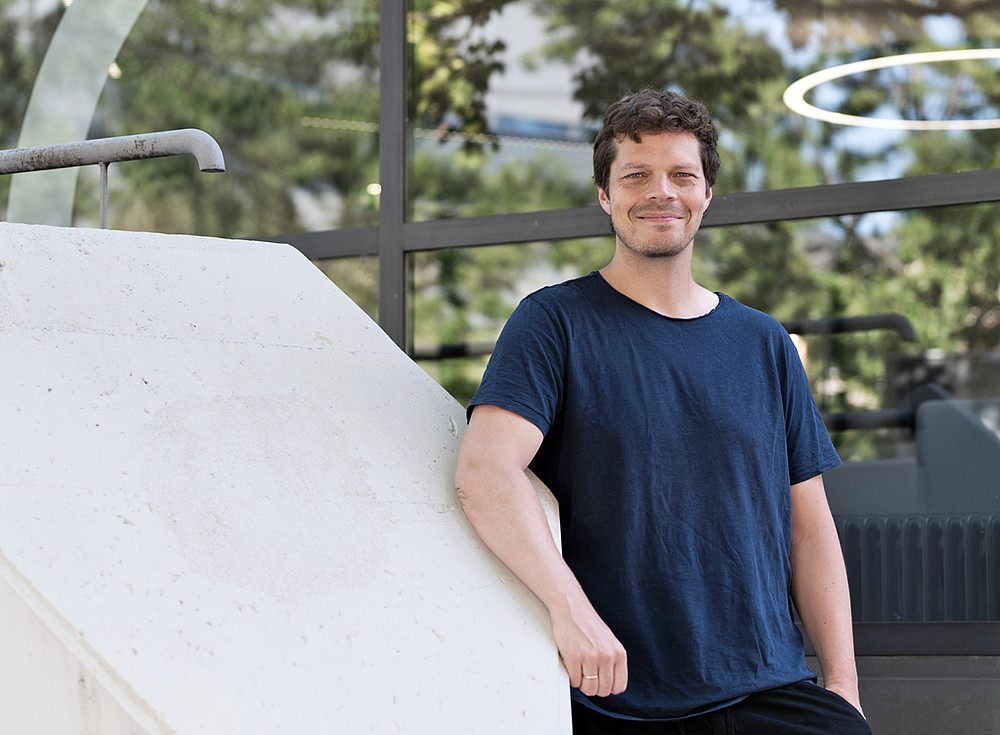
David Clases leaning against a wide concrete staircase railing outside the Mensa Space at the University of Graz ©Uni Graz/Angele
©Uni Graz/Angele

Thanks to a new nanoparticle analysis method he has developed, David Clases is able to investigate how the Gobi Desert ends up at the North Pole. He is now adapting this method for particles on a micro-scale. Photo: University of Graz/Angele

Nanoparticles trapped in polar ice can reveal a great deal about the climate 100,000 years ago. Chemist David Clases is developing unique methods to analyse them in detail. He will now adapt these methods for use with larger particles in order to glean even more information about Earth’s history. The method can be used for a wide range of other purposes – for example, in medical diagnostics or the investigation of environmental pollution. Clases has been awarded a Proof-of-Concept Grant by the European Research Council (ERC) for this work.

Dust, volcanic ash and even traces of sand from the Gobi Desert: all of these can be found in ice cores from the poles. They provide insights into the climatic conditions and changes on Earth tens of thousands of years ago. It is only recently that it has become possible to study the size, shape, number and chemical composition of the smallest particles. David Clases is developing new techniques to achieve this as part of the NanoArchive project, for which he was awarded an ERC Starting Grant. The researcher is now adapting the method for larger particles on a micro-scale. “From these, we can glean even more information about their properties and origin,” explains Clases. To this end, he has received further funding from the European Research Council: the Proof of Concept Grant, worth 150,000 euros.

For the first time, the scientist is combining various analytical methods to detect individual particles and characterise them much more quickly and accurately than was previously possible. The method can then also be used for numerous other applications. “It allows, for example, microplastics or individual cells to be examined efficiently and precisely,” says Clases, citing examples. “In analytical chemistry, we often act as a bridgehead, linking a wide variety of disciplines. The Proof of Concept Grant is a great example of this: whilst we drive forward new technologies and new expertise, we are in the privileged position of being able to collaborate with experts from other fields,” he says, describing his role. 
created by Dagmar Eklaude

Related news

Staying fit during the holidays: summer sports on the University of Graz campus

The Kleeblattlauf is not the end of the fitness term. Following last year’s successful launch, the University of Graz is once again offering summer sports on campus this year. From 30 June to 16 July 2026, there will be a free exercise programme in the open air. On the shady Südwiese (between the main building and Universitätsplatz 2), anyone interested can get in shape in the afternoons with body workouts, fascia training and yoga.

Getting even hotter: Researchers predict global warming of 1.7 degrees by 2027

While Europe is currently sweltering in the heat, global temperatures are also rising towards concerning record levels. In 2026, Earth’s surface air temperature is expected to reach 1.62 degrees, and in 2027 even 1.71 degrees Celsius above pre-industrial levels. The long-term temperature rise – an average over a 20-year period – is predicted to exceed the 1.5-degree threshold of the Paris Agreement as of 2026 already. For the first time, researchers at the University of Graz have been able to make such a forecast so far in advance. The intensifying El Niño climate event favors forecast skill and thereby facilitates a reliable computation.

Forest fire at Rosenhain: Volunteer fire brigade carried out an evacuation drill at the Jesuit refectory

Thick smoke in the stairwell, flames at the edge of the forest, people missing in the Jesuit refectory at the University of Graz: at Rosenhain, the Graz Volunteer Fire Brigade carried out a drill simulating a scenario that is becoming increasingly realistic given the heat and drought

Wie war das Klima vor 100.000 Jahren? Chemiker untersucht Partikel im ewigen Eis

Sie sind winzig klein, tragen aber eine große Geschichte in sich. Kleinste Staubteilchen, die seit Jahrtausenden an den Polkappen sowie in den Alpen im Eis eingeschlossen sind. Bis heute. Chemiker David Clases findet und analysiert sie mit einer eigens entwickelten Methode und hochsensiblen Geräten und kann mit den Informationen aus der Nano-Welt die Erdgeschichte rekonstruieren.

Begin of page section:
Additional information:

University of Graz
Universitaetsplatz 3
8010 Graz
Austria
  • Contact
  • Web Editors
  • Moodle
  • UNIGRAZonline
  • Imprint
  • Data Protection Declaration
  • Accessibility Declaration
Weatherstation
Uni Graz

End of this page section. Go to overview of page sections

End of this page section. Go to overview of page sections

Begin of page section:

End of this page section. Go to overview of page sections