Begin of page section:
Page sections:

  • Go to contents (Accesskey 1)
  • Go to position marker (Accesskey 2)
  • Go to main navigation (Accesskey 3)
  • Go to sub navigation (Accesskey 4)
  • Go to additional information (Accesskey 5)
  • Go to page settings (user/language) (Accesskey 8)
  • Go to search (Accesskey 9)

End of this page section. Go to overview of page sections

Begin of page section:
Page settings:

English en
Deutsch de
Search
Login

End of this page section. Go to overview of page sections

Begin of page section:
Search:

Search for details about Uni Graz
Close

End of this page section. Go to overview of page sections


Search

Begin of page section:
Main navigation:

Page navigation:

  • University

    University
    • About the University
    • Organisation
    • Faculties
    • Library
    • Working at University of Graz
    • Campus
    Developing solutions for the world of tomorrow - that is our mission. Our students and our researchers take on the great challenges of society and carry the knowledge out.
  • Research Profile

    Research Profile
    • Our Expertise
    • Research Questions
    • Research Portal
    • Promoting Research
    • Research Transfer
    • Ethics in Research
    • Commission for Scientific Integrity
    Scientific excellence and the courage to break new ground. Research at the University of Graz creates the foundations for making the future worth living.
  • Studies

    Studies
    • Prospective Students
    • Students
    • Registration for Study Programme (Winter semester 2026/27)
    • Study Days 22-26 June 2026
  • Community

    Community
    • International
    • Location
    • Research and Business
    • Alumni
    The University of Graz is a hub for international research and brings together scientists and business experts. Moreover, it fosters the exchange and cooperation in study and teaching.
Topics
  • Sustainable University
  • Researchers answer
  • Work for us
Close menu

End of this page section. Go to overview of page sections

Begin of page section:
You are here:

University of Graz News Forest fire at Rosenhain: Volunteer fire brigade carried out an evacuation drill at the Jesuit refectory

End of this page section. Go to overview of page sections

Wednesday, 24 June 2026

Forest fire at Rosenhain: Volunteer fire brigade carried out an evacuation drill at the Jesuit refectory

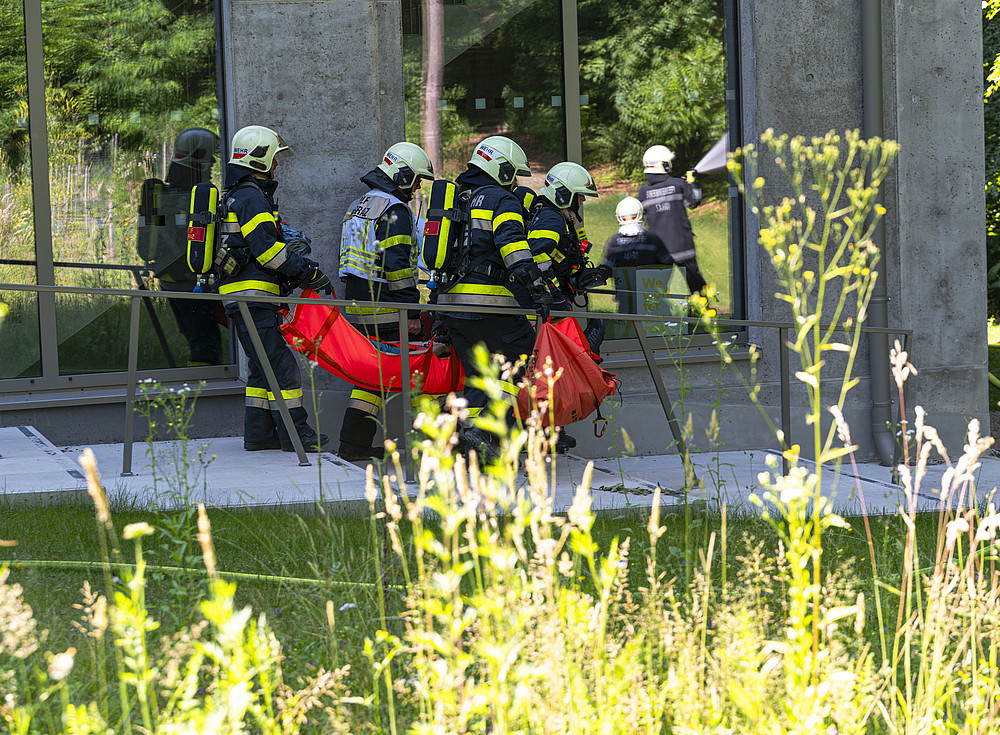
Leute in Feuerwehrbekleidung tragen eine verletzte Person ©Konstantinos Tzivanopoulos

Successful evacuation: The University of Graz and the Graz Volunteer Fire Brigade carried out an emergency drill at Rosenhain. Photo: Graz Volunteer Fire Brigade

Thick smoke in the stairwell, flames at the edge of the forest, people missing in the Jesuit refectory at the University of Graz: at Rosenhain, the Graz Volunteer Fire Brigade carried out a drill simulating a scenario that is becoming increasingly realistic given the heat and drought

On a hot June day, the Rosenhain lies quiet over the city. Normally, this recreational area in Graz is a place for walks, sport and short breaks in the countryside. But on this Saturday, the tranquillity is shattered: smoke is rising; a fire has spread rapidly in the neighbouring woodland. The fire is threatening the historic Jesuit refectory at the University of Graz. Inside the building itself, the smoke is already clearly noticeable. Ten people are reported missing.

This was the scenario for the emergency drill carried out by the Graz Volunteer Fire Brigade on Saturday, 20 June 2026, at the Rosenhain. Thirty-five firefighters set out in four vehicles to practise responding to an emergency under conditions as close to reality as possible. The scenario was challenging: a wildfire in the immediate vicinity of a historic building, heavy smoke on the upper floor, several people missing and the risk of the flames spreading to the Jesuit refectory. It is precisely these kinds of complex scenarios that the Graz Volunteer Fire Brigade must practise on a regular basis. It supports the Graz Professional Fire Brigade, particularly during storms and major incidents, and is therefore an important part of the city’s civil protection system.

Person in a wheelchair rescued from the top floor

Inside the building, the emergency services initially focused on rescuing people. The stairwell was kept smoke-free using a high-powered fan to create safe escape and rescue routes. This enabled a person in a wheelchair to be successfully evacuated from the second floor. At the same time, a so-called ‘firebreak’ was set up behind the Jesuit refectory: a tactical fire-fighting measure designed to prevent the fire from spreading from the adjacent woodland to the building. Three firefighting crews, along with additional reinforcements from the Graz Fire Brigade, worked closely together on this. After around an hour, the exercise was successfully completed.

For the University of Graz, the operation was an important test. The Jesuit Refectory on Aigner-Rollet-Allee was only completed and occupied last autumn. Today, it houses the Institute for Movement Sciences, Sport and Health. “The cooperation between the Graz Volunteer Fire Brigade and the university’s management worked exceptionally well. Such regular joint exercises with the emergency services are of particular importance to us. They enable us to test procedures under realistic conditions, further strengthen our cooperation and gain valuable insights for use in an emergency. Only through joint training can we ensure that we act swiftly, in a coordinated and efficient manner should an incident occur,” emphasises Thomas Suchy, Central Fire Safety Officer at the University of Graz.

University of Graz and emergency services work closely together

For the Graz Volunteer Fire Brigade, however, the exercise also highlights just how much emergency situations are changing. Heatwaves, droughts and wildfires are no longer issues confined to southern regions; they are now a likely prospect in the Styrian capital as well. “The exercise has shown what we need to be prepared for here in Graz too: forest and wildfires are no longer an abstract scenario. Where woodland, built-up areas and historic buildings are in close proximity, we need well-rehearsed procedures and the right equipment. We therefore train not only in fire-fighting, but also in the coordinated interplay of rescuing people, clearing smoke, evacuating and preventing the fire from spreading to unaffected areas,” emphasises Andreas Grinschgl, commander of the Graz Volunteer Fire Brigade.

The Graz Volunteer Fire Brigade was founded in 2008 and is now an indispensable part of Graz’s civil protection system. Currently, around 160 members – 120 of whom are active volunteers – serve the city on a voluntary basis. Through regular training under realistic conditions, the team is fully prepared for emergencies – and is a reliable partner for the professional fire service and the people of Graz.


created by Konstantin Tzivanopoulos

Related news

Full effort in the heat: the Sports Centre was in full swing at the Kleeblattlauf

On 19 June 2026, 2,000 runners and hundreds of supporters made their way to the Rosenhain for a sporting end-of-term event.

Save, invest or guarantee: What Austrians expect from the state

Austria needs to make savings. But where? And what should the Republic actually be spending its money on? The answers are provided by the initial findings of a major study involving the University of Graz. 99 per cent of those surveyed are in favour of the state ensuring healthcare provision. Almost three-quarters would like to see more public funding for education, whilst only around three per cent are in favour of cuts in this sector.

Science meets blockbuster: Campus cinema at the University of Graz

A cinematic treat for the scientific community: the courtyard of the University of Graz’s main building is once again being transformed into an atmospheric open-air cinema this year. From 29 June to 10 July 2026 (Mondays to Fridays from 8.30 pm), blockbusters and documentaries will be shown on the open-air screen. Academics from the University of Graz will be taking a closer look at the films shown, examining them to distinguish fact from fiction.

Complying with the norm: Why Do Standards Shape Our Lives, Elisabeth Staudegger?

Standards determine whether a sheet of paper fits in a printer or whether a charging plug can power multiple devices. These standards shape our everyday lives. But who actually sets these standards? Where are the weaknesses, and how could science help to improve them? Elisabeth Staudegger, Head of the ‘Law and IT’ Department at the Institute for Legal Foundations at the University of Graz, host the Academic Standards Day on 16 June. Here she relays how sciences can contribute to the topic of standardisation and reveals her personal favourite standard.

Begin of page section:
Additional information:

University of Graz
Universitaetsplatz 3
8010 Graz
Austria
  • Contact
  • Web Editors
  • Moodle
  • UNIGRAZonline
  • Imprint
  • Data Protection Declaration
  • Accessibility Declaration
Weatherstation
Uni Graz

End of this page section. Go to overview of page sections

End of this page section. Go to overview of page sections

Begin of page section:

End of this page section. Go to overview of page sections