Begin of page section:
Page sections:

  • Go to contents (Accesskey 1)
  • Go to position marker (Accesskey 2)
  • Go to main navigation (Accesskey 3)
  • Go to sub navigation (Accesskey 4)
  • Go to additional information (Accesskey 5)
  • Go to page settings (user/language) (Accesskey 8)
  • Go to search (Accesskey 9)

End of this page section. Go to overview of page sections

Begin of page section:
Page settings:

English en
Deutsch de
Search
Login

End of this page section. Go to overview of page sections

Begin of page section:
Search:

Search for details about Uni Graz
Close

End of this page section. Go to overview of page sections


Search

Begin of page section:
Main navigation:

Page navigation:

  • University

    University
    • About the University
    • Organisation
    • Faculties
    • Library
    • Working at University of Graz
    • Campus
    Developing solutions for the world of tomorrow - that is our mission. Our students and our researchers take on the great challenges of society and carry the knowledge out.
  • Research Profile

    Research Profile
    • Our Expertise
    • Research Questions
    • Research Portal
    • Promoting Research
    • Research Transfer
    • Ethics in Research
    • Commission for Scientific Integrity
    Scientific excellence and the courage to break new ground. Research at the University of Graz creates the foundations for making the future worth living.
  • Studies

    Studies
    • Prospective Students
    • Students
  • Community

    Community
    • International
    • Location
    • Research and Business
    • Alumni
    The University of Graz is a hub for international research and brings together scientists and business experts. Moreover, it fosters the exchange and cooperation in study and teaching.
  • Spotlight
Topics
  • Sustainable University
  • Researchers answer
  • Work for us
Close menu

End of this page section. Go to overview of page sections

Begin of page section:
You are here:

University of Graz Spotlight Pretty close to the sun

End of this page section. Go to overview of page sections

Pretty close to the sun

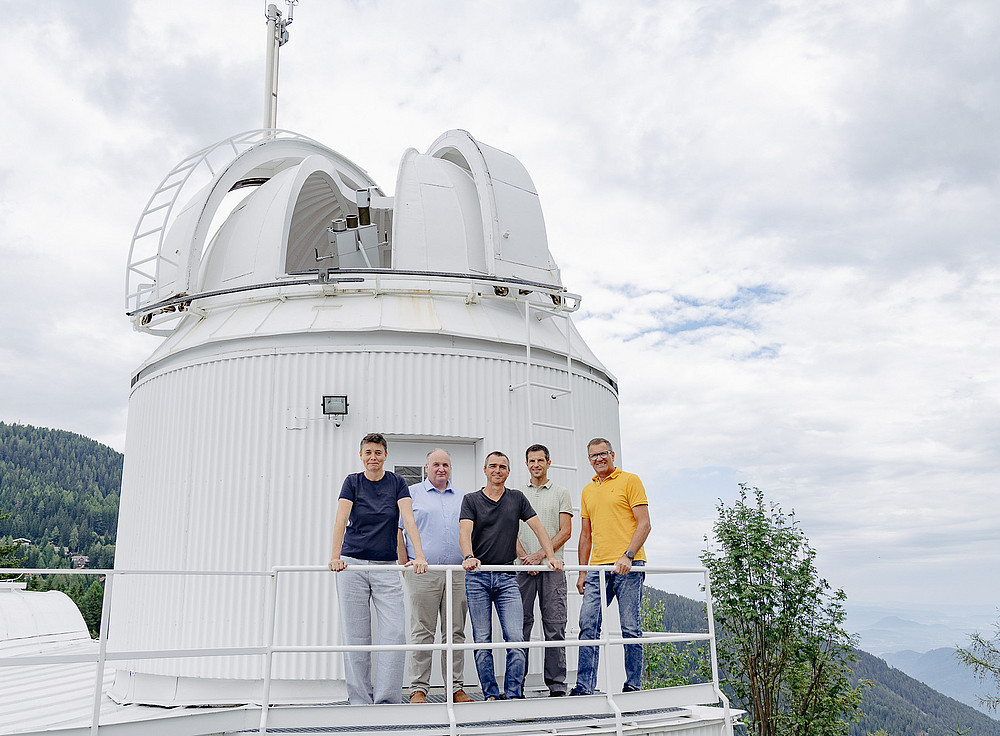
People standing in front of a telescope ©Uni Graz/Tzivanopoulos

They have the highest workplace at the University of Graz: Astrid Veronig, Dietmar Baumgartner, Werner Pötzi, Heinrich Freislich and Heinz Strutzmann (from left) make up the team at the Kanzelhöhe Solar Observatory. Photo: University of Graz

At 1526 metres above sea level, the Kanzelhöhe observatory is probably the highest workplace at the University of Graz. A team led by astrophysicist Astrid Veronig observes how the sun behaves and how it influences space weather.

It is exactly 191 kilometres from the campus of the University of Graz to the Kanzelhöhe mountain observatory on the Gerlitzen in Carinthia. From the small village of Treffen am Ossiacher See, a winding road leads up to 1526 metres above sea level. Once you reach the top, you are rewarded with a panoramic view from the Koralpe to the Turracher Höhe - if the visibility is good. An ideal place to enjoy the sun - or to study it. 

The observatory is the workplace of astrophysicist Astrid Veronig, Dietmar Baumgartner, Werner Pötzi, Heinrich Freislich and Heinz Strutzmann. Every day when the sun shines, four telescopes with special filters are aimed at this star in order to observe it closely and learn new things about it. Almost 300 days a year. "It takes about eight minutes for sunlight to reach the earth," explains Astrid Veronig. 

The Kanzelhöhe Observatory, which belongs to the Institute of Physics at the University of Graz, is unique in Austria. It was built by the German Air Force during the Second World War between 1941 and 1943. Even then, it was used to observe solar flares and the effects on radio communications, which were so important for air traffic. Today it is used for scientific purposes: in addition to researching solar activity, radiation measurements are also carried out. 
Photos of the sun are taken every ten seconds with 4K cameras through the telescope's optics, archived and automatically made available to the global research community. "An important partner that receives data from us is the European Space Agency (ESA)," says the physicist. "Anyone interested can view current images of the sun on our website." Sunspots are of particular interest to the researcher. These areas on the surface of the sun, which are particularly influenced by the magnetic field, are responsible for solar eruptions - and they ultimately also determine space weather.

High-energy matter is hurled away from the surface of the star at several million kilometres per hour. The journey to Earth can then take up to three days. "Being able to predict space weather is crucial for different areas of life." Disturbed space weather has a negative impact on satellite communication and can disrupt electrical systems on Earth to such an extent that large-scale power outages occur. "Aviation is also dependent on what happens on the sun," explains the astrophysicist. "If strong solar storms are expected, flight routes have to be rescheduled." 

A home-made telescope such as the one found at Kanzelhöhe is fitted with expensive, cutting-edge technology. Nevertheless, the process of documenting sunspots over the long term is seemingly banal. When the dome opens and the telescope is pointed directly at the sun, a mirror image of the celestial body is projected onto a white sheet of paper. "We then trace the visible spots on the paper with a well-sharpened pencil and make a handwritten note of the date and time," emphasises Werner Pötzi. There is a simple and plausible reason for this analogue procedure: "We record in the same way as Galileo Galilei did more than 400 years ago. This gives us a direct comparison with historical data to measure long-term changes in solar radiation and solar activity." 

created by Konstantin Tzivanopoulos

Related news

Scientific freedom and neutrality: a question of attitude

How neutral must research be? At the Styrian University Conference at the University of Graz, keynote speaker David Beaver questioned the concept of objectivity. He advocated for bold science that stands by its values in order to remain resilient in times of crisis and actively shape social progress.

University of Graz: Discover the apprentice game and secure jobtraining

The University of Graz not only educates students – it also offers apprenticeships in eight future-oriented professions – even with a school-leaving certificate if desired! From metal technology in the physics workshop to IT systems engineering: discover apprenticeships now and immerse yourself in the world of university apprentices with an interactive game.

Green carpet, wooden staircase, reading room: the specialist history library is back

In just eight months, the university renovated, expanded and modernised the specialist library for history on Heinrichstraße. A total of 200,000 volumes are now available, corresponding to around 3,000 metres of shelving. Head Felicitas Schober explains what has changed and why smaller collections are now also housed there. A local inspection.

Listening to the Middle Ages: exhibition brings poverty then and now to life

What connects Giulio, a blacksmith who worked in Bologna almost 500 years ago, with a single mother from Styria who recently lost her job? Both are afraid that they will soon be unable to pay their rent. How does it feel to have existential worries? An exhibition at the University of Graz provides personal insights into experiences of poverty then and now. Listening stations give a voice to people from the Middle Ages. The exhibition opened on 5 March 2026 in the foyer of the University Library Graz.

Begin of page section:
Additional information:

University of Graz
Universitaetsplatz 3
8010 Graz
Austria
  • Contact
  • Web Editors
  • Moodle
  • UNIGRAZonline
  • Imprint
  • Data Protection Declaration
  • Accessibility Declaration
Weatherstation
Uni Graz

End of this page section. Go to overview of page sections

End of this page section. Go to overview of page sections

Begin of page section:

End of this page section. Go to overview of page sections