Begin of page section:
Page sections:

  • Go to contents (Accesskey 1)
  • Go to position marker (Accesskey 2)
  • Go to main navigation (Accesskey 3)
  • Go to sub navigation (Accesskey 4)
  • Go to additional information (Accesskey 5)
  • Go to page settings (user/language) (Accesskey 8)
  • Go to search (Accesskey 9)

End of this page section. Go to overview of page sections

Begin of page section:
Page settings:

English en
Deutsch de
Search
Login

End of this page section. Go to overview of page sections

Begin of page section:
Search:

Search for details about Uni Graz
Close

End of this page section. Go to overview of page sections


Search

Begin of page section:
Main navigation:

Page navigation:

  • University

    University
    • About the University
    • Organisation
    • Faculties
    • Library
    • Working at University of Graz
    • Campus
    Developing solutions for the world of tomorrow - that is our mission. Our students and our researchers take on the great challenges of society and carry the knowledge out.
  • Research Profile

    Research Profile
    • Our Expertise
    • Research Questions
    • Research Portal
    • Promoting Research
    • Research Transfer
    • Ethics in Research
    • Commission for Scientific Integrity
    Scientific excellence and the courage to break new ground. Research at the University of Graz creates the foundations for making the future worth living.
  • Studies

    Studies
    • Prospective Students
    • Students
    • Post-registration Law
  • Community

    Community
    • International
    • Location
    • Research and Business
    • Alumni
    The University of Graz is a hub for international research and brings together scientists and business experts. Moreover, it fosters the exchange and cooperation in study and teaching.
Topics
  • Sustainable University
  • Researchers answer
  • Work for us
Close menu

End of this page section. Go to overview of page sections

Begin of page section:
You are here:

University of Graz News Between Myth and Crisis: The Hidden Stories of Rivers

End of this page section. Go to overview of page sections

Friday, 22 May 2026

Between Myth and Crisis: The Hidden Stories of Rivers

A bridge over a river

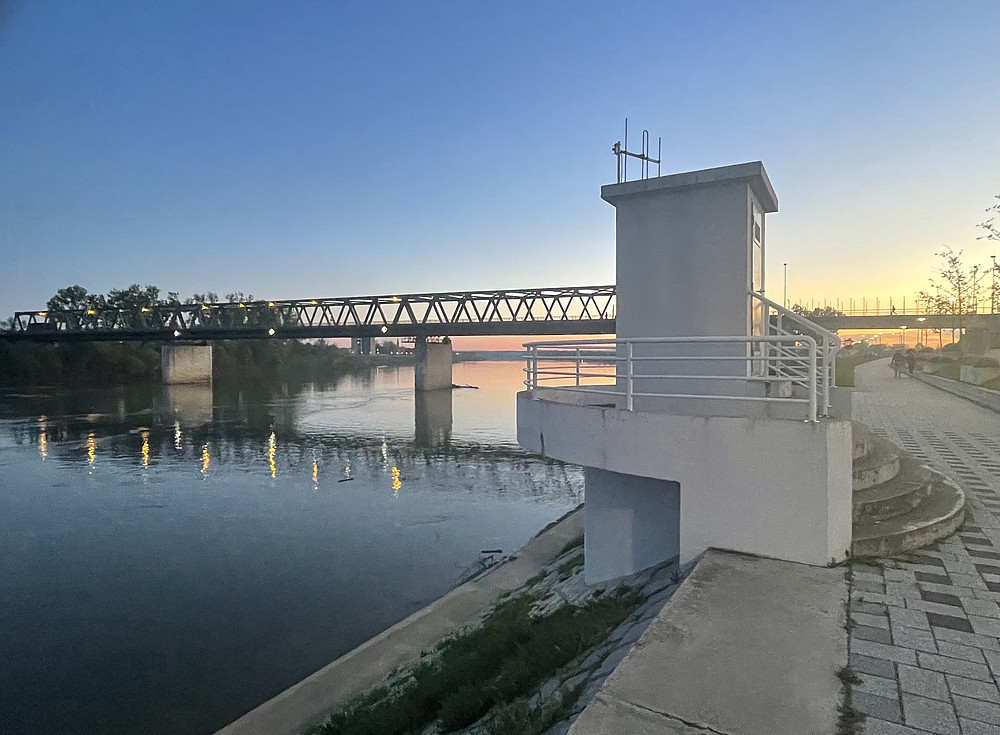
The bridge spans the River Save and connects the towns of Slavonski Brod in Croatia and Bosanski Brod in Bosnia and Herzegovina. Photo: Zivkovic

Rivers connect landscapes, cities, people and identities. They form trade routes, preserve memories and mark boundaries. They shape the environment and provide habitats. At the same time, they lie at the heart of ecological, political and social crises. This is precisely where the “RIVERS IN CRISIS” research project at the Institute of Slavic Studies comes in

In Greek mythology, the River Styx separates the world of the living from the realm of the dead. The Greek hero Achilles was bathed in it and thus gained his invulnerability. Johann Strauss’s ‘The Blue Danube’ is regarded as the epitome of the Viennese waltz and is performed every year at the Vienna Philharmonic’s New Year’s Concert and broadcast around the world. Flowing waters have therefore always played an important role and hold strong symbolic significance for humanity. 

In a Europe-wide HERA/CHANSE consortium called LIMINALWATER, researchers from the UK, France, Portugal, Croatia and Austria are taking an interdisciplinary approach to waterways in borderlands. Together, they are investigating how these appear as spaces of crisis in literature, film and culture, history and society. 

Three rivers that connect

At the University of Graz, the FWF-funded sub-project is based at the Institute of Slavic Studies and forms part of the ‘Dimensions of Europe’ research focus. In “RIVERS IN CRISIS”, literary scholars Yvonne Živković and Stefanie Populorum turn their attention to the Danube, Drava and Drina. These three rivers connect Austria with the Western Balkans. They traverse landscapes, political orders and historical spheres of experience. “Unlike in Western Europe, rivers in the Balkans, particularly those in the former Yugoslavia, hold a special significance. People and rivers share a strong, symbiotic relationship. This is especially true because, due to political and social circumstances, technological change arrived there later than elsewhere,” emphasises project leader Yvonne Živković. 

The academic inquiry focuses on the question of how Austrian and ex-Yugoslav texts and films from 1918 to the present day narrate crises through the lens of rivers. “Authors such as Friedericke Mayröcker, Frieda Paris and Nobel Prize-winning author Ivo Andrić have frequently addressed this theme in their works,” emphasises the Croatian-born researcher. The research examines prose, travelogues, folk tales, poetry and films. They deal with wars, migration, environmental destruction, climate change, floods, droughts, pollution, human trafficking and collective belonging. 

Spaces of memory and conflict

In these narratives, rivers appear not merely as transport and trade routes. They are places of memory and identity. It is along them that notions of homeland, nation, cultural heritage and belonging take shape. At the same time, they reveal the extent to which people strive to organise and control waterways. Political borders, surveillance, straightening, dam construction and economic exploitation clash with the dynamics of the river landscapes. Just how controversial these river narratives can be is demonstrated by Peter Handke’s work “A Winter Journey to the Rivers Danube, Sava, Morava and Drina, or Justice for Serbia”. In it, the Austrian author combines a travelogue with a politically highly controversial interpretation of the Yugoslav Wars. 

Exhibition: “Troubled Waters: Waterways in Crisis”

“The aim of the project is to develop a transnational map of literary and cinematic river narratives. It is intended to highlight how the Danube, Drau and Drina are linked through historical experiences of crisis,” explains Živković.

Public outreach plays a key role in this. Together with the Akademie Graz, the project team is preparing the exhibition “Troubled Waters: Waterways in Crisis”. It makes central themes accessible to a wider audience and also includes Styrian rivers. The exhibition will open on 28 May 2026 at 7 pm with a reading and guided tour at Neutorgasse 42 in Graz and will run until 10 July 2026.


created by Konstantin Tzivanopoulos

Related news

#SaveOurUniversities #StopTheAusterity: Demonstration on 28 May in Graz

The Austrian Student Union and the universities are jointly calling for large rallies. The meeting point in Graz is on 28 May at 2 pm on Wilhelm-Fischer-Allee.

Graz to become centre for psychotherapy studies: 215 applications for the entrance exam

A total of 215 people who meet the entry requirements for the new Master’s programme in Psychotherapy have registered for the first entrance examination, which will take place on 6 July 2026 in Graz. They are applying for 140 places on the programme in Graz.

The future of Styria as a knowledge region is at risk

It is reported that 500 million euros are to be cut from Styrian universities. University vice-chancellors fear that this will sacrifice the development and competitiveness of the region as a centre for science, culture and business in favour of short-term cost-cutting targets.

Uni Vibes 2026: Universität Graz öffnet ihren Campus

Am 29. Mai 2026 verwandeln Universität Graz und La Strada Graz den Campus erneut in ein offenes Festgelände. „Uni Vibes – das Fest, das Grenzen überwindet“ verbindet Wissenschaft, Kunst und Gesellschaft bei freiem Eintritt und für alle Generationen.

Begin of page section:
Additional information:

University of Graz
Universitaetsplatz 3
8010 Graz
Austria
  • Contact
  • Web Editors
  • Moodle
  • UNIGRAZonline
  • Imprint
  • Data Protection Declaration
  • Accessibility Declaration
Weatherstation
Uni Graz

End of this page section. Go to overview of page sections

End of this page section. Go to overview of page sections

Begin of page section:

End of this page section. Go to overview of page sections