Begin of page section:
Page sections:

  • Go to contents (Accesskey 1)
  • Go to position marker (Accesskey 2)
  • Go to main navigation (Accesskey 3)
  • Go to sub navigation (Accesskey 4)
  • Go to additional information (Accesskey 5)
  • Go to page settings (user/language) (Accesskey 8)
  • Go to search (Accesskey 9)

End of this page section. Go to overview of page sections

Begin of page section:
Page settings:

English en
Deutsch de
Search
Login

End of this page section. Go to overview of page sections

Begin of page section:
Search:

Search for details about Uni Graz
Close

End of this page section. Go to overview of page sections


Search

Begin of page section:
Main navigation:

Page navigation:

  • University

    University
    • About the University
    • Organisation
    • Faculties
    • Library
    • Working at University of Graz
    • Campus
    Developing solutions for the world of tomorrow - that is our mission. Our students and our researchers take on the great challenges of society and carry the knowledge out.
  • Research Profile

    Research Profile
    • Our Expertise
    • Research Questions
    • Research Portal
    • Promoting Research
    • Research Transfer
    • Ethics in Research
    • Commission for Scientific Integrity
    Scientific excellence and the courage to break new ground. Research at the University of Graz creates the foundations for making the future worth living.
  • Studies

    Studies
    • Prospective Students
    • Students
    • Post-registration Law
  • Community

    Community
    • International
    • Location
    • Research and Business
    • Alumni
    The University of Graz is a hub for international research and brings together scientists and business experts. Moreover, it fosters the exchange and cooperation in study and teaching.
Topics
  • Sustainable University
  • Researchers answer
  • Work for us
Close menu

End of this page section. Go to overview of page sections

Begin of page section:
You are here:

University of Graz News The future of Styria as a knowledge region is at risk

End of this page section. Go to overview of page sections

Wednesday, 20 May 2026

The future of Styria as a knowledge region is at risk

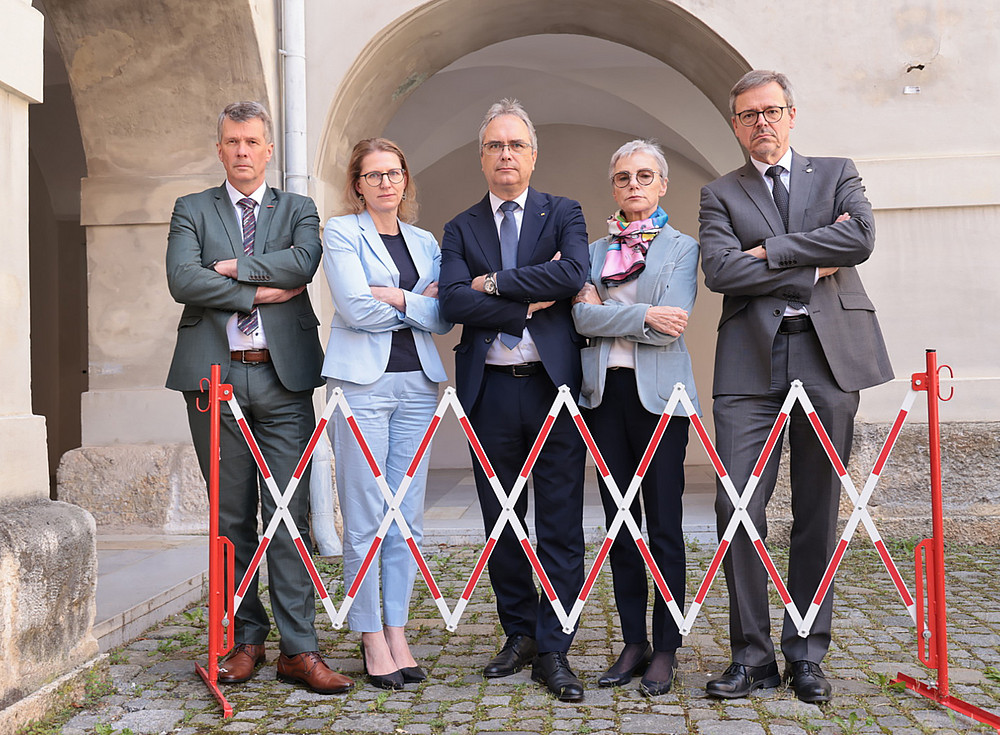
Four rectors and one vice-rector stand behind a barrier with their arms crossed and grim expressions on their faces. ©Harry Schiffer Photodesign

Horst Bischof (Vice-Chancellor of Graz University of Technology), Manuela Raith (Vice-Chancellor of the Montanuniversität Leoben), Peter Riedler (Vice-Chancellor of the University of Graz), Andrea Kurz (Vice-Chancellor of the Medical University of Graz) and Georg Schulz (Vice-Chancellor of the University of Music and Performing Arts Graz) warned of the consequences of budget cuts at universities during a press conference. Photo: Harry Schiffer

It is reported that 500 million euros are to be cut from Styrian universities. University vice-chancellors fear that this will sacrifice the development and competitiveness of the region as a centre for science, culture and business in favour of short-term cost-cutting targets.

The announced cuts of billions to universities pose a massive threat to Styria’s position as a centre of research and science; with a research quota of 5.31 per cent, the region accounts for more than a fifth of Austria’s total research and development output. A quarter of this comes from public universities. With the historic setback that is expected, it will not be possible to maintain this leading position within Europe. 

“This is not an austerity package; it is a drastic cut at the heart of Styria as a region of knowledge. If these cuts go ahead, we will lose cutting-edge research, prolong study programmes, lose young talent and jeopardise the prosperity and innovative strength of the entire region,” the Styrian rectors declare in unison.

The university budget for the current performance agreement period from 2025 to 2027 amounts to 16.5 billion euros. To maintain the status quo of the Austrian research landscape, a funding requirement of around 18 billion euros has been calculated for the years 2028 to 2030. However, the government plans to cut the university budget by one billion euros compared to the current period, reducing it to 15.5 billion euros. This budgetary policy not only represents a step backwards in the training of urgently needed skilled workers; it also acts as a serious brake on excellent research and the development of new technologies and innovations. 

The University Conference has clearly calculated what it means if universities are short of 2.5 billion euros: it means a cut of around 20 per cent in staff, meaning that one in five people can no longer be employed. This would primarily affect early-career researchers who are currently employed on fixed-term contracts. 

Funding shortfall hits Styria hard

For Styria, this means that several thousand young experts will lose their jobs and are likely to leave the region. After all, they have received a top-class education here that is in demand worldwide. 

If €500 million is cut from the Styrian universities in Graz and Leoben, this will have a particularly severe impact on students in Styria, and especially in Graz. Without the next generation of researchers, the current range of courses cannot be maintained. This means that students will have to prepare for waiting lists and a delayed graduation. And this will harm the Styrian and Carinthian economic region.

But it is not only Styria that will lose prestige; Graz, as a university and cultural city, will too. This is because the universities are major employers and contribute to value creation and the quality of life in Graz. If the universities are forced to cut back on their educational and research programmes, the city’s appeal to young people and renowned specialists from abroad will also decline. 

“To make such massive cuts in education, science and research is short-sighted and simply a major mistake. For this will curtail the intellectual potential of this country, future innovation and, consequently, economic development. Styria can only remain an innovative industrial hub if it also remains an attractive hub for science. We urgently appeal to the federal government to prevent these cuts,” the rectors conclude.
Related news

A good winter for honeybees: mortality rate in Austria below ten per cent

20 May is World Bee Day. Local beekeepers can celebrate it with confidence this year, as their colonies have come through the winter relatively well.

Whistles against division: Rivka Saltiel experienced both unrest and solidarity in the US

Rivka Saltiel, a geographer from the University of Graz, has been working as a visiting professor in Minneapolis for the past five months and has witnessed first-hand the state of emergency and the deadly raids carried out by the immigration agency ICE. She reports on the collective solidarity of the population, the resistance to the President’s attempts to divide the community, and the power of informal social networks that ensure day-to-day provision and safety. These practices of solidarity are also relevant for Europe.

Record of reported species: Styria wins the global City Nature Challenge

Observers in Styria recorded 5,158 different animals, plants and fungi as part of the international City Nature Challenge between 24 and 27 April 2026. This saw the region take first place in the "species" category. Ostrava in the Czech Republic made the most observations, with just under 140,000, whilst the San Francisco Bay Area had the highest number of participants, namely 3,019.

Studying at the University of Graz: How to enrol

Ready for a new chapter in your life with the start of your studies at the University of Graz in the winter semester 2026/27? Here you will find information on deadlines, admission procedures, registration, and everything else you need to successfully start your studies in the fall.

Begin of page section:
Additional information:

University of Graz
Universitaetsplatz 3
8010 Graz
Austria
  • Contact
  • Web Editors
  • Moodle
  • UNIGRAZonline
  • Imprint
  • Data Protection Declaration
  • Accessibility Declaration
Weatherstation
Uni Graz

End of this page section. Go to overview of page sections

End of this page section. Go to overview of page sections

Begin of page section:

End of this page section. Go to overview of page sections