When you think back to your own school days, there were teachers who were so inspiring that you still remember their lessons today - while other subjects have long been forgotten. But why is that? Shouldn't lessons be designed in such a way that they engage all children, regardless of their personal preferences, and ensure that the learning content is firmly anchored in their memories?
These are precisely the questions being explored by the FUTURE EDUCATION Network at the University of Graz. Here, researchers are investigating how interactive apps can be used to train mathematical skills and what happens in children's brains when they add, subtract, multiply, and divide. The scientists are demonstrating how important text competence is in learning to distinguish false information from correct information. In the Creative Cognition Lab, experts are investigating the neurological processes that give rise to creativity and innovation.
Young scientists honored
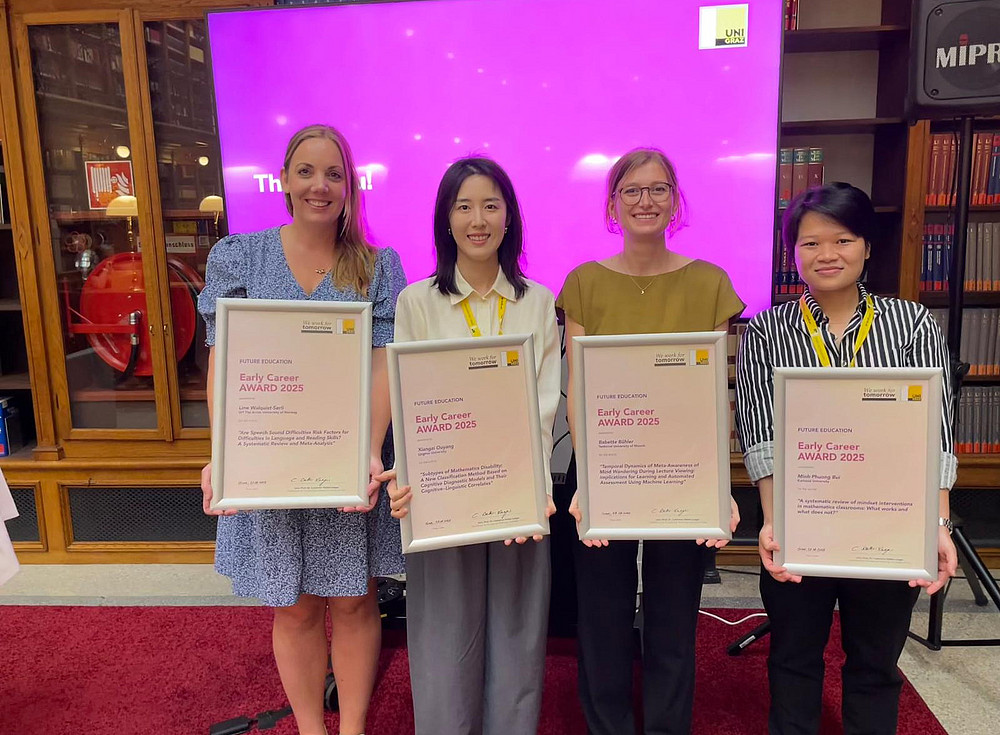
At the major EARLI conference in Graz, the FUTURE EDUCATION network not only demonstrated how international and forward-looking its work is. Four young scientists were also honored with the FUTURE EDUCATION Award for their work, which showcased the great diversity of educational research.
Minh-Phuong Bui from Karlstadt University in Finland investigated which learning environments have a positive effect on mathematical thinking. She is currently working on how AI can support teachers and students
Babette Müller from the Technical University of Munich also focuses on AI and large language models (LLM) in her work. She is developing algorithms that recognize when children's minds wander in the classroom. The aim is to help teachers respond even better to children's needs.
Xiangzi Ouyang from Lingnan University in China has developed a new testing system that detects dyscalculia (i.e., math difficulties) at an earlier stage. Why? So that children can get the support they need before they feel like they are falling behind in math.
Research by Line Walquist Sørli from the Arctic University of Norway shows that children who have early language problems often find reading more difficult later on. Affected children can receive the necessary support early on to counteract reading difficulties before they develop.
Conference 2026
The award ceremony was one of the highlights of the EARLI Congress in Graz, organized by University of Graz researchers Roland Grabner and Stephan Vogel. At the end of August, around 2,500 learning and teaching researchers from a wide variety of regions met in Graz to discuss the latest scientific findings. Next year, the University of Graz will once again be the stage for educational research. The FUTURE EDUCATION research network is inviting participants to its second congress, where another Early Career Award will be presented.