Begin of page section:
Page sections:

  • Go to contents (Accesskey 1)
  • Go to position marker (Accesskey 2)
  • Go to main navigation (Accesskey 3)
  • Go to sub navigation (Accesskey 4)
  • Go to additional information (Accesskey 5)
  • Go to page settings (user/language) (Accesskey 8)
  • Go to search (Accesskey 9)

End of this page section. Go to overview of page sections

Begin of page section:
Page settings:

English en
Deutsch de
Search
Login

End of this page section. Go to overview of page sections

Begin of page section:
Search:

Search for details about Uni Graz
Close

End of this page section. Go to overview of page sections


Search

Begin of page section:
Main navigation:

Page navigation:

  • University

    University
    • About the University
    • Organisation
    • Faculties
    • Library
    • Working at University of Graz
    • Campus
    Developing solutions for the world of tomorrow - that is our mission. Our students and our researchers take on the great challenges of society and carry the knowledge out.
  • Research Profile

    Research Profile
    • Our Expertise
    • Research Questions
    • Research Portal
    • Promoting Research
    • Research Transfer
    • Ethics in Research
    Scientific excellence and the courage to break new ground. Research at the University of Graz creates the foundations for making the future worth living.
  • Studies

    Studies
    • Prospective Students
    • Students
  • Community

    Community
    • International
    • Location
    • Research and Business
    • Alumni
    The University of Graz is a hub for international research and brings together scientists and business experts. Moreover, it fosters the exchange and cooperation in study and teaching.
  • Spotlight
Topics
  • StudiGPT is here! Try it out!
  • Sustainable University
  • Researchers answer
  • Work for us
Close menu

End of this page section. Go to overview of page sections

Begin of page section:
You are here:

University of Graz News The future of learning: How the University of Graz is revolutionizing education

End of this page section. Go to overview of page sections

Thursday, 16 October 2025

The future of learning: How the University of Graz is revolutionizing education

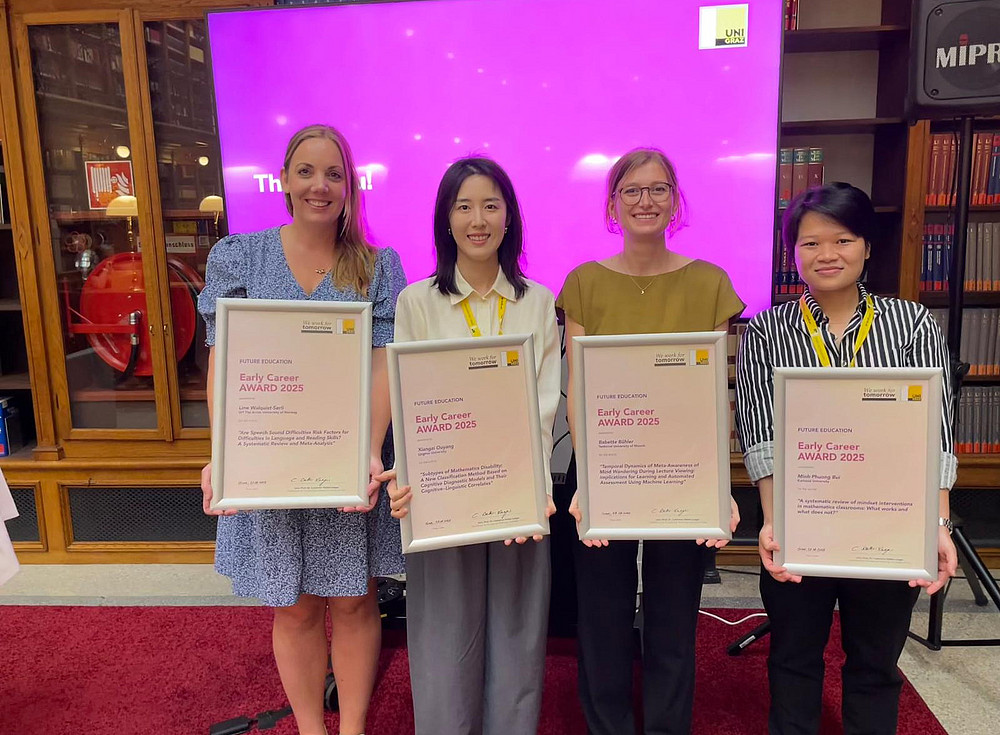
two white woman and two asian women are smiling for a photo while posing with their awards.

Line Walquist Sørli, Xiangzi Ouyang, Babette Bühler, and Minh-Phuong Bui received the Future Education Award. Photo: University of Graz/Kluger

The FUTURE EDUCATION Network at the University of Graz is conducting research into the education of tomorrow. In August, four young and innovative researchers were honored with an Early Career Award. The topics range from AI in the classroom to the early detection of dyscalculia.

When you think back to your own school days, there were teachers who were so inspiring that you still remember their lessons today - while other subjects have long been forgotten. But why is that? Shouldn't lessons be designed in such a way that they engage all children, regardless of their personal preferences, and ensure that the learning content is firmly anchored in their memories?

These are precisely the questions being explored by the FUTURE EDUCATION Network at the University of Graz. Here, researchers are investigating how interactive apps can be used to train mathematical skills and what happens in children's brains when they add, subtract, multiply, and divide. The scientists are demonstrating how important text competence is in learning to distinguish false information from correct information. In the Creative Cognition Lab, experts are investigating the neurological processes that give rise to creativity and innovation.

Young scientists honored

At the major EARLI conference in Graz, the FUTURE EDUCATION network not only demonstrated how international and forward-looking its work is. Four young scientists were also honored with the FUTURE EDUCATION Award for their work, which showcased the great diversity of educational research.

Minh-Phuong Bui from Karlstadt University in Finland investigated which learning environments have a positive effect on mathematical thinking. She is currently working on how AI can support teachers and students

Babette Müller from the Technical University of Munich also focuses on AI and large language models (LLM) in her work. She is developing algorithms that recognize when children's minds wander in the classroom. The aim is to help teachers respond even better to children's needs.

Xiangzi Ouyang from Lingnan University in China has developed a new testing system that detects dyscalculia (i.e., math difficulties) at an earlier stage. Why? So that children can get the support they need before they feel like they are falling behind in math.

Research by Line Walquist Sørli from the Arctic University of Norway shows that children who have early language problems often find reading more difficult later on. Affected children can receive the necessary support early on to counteract reading difficulties before they develop.

Conference 2026

The award ceremony was one of the highlights of the EARLI Congress in Graz, organized by University of Graz researchers Roland Grabner and Stephan Vogel. At the end of August, around 2,500 learning and teaching researchers from a wide variety of regions met in Graz to discuss the latest scientific findings. Next year, the University of Graz will once again be the stage for educational research. The FUTURE EDUCATION research network is inviting participants to its second congress, where another Early Career Award will be presented.
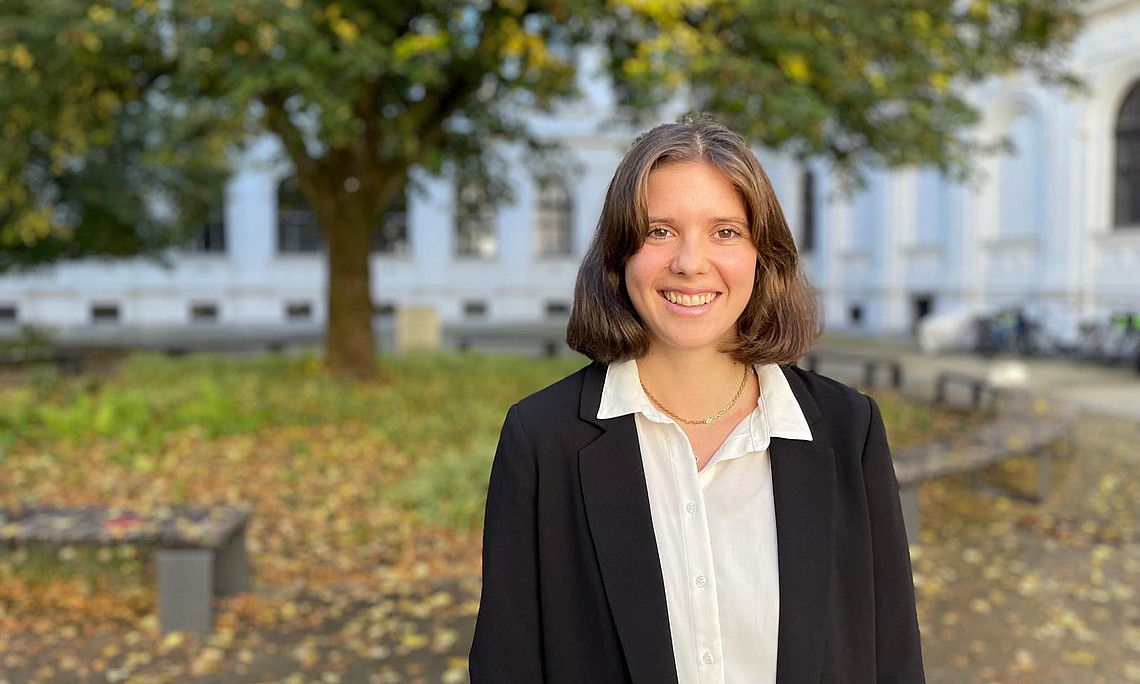
created by Roman Vilgut

Related news

Bio-plastics and baroque theatre: Awards for two researchers from the University of Graz

Chemist Katalin Barta Weissert received this year's "Forschungspreis des Landes Steiermark", while Germanist Christian Neuhuber received the "Erzherzog-Johann-Forschungspreis". The awards are endowed with 12,000 euros each and are presented for outstanding achievements in the field of science and research. Provincial Councillor Willibald Ehrenhöfer presented the awards on 7 November 2025 in the White Hall of Graz Castle.

EU supports team led by molecular biologist Brigitte Pertschy with around ten million euro

The European Research Council (ERC) is funding the snoOPERA project with around ten million euros to research the structure of cellular protein factories. The four researchers involved want to clarify how tiny RNA-protein complexes control the formation of ribosomes—a key to understanding diseases such as cancer and Alzheimer's.

Maths made easy: how gaming elements motivate children to practise

Where does the six belong on a number line from one to ten? This task is a challenge for children with dyscalculia. For fear of failure, many are reluctant to tackle the exercise in the first place. A playful approach can remove this obstacle and give the affected pupils more self-confidence, as psychologist Manuel Ninaus found out in a study.

How artificial intelligence is changing the digital future in Europe

On November 20, 2025, the Technology Impact Summit at the Seifenfabrik in Graz will bring together experts from politics, business, and science. The focus will be on how artificial intelligence is transforming our working world and which specific AI solutions are already being used successfully today.

Begin of page section:
Additional information:

University of Graz
Universitaetsplatz 3
8010 Graz
Austria
  • Contact
  • Web Editors
  • Moodle
  • UNIGRAZonline
  • Imprint
  • Data Protection Declaration
  • Accessibility Declaration
Weatherstation
Uni Graz

End of this page section. Go to overview of page sections

End of this page section. Go to overview of page sections

Begin of page section:

End of this page section. Go to overview of page sections