Begin of page section:
Page sections:

  • Go to contents (Accesskey 1)
  • Go to position marker (Accesskey 2)
  • Go to main navigation (Accesskey 3)
  • Go to sub navigation (Accesskey 4)
  • Go to additional information (Accesskey 5)
  • Go to page settings (user/language) (Accesskey 8)
  • Go to search (Accesskey 9)

End of this page section. Go to overview of page sections

Begin of page section:
Page settings:

English en
Deutsch de
Search
Login

End of this page section. Go to overview of page sections

Begin of page section:
Search:

Search for details about Uni Graz
Close

End of this page section. Go to overview of page sections


Search

Begin of page section:
Main navigation:

Page navigation:

  • University

    University
    • About the University
    • Organisation
    • Faculties
    • Library
    • Working at University of Graz
    • Campus
    Developing solutions for the world of tomorrow - that is our mission. Our students and our researchers take on the great challenges of society and carry the knowledge out.
  • Research Profile

    Research Profile
    • Our Expertise
    • Research Questions
    • Research Portal
    • Promoting Research
    • Research Transfer
    • Ethics in Research
    • Commission for Scientific Integrity
    Scientific excellence and the courage to break new ground. Research at the University of Graz creates the foundations for making the future worth living.
  • Studies

    Studies
    • Prospective Students
    • Students
    • Registration for Study Programme (Winter semester 2026/27)
    • Study Days 22-26 June 2026
  • Community

    Community
    • International
    • Location
    • Research and Business
    • Alumni
    The University of Graz is a hub for international research and brings together scientists and business experts. Moreover, it fosters the exchange and cooperation in study and teaching.
Topics
  • Sustainable University
  • Researchers answer
  • Work for us
Close menu

End of this page section. Go to overview of page sections

Begin of page section:
You are here:

University of Graz News Zukunft des Buches

End of this page section. Go to overview of page sections

Friday, 09 July 2021

Zukunft des Buches

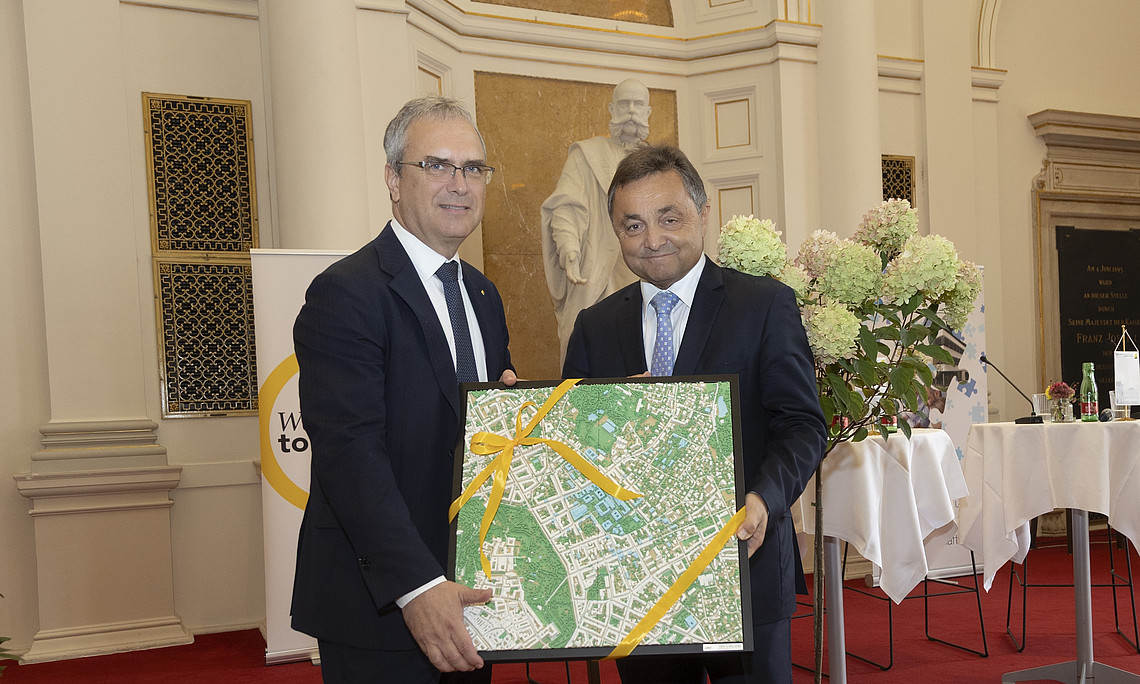
UB-Leiterin Pamela Stückler (links) mit den GewinnerInnen und den Verantwortlichen der Umfrage. Foto: Uni Graz/Tzivanopoulos

UB-Leiterin Pamela Stückler (links) mit den GewinnerInnen und den Verantwortlichen der Umfrage. Foto: Uni Graz/Tzivanopoulos

Umfrage unter Studierenden ergab: E-Book-NutzerInnen haben sich seit 2013 mehr als verdoppelt

Die Bibliothek ständig mit dabei. Kein nervenaufreibendes Warten auf ein begehrtes Exemplar, keine vollgekritzelten Lehrbücher, Buchdeckel ohne Kaffeeflecken: E-Books haben Vorteile. Klar, der Geruch von Papier und Druckerschwärze fehlt, das Umblättern ist obsolet, aber dafür gibt es einen Zugriff rund um die Uhr. Die Bibliothek der Universität Graz (UB Graz) stellt mehr als 420.000 Stück zur Verfügung. Tendenz steigend. Grund genug unter den Studierenden einmal nachzufragen, wie sie es mit dem Medium so halten. Fazit: Die Studierenden wünschen sich ein vergrößertes Angebot an deutschsprachigen Lehrbüchern und spezifischer wissenschaftlicher Literatur.

Seit der letzten Umfrage 2013 hat sich die Nutzung elektronischer Bücher von rund 42 Prozent auf heute 88 Prozent verdoppelt. Das liegt darin, dass sich die mobilen Endgeräte wie Smartphones und Tablets etabliert haben. Auch die zunehmende Digitalisierung sowie der Komfort, E-Books einfach zu durchsuchen, spielen eine Rolle. Andererseits setzt die UB Graz auf dem Weg zu einer digitalen Universität in der Literaturbeschaffung immer mehr auf elektronische Lösungen.

E-Books können von mehreren LeserInnen gleichzeitig genutzt werden. Es spart wertvollen Lagerplatz in den Bibliotheks-Magazinen und ist schnell und ohne viel Aufwand im System auffindbar. „Ich freue mich, dass das Ergebnis der Umfrage die Strategie der Universitätsbibliothek der vergangenen Jahre bestätigt. Nämlich E-Books – aber auch E-Journals – für die Bereiche zu erwerben, in denen es nachhaltig, sinnvoll und finanzierbar ist“, sagt Pamela Stückler, Leiterin der UB Graz. „Es wird jedoch auch in Zukunft Bereiche geben, in denen es durchaus Sinn macht, dem physischen Exemplar den Vorzug zu geben“, betont sie.

Die Umfrage wurde von drei Studierenden im Rahmen des Universitätslehrganges „Library and Information Studies“ gestaltet, durchgeführt und auch ausgewertet. Als Anreiz für die Teilnahme an der Umfrage hat die UB Graz unter allen Mitmachenden Preise – gesponsert vom Verlag De Gruyter – verlost. Der Hauptgewinn, ein Lenovo-Tablet, und Kaffeehausgutscheine wurden Anfang Juli an die Gewinnerinnen übergeben.

Mehr Informationen unter https://ub.uni-graz.at/de/recherche/e-ressourcen/
created by Konstantin Tzivanopoulos

Related news

Getting even hotter: Researchers predict global warming of 1.7 degrees by 2027

While Europe is currently sweltering in the heat, global temperatures are also rising towards concerning record levels. In 2026, Earth’s surface air temperature is expected to reach 1.62 degrees, and in 2027 even 1.71 degrees Celsius above pre-industrial levels. The long-term temperature rise – an average over a 20-year period – is predicted to exceed the 1.5-degree threshold of the Paris Agreement as of 2026 already. For the first time, researchers at the University of Graz have been able to make such a forecast so far in advance. The intensifying El Niño climate event favors forecast skill and thereby facilitates a reliable computation.

Forest fire at Rosenhain: Volunteer fire brigade carried out an evacuation drill at the Jesuit refectory

Thick smoke in the stairwell, flames at the edge of the forest, people missing in the Jesuit refectory at the University of Graz: at Rosenhain, the Graz Volunteer Fire Brigade carried out a drill simulating a scenario that is becoming increasingly realistic given the heat and drought

Full effort in the heat: the Sports Centre was in full swing at the Kleeblattlauf

On 19 June 2026, 2,000 runners and hundreds of supporters made their way to the Rosenhain for a sporting end-of-term event.

Save, invest or guarantee: What Austrians expect from the state

Austria needs to make savings. But where? And what should the Republic actually be spending its money on? The answers are provided by the initial findings of a major study involving the University of Graz. 99 per cent of those surveyed are in favour of the state ensuring healthcare provision. Almost three-quarters would like to see more public funding for education, whilst only around three per cent are in favour of cuts in this sector.

Begin of page section:
Additional information:

University of Graz
Universitaetsplatz 3
8010 Graz
Austria
  • Contact
  • Web Editors
  • Moodle
  • UNIGRAZonline
  • Imprint
  • Data Protection Declaration
  • Accessibility Declaration
Weatherstation
Uni Graz

End of this page section. Go to overview of page sections

End of this page section. Go to overview of page sections

Begin of page section:

End of this page section. Go to overview of page sections