


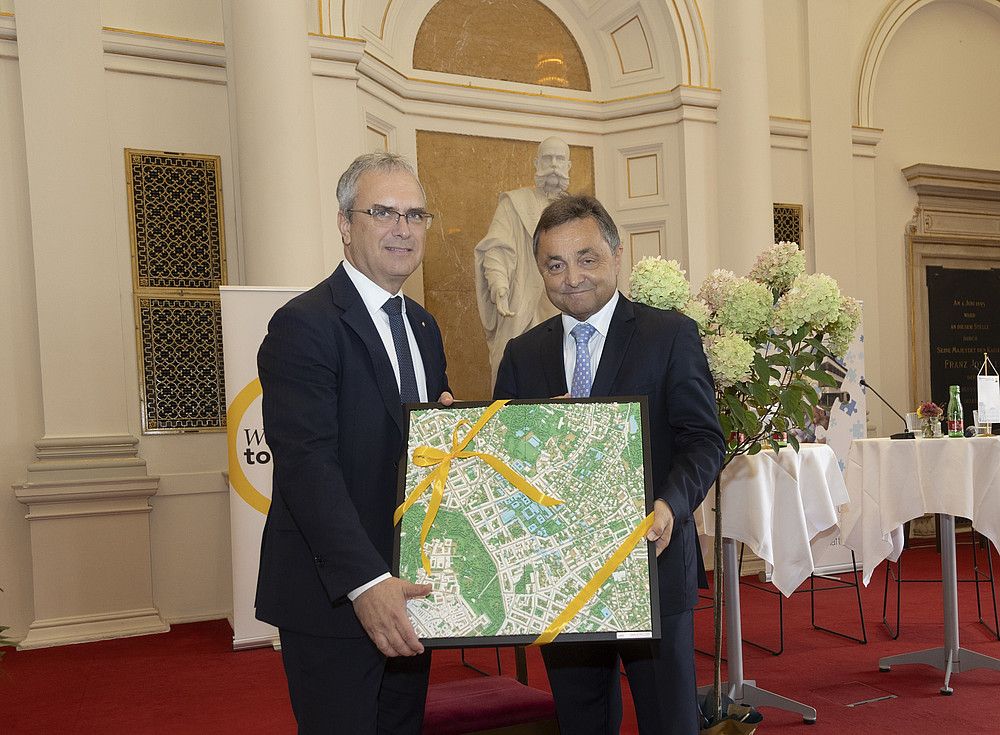
Alfred Gutschelhofer was a pioneer. One of the key tasks during his tenure as Vice-Chancellor was the implementation of the new university autonomy under the Universities Act 2002. This required the establishment of management tools, the reorganisation of responsibilities and the creation of modern organisational structures. “Those who are granted greater freedom must also take on greater responsibility. The crucial question is whether this basic model is robust enough to meet the challenges of tomorrow. To achieve this, universities must engage even more with the wider world,” he emphasised. During a ceremonial symposium on 9 October, the economist bid farewell as he entered his well-deserved retirement. “One of his greatest achievements was leading the University of Graz into a new era. Moving away from tradition and into a new age. The university as a partner in life with a clear role in society,” said Peter Riedler, Rector of the University of Graz, in his welcoming address, paying tribute to Alfred Gutschelhofer.
Just how topical this aspiration is was also demonstrated by the keynote address from Christoph Badelt, the current President of the Austrian Fiscal Council and former Rector of the Vienna University of Economics and Business. This exchange is particularly relevant in light of the debate on the funding of public services and necessary investments for the future, including in the tertiary education sector.
“Universities are competing”
Badelt made a number of remarks in his keynote address that caught the audience’s attention. The President of the Fiscal Council emphasised that, in any case, something must change at universities. They are increasingly competing for resources and talent and must prepare for a necessary course of consolidation. There is no way around this. At the same time, he said, it was essential for them to fulfil their public service mandate and respond to the growing tasks and challenges facing people in Europe and around the world. However, this presented not only burdens but also opportunities for universities.
In addition to those who have accompanied the university on its journey, numerous representatives from the worlds of politics and higher education also offered their congratulations. Among the invited guests were, amongst others, former Provincial Councillor Kristina Edlinger-Ploder, Rector and Managing Director of FH Campus 02; Horst Bischof, Rector of Graz University of Technology; Andrea Kurz, Vice-Chancellor of the Medical University of Graz, as well as the former Vice-Chancellors of the University of Graz, Christian Brünner, Helmut Konrad and Wolf Rauch, the former Vice-Chancellor of the Medical University of Graz, Josef Smolle, and the former Vice-Chancellors of Graz University of Technology, Harald Kainz and Hans Sünkel. Also in attendance from the world of politics were former Styrian Governor Christopher Drexler, former Federal Minister Martin Polaschek, former Hessian Minister-President Volker Bouffier, former Federal Minister Beatrix Karl and Graz City Councillor Claudia Unger.
Internationalisation of studies, local partnerships
The years under Gutschelhofer’s leadership were also marked by far-reaching changes in studies and teaching. Under his leadership, the University of Graz implemented the Bologna Process, thereby adapting to the new European study structures. Furthermore, new organisational units were established, including the Faculty of Environmental, Regional and Educational Sciences and the so-called ‘7th Faculty’. At the same time, the Faculty of Medicine was spun off following a consensual process and has operated as an independent university since 2004.
Another key focus was on collaboration across institutional boundaries. NAWI Graz was established as a highly acclaimed collaborative project, which has gained architectural prominence through the Graz Centre of Physics. Similarly, UNI for LIFE Weiterbildungs GmbH was founded as an institution dedicated to further developing the university’s continuing education programmes.