Begin of page section:
Page sections:

  • Go to contents (Accesskey 1)
  • Go to position marker (Accesskey 2)
  • Go to main navigation (Accesskey 3)
  • Go to sub navigation (Accesskey 4)
  • Go to additional information (Accesskey 5)
  • Go to page settings (user/language) (Accesskey 8)
  • Go to search (Accesskey 9)

End of this page section. Go to overview of page sections

Begin of page section:
Page settings:

English en
Deutsch de
Search
Login

End of this page section. Go to overview of page sections

Begin of page section:
Search:

Search for details about Uni Graz
Close

End of this page section. Go to overview of page sections


Search

Begin of page section:
Main navigation:

Page navigation:

  • University

    University
    • About the University
    • Organisation
    • Faculties
    • Library
    • Working at University of Graz
    • Campus
    Developing solutions for the world of tomorrow - that is our mission. Our students and our researchers take on the great challenges of society and carry the knowledge out.
  • Research Profile

    Research Profile
    • Our Expertise
    • Research Questions
    • Research Portal
    • Promoting Research
    • Research Transfer
    • Ethics in Research
    • Commission for Scientific Integrity
    Scientific excellence and the courage to break new ground. Research at the University of Graz creates the foundations for making the future worth living.
  • Studies

    Studies
    • Prospective Students
    • Students
    • Registration for Study Programme (Winter semester 2026/27)
    • Welcome Weeks for First Year Students
  • Community

    Community
    • International
    • Location
    • Research and Business
    • Alumni
    The University of Graz is a hub for international research and brings together scientists and business experts. Moreover, it fosters the exchange and cooperation in study and teaching.
Topics
  • Sustainable University
  • Researchers answer
  • Work for us
Close menu

End of this page section. Go to overview of page sections

Begin of page section:
You are here:

University of Graz News Discussions on Europe’s digital future are taking place in Graz

End of this page section. Go to overview of page sections

Wednesday, 12 August 2026

Discussions on Europe’s digital future are taking place in Graz

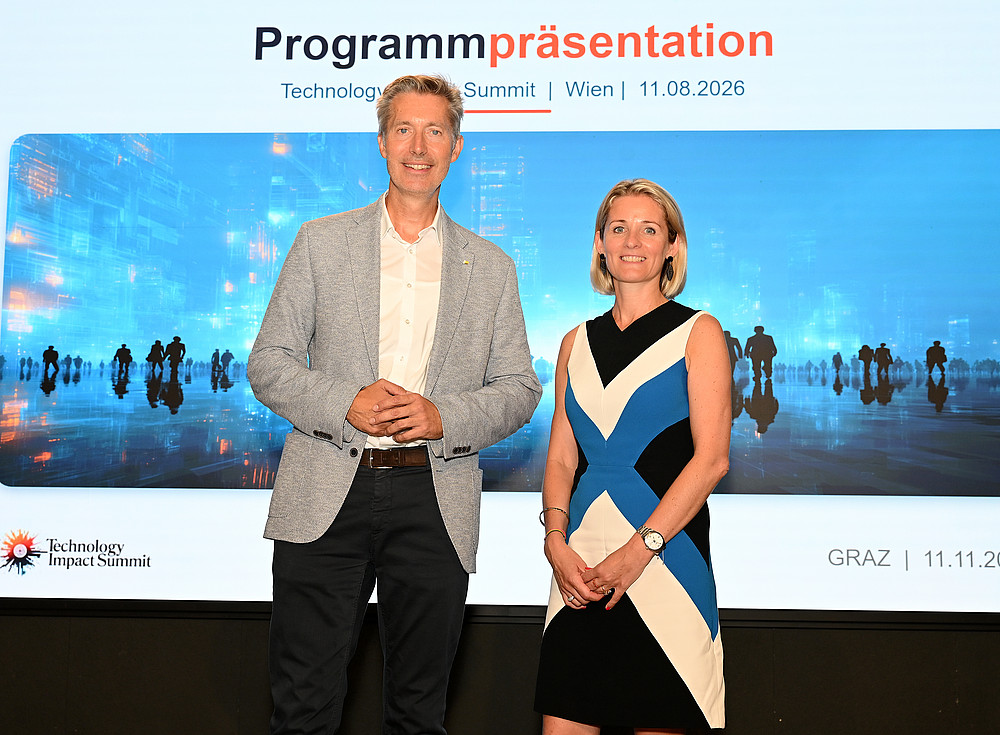
A man in a grey blazer and a woman in a black, blue and white dress are standing, smiling, in front of a screen bearing the words ‘Technology Impact Summit Programme Presentation’.

Vice-Rector Markus Fallenböck and Events Manager Magdalena Hankus at the presentation of the TIS 2026 programme. Photo: Leissure Communication/Jobst

Exactly three months before the event, the Technology Impact Summit (TIS) team is unveiling the programme for this year’s think tank event.

Since the beginning of August, many people have become increasingly aware of just how much artificial intelligence has become part of everyday life: the European Union’s labelling requirement makes it clear that large swathes of advertising are no longer created by humans. However, this is just one of many aspects of the European Union’s AI Act, which is intended to regulate the use of a technology that, despite its ubiquity, is still at an early stage of development. The third edition of the Technology Impact Summit, taking place on 11 November 2026 in Graz under the title ‘Europe’s Digital Future – Between Sovereignty, Security and the AI Race’, will discuss where this journey is heading and how Europe can position itself.

On Tuesday evening, Markus Fallenböck (University of Graz) and Magdalena Hankus (Hankus3sixty) presented the highlights of this high-profile summit, which brings together business, academia and politics as a platform for discourse.

Technology-intensive research drives prosperity

“Styria is a region of research and innovation where the future is being shaped. Technology-intensive science is the driving force behind shaping the region as a hub for economic prosperity. This is what the Technology Impact Summit stands for, bringing together the brightest minds from academia and industry. They will define the jobs of tomorrow,” said Provincial Councillor Willibald Ehrenhöfer (Province of Styria) in his welcoming address.

“The major technological questions of our time cannot be answered within a single discipline. It was from this simple conviction that the Technology Impact Summit emerged, where business, science, politics and society engage in discussion on an equal footing. Technology is transforming our world of work, our economy and our society. In Graz, we will be discussing the contribution Austria can make towards robust European sovereignty,” emphasises Fallenböck.

“Innovation arises where people, perspectives and disciplines come together. The Technology Impact Summit has proven itself as a platform for dialogue that provides direction and generates new impetus. In three months’ time, here in Graz, we will be focusing on the question of how Europe can cross the finish line as the winner in the AI race,” says Hankus.

A bold look ahead

The third edition of the Technology Impact Summit will be opened by Alexander Pröll, State Secretary for Digitalisation (Federal Chancellery), before Agnes Heftberger (Microsoft) addresses Europe’s digital future in her opening keynote. The question of how Europe can win the race will be explored in a keynote debate by, amongst others, Philipp Amann (European Central Bank), Stefan Mangard (Graz University of Technology) and Daniel Keinrath (Fonio). In an Oxford-style debate, Philipp Töbich (SAP) and Christian Winkelhofer (Accenture) will discuss the prospects for a European AI infrastructure. Futurist Tristan Horx will offer a glimpse into the world of tomorrow and the societal impact of technological developments.

Insights from science, research and practice, in the form of use cases, will also be shared with the audience in the auditorium of the University of Graz by: Andreas Diensthuber (DaphOS.ai), Martin Holler (University of Graz), Helmut Lindner (Joanneum University of Applied Sciences), Sabine Prossnegg (Joanneum University of Applied Sciences) and Christian Rechberger (Graz University of Technology). Further practical examples will be presented by Cancom, Experts Inside, EY, JOANNEUM RESEARCH, Manz and Taceo.

This think tank event will be moderated for the second time by tech insider Katrin-Cécile Ziegler.

A preview of the TIS

A preview of the inspiring lightning talks featuring successful case studies was already provided at the programme presentation in Vienna: Martin Holler (University of Graz) will present DaphoOS.ai, a groundbreaking innovation for the healthcare sector from Styria, which was developed through collaboration between industry and academia. The AI platform for decision-making, operations and resource management is just one of many exemplary use cases that will stimulate discussion at this year’s Technology Impact Summit.

More Information >> click here
Related news

Preserving cultural heritage: Graz researchers make Roman inscriptions legible again

Researchers from the University of Graz and Graz University of Technology are working to save inscriptions carved in stone in Styria during Roman times from disappearing. They have developed a simple and cost-effective method to make inscriptions on tombs and votive altars – which have been weathered or damaged – legible again. They are currently testing the method on Roman stones at several sites across Styria. The aim is to provide other historians with a tool to preserve cultural heritage when expensive research equipment is not available. The method was recently published in the research journal Heritage Science.

When the sun goes dark: Enlightening for science and the people of Graz

When the moon partially passes in front of the sun in Graz on 12 August 2026, the event will once again captivate many people. This includes Manuela Temmer, an astrophysicist at the University of Graz. The scientist confirms that this celestial phenomenon offers significant value for research: “During a solar eclipse, the corona can be observed more clearly than with any instrument.”

Courtly Love and Aubergines: What Medieval Literature Has in Common with Emojis

Plants and fruits were already used as symbols of love in the Middle Ages. German studies scholar Isabella Managò, together with her colleagues Brigitte Spreitzer-Fleck and Julia Zimmermann, explains how this came about and why this figurative language remains familiar to us to this day.

New technology from the University of Graz reveals the hidden properties of tumour cells

It sounds like science fiction, but it could advance cancer research in the future: a team at the University of Graz, led by physicist Jan Enenkel, is developing a new laboratory device using laser technology that can be used to examine individual tumour cells. The idea is reminiscent of the medical tricorder from the Star Trek film series – albeit as a high-precision measurement platform. A spin-off fellowship from the Austrian Research Promotion Agency (FFG) is supporting the development of the technology at the University of Graz with around 500,000 euros.

Begin of page section:
Additional information:

University of Graz
Universitaetsplatz 3
8010 Graz
Austria
  • Contact
  • Web Editors
  • Moodle
  • UNIGRAZonline
  • Imprint
  • Data Protection Declaration
  • Accessibility Declaration
Weatherstation
Uni Graz

End of this page section. Go to overview of page sections

End of this page section. Go to overview of page sections

Begin of page section:

End of this page section. Go to overview of page sections