Begin of page section:
Page sections:

  • Go to contents (Accesskey 1)
  • Go to position marker (Accesskey 2)
  • Go to main navigation (Accesskey 3)
  • Go to sub navigation (Accesskey 4)
  • Go to additional information (Accesskey 5)
  • Go to page settings (user/language) (Accesskey 8)
  • Go to search (Accesskey 9)

End of this page section. Go to overview of page sections

Begin of page section:
Page settings:

English en
Deutsch de
Search
Login

End of this page section. Go to overview of page sections

Begin of page section:
Search:

Search for details about Uni Graz
Close

End of this page section. Go to overview of page sections


Search

Begin of page section:
Main navigation:

Page navigation:

  • University

    University
    • About the University
    • Organisation
    • Faculties
    • Library
    • Working at University of Graz
    • Campus
    Developing solutions for the world of tomorrow - that is our mission. Our students and our researchers take on the great challenges of society and carry the knowledge out.
  • Research Profile

    Research Profile
    • Our Expertise
    • Research Questions
    • Research Portal
    • Promoting Research
    • Research Transfer
    • Ethics in Research
    • Commission for Scientific Integrity
    Scientific excellence and the courage to break new ground. Research at the University of Graz creates the foundations for making the future worth living.
  • Studies

    Studies
    • Prospective Students
    • Students
    • Registration for Study Programme (Winter semester 2026/27)
    • Study Days 22-26 June 2026
  • Community

    Community
    • International
    • Location
    • Research and Business
    • Alumni
    The University of Graz is a hub for international research and brings together scientists and business experts. Moreover, it fosters the exchange and cooperation in study and teaching.
Topics
  • Sustainable University
  • Researchers answer
  • Work for us
Close menu

End of this page section. Go to overview of page sections

Begin of page section:
You are here:

University of Graz News Science meets blockbuster: Campus cinema at the University of Graz

End of this page section. Go to overview of page sections

Monday, 22 June 2026

Science meets blockbuster: Campus cinema at the University of Graz

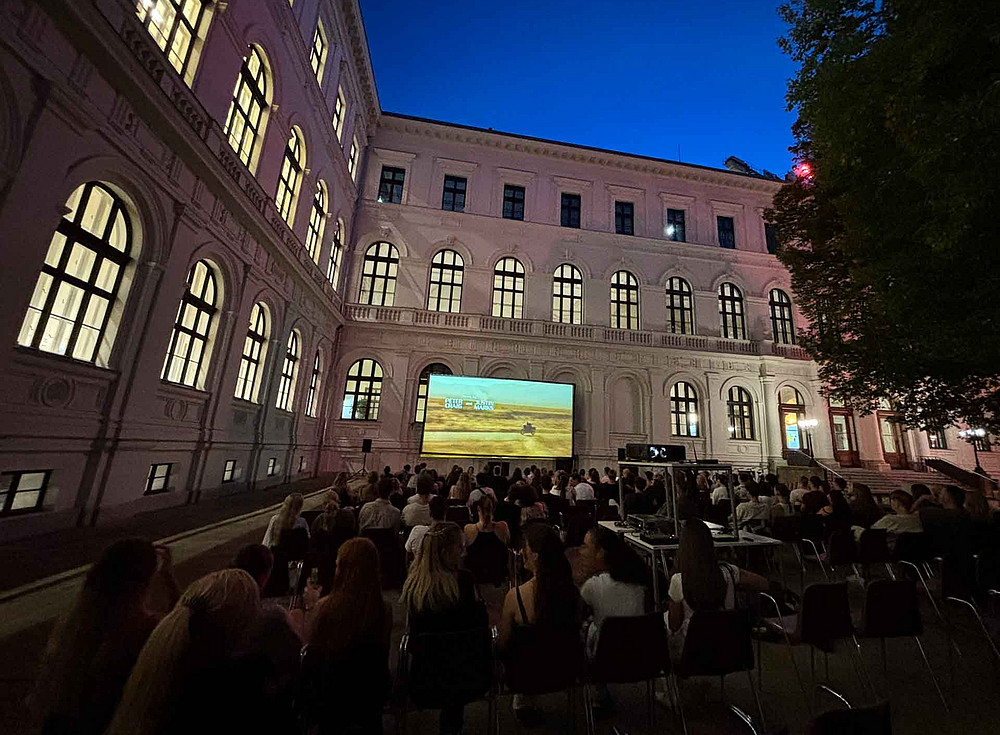
In the evenings, many young adults sit on chairs in the courtyard in front of a screen and watch a film, surrounded by a historic building. ©Uni Graz/Schweiger

For two weeks, the courtyard of the university’s main building is transformed into one of the city’s most beautiful open-air cinemas. Photo: Uni Graz/Schweiger

A cinematic treat for the scientific community: the courtyard of the University of Graz’s main building is once again being transformed into an atmospheric open-air cinema this year. From 29 June to 10 July 2026 (Mondays to Fridays from 8.30 pm), blockbusters and documentaries will be shown on the open-air screen. Academics from the University of Graz will be taking a closer look at the films shown, examining them to distinguish fact from fiction.

In the introduction to “Jurassic World: A New Age” (9 July), molecular biologist Kai-Uwe Fröhlich explains whether dinosaurs and mammoths could really be brought back to life.
Sociologist Karin Scaria-Braunstein provides an introduction to the courtroom drama “She Says. He Says.” by Ferdinand von Schirach (2 July) and explains how our society deals with conflict.
Each episode is presented by Fritz Treiber, molecular biologist and nutrition expert on the ORF programme “Studio 2”.

The finale on 10 July will be presented by Treiber and historian Margit Linder with a new episode of “Science & Cinema”. They will explore the facts and fiction in films centred on ancient Greece. Excerpts from “Alexander”, “Asterix at the Olympic Games” and “Troy” will be shown.

In the event of bad weather, the Campus Cinema will be moved to the Alumni Lecture Theatre (Library).
The full film programme and tickets (€6) are available at: https://campus-kino.uni-graz.at

A leading role for research

A recent study by the University of Graz confirms that cinema, when combined with science, offers added value. Researchers from the 7th Faculty, the Centre for Society, Knowledge and Communication, demonstrate that conveying knowledge through films can positively influence understanding of scientific topics. 
The study was carried out as part of two events in the University of Graz’s ‘Science & Cinema’ series in 2022. During these events, geophysicist Ulrich Foelsche explored climate change using selected films, including clips from “The Day After Tomorrow”, “A.I.” and “Mad Max”.

The audience was surveyed before and after the events; their responses formed the basis for the analysis carried out by an interdisciplinary research team. Author Hildrun Walter summarises: “The film sequences, with their music, powerful imagery and gripping plots, evoke emotions; this can be harnessed as a learning opportunity for often complex content.” On the one hand, they capture the audience’s attention; on the other, the impressions encourage people to actively question the facts.
The conclusion: most visitors felt better informed after the event and were better able to assess the background to climate change. “Cinema becomes a vehicle for science and, at the same time, opens up new target audiences,” the researcher emphasises.
The publication has appeared in the Journal of Science Communication.
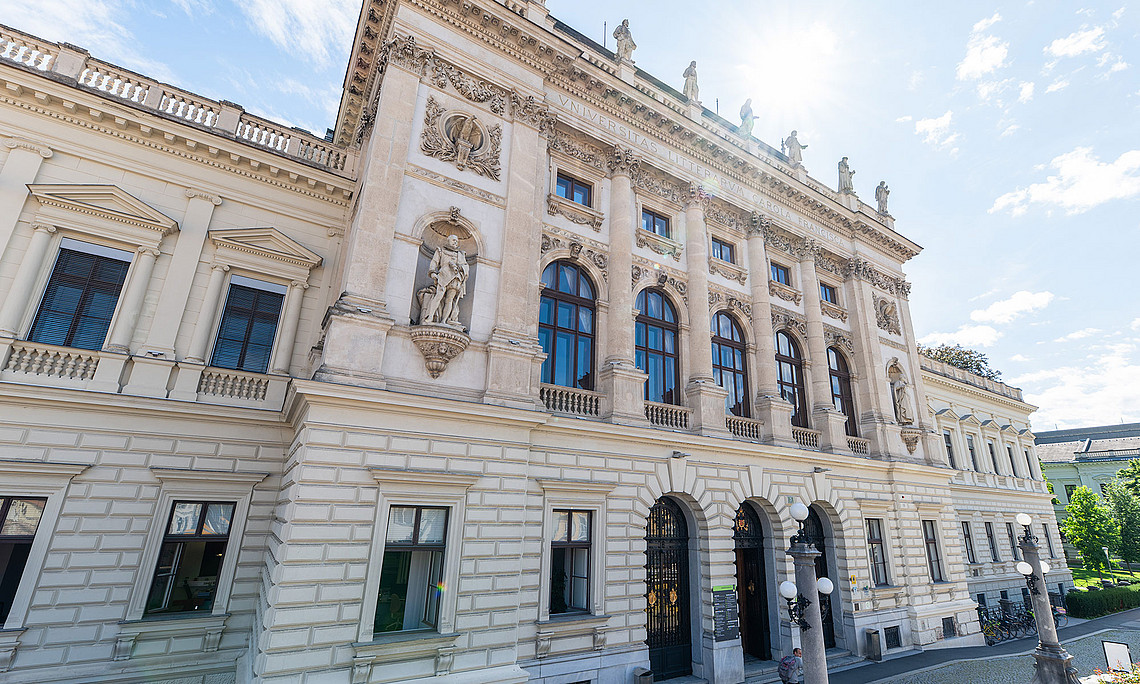

created by Andreas Schweiger

Related news

Full effort in the heat: the Sports Centre was in full swing at the Kleeblattlauf

On 19 June 2026, 2,000 runners and hundreds of supporters made their way to the Rosenhain for a sporting end-of-term event.

Save, invest or guarantee: What Austrians expect from the state

Austria needs to make savings. But where? And what should the Republic actually be spending its money on? The answers are provided by the initial findings of a major study involving the University of Graz. 99 per cent of those surveyed are in favour of the state ensuring healthcare provision. Almost three-quarters would like to see more public funding for education, whilst only around three per cent are in favour of cuts in this sector.

Complying with the norm: Why Do Standards Shape Our Lives, Elisabeth Staudegger?

Standards determine whether a sheet of paper fits in a printer or whether a charging plug can power multiple devices. These standards shape our everyday lives. But who actually sets these standards? Where are the weaknesses, and how could science help to improve them? Elisabeth Staudegger, Head of the ‘Law and IT’ Department at the Institute for Legal Foundations at the University of Graz, host the Academic Standards Day on 16 June. Here she relays how sciences can contribute to the topic of standardisation and reveals her personal favourite standard.

More body awareness than a culture war

In Italy, sex education lessons will in future only be permitted with parental consent, and will be banned entirely in nurseries and primary schools. At the same time, Pride Month highlights why knowledge about the body, relationships, boundaries and diversity is important for young people. A study by the University of Graz shows how important knowledge about the body, contraception, relationship skills and protection against violence is

Begin of page section:
Additional information:

University of Graz
Universitaetsplatz 3
8010 Graz
Austria
  • Contact
  • Web Editors
  • Moodle
  • UNIGRAZonline
  • Imprint
  • Data Protection Declaration
  • Accessibility Declaration
Weatherstation
Uni Graz

End of this page section. Go to overview of page sections

End of this page section. Go to overview of page sections

Begin of page section:

End of this page section. Go to overview of page sections