Begin of page section:
Page sections:

  • Go to contents (Accesskey 1)
  • Go to position marker (Accesskey 2)
  • Go to main navigation (Accesskey 3)
  • Go to sub navigation (Accesskey 4)
  • Go to additional information (Accesskey 5)
  • Go to page settings (user/language) (Accesskey 8)
  • Go to search (Accesskey 9)

End of this page section. Go to overview of page sections

Begin of page section:
Page settings:

English en
Deutsch de
Search
Login

End of this page section. Go to overview of page sections

Begin of page section:
Search:

Search for details about Uni Graz
Close

End of this page section. Go to overview of page sections


Search

Begin of page section:
Main navigation:

Page navigation:

  • University

    University
    • About the University
    • Organisation
    • Faculties
    • Library
    • Working at University of Graz
    • Campus
    Developing solutions for the world of tomorrow - that is our mission. Our students and our researchers take on the great challenges of society and carry the knowledge out.
  • Research Profile

    Research Profile
    • Our Expertise
    • Research Questions
    • Research Portal
    • Promoting Research
    • Research Transfer
    • Ethics in Research
    • Commission for Scientific Integrity
    Scientific excellence and the courage to break new ground. Research at the University of Graz creates the foundations for making the future worth living.
  • Studies

    Studies
    • Prospective Students
    • Students
    • Registration for Study Programme (Winter semester 2026/27)
  • Community

    Community
    • International
    • Location
    • Research and Business
    • Alumni
    The University of Graz is a hub for international research and brings together scientists and business experts. Moreover, it fosters the exchange and cooperation in study and teaching.
Topics
  • Sustainable University
  • Researchers answer
  • Work for us
Close menu

End of this page section. Go to overview of page sections

Begin of page section:
You are here:

University of Graz News Wie wir wählen wollen

End of this page section. Go to overview of page sections

Wednesday, 21 October 2015

Wie wir wählen wollen

Das interdisziplinäre Projekt „Parallelwahl“ testeste rund um die steirische Landtagswahl Ende Mai 2015 sowie auch bei der HochschülerInnenschaftswahl an der Uni Graz das Wahlverfahren. Foto: pixabay.com

Das interdisziplinäre Projekt „Parallelwahl“ testeste rund um die steirische Landtagswahl Ende Mai 2015 sowie auch bei der HochschülerInnenschaftswahl an der Uni Graz das Wahlverfahren. Foto: pixabay.com

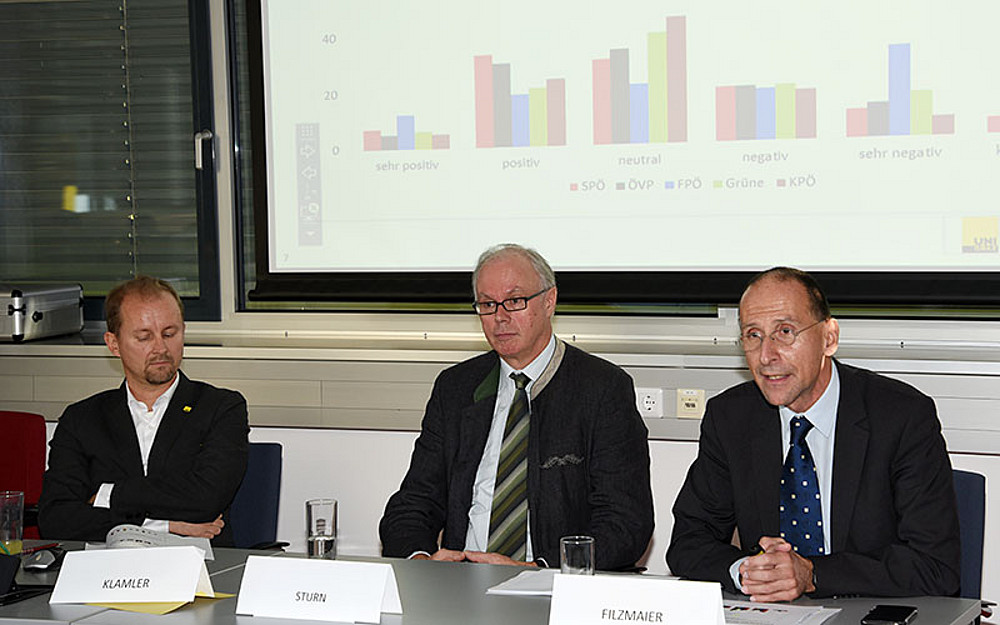
Christian Klamler, Richard Sturn und Peter Filzmaier (v.l.) präsentierten die Ergebnisse des Projekts Parallelwahl. Foto: Uni Graz/Pichler

Christian Klamler, Richard Sturn und Peter Filzmaier (v.l.) präsentierten die Ergebnisse des Projekts Parallelwahl. Foto: Uni Graz/Pichler

Forscher der Uni Graz präsentierten Projekt zu Wahlverfahren und Zufriedenheit mit der Stimmabgabe

Wer in der steirischen Landtagswahl seine Stimme abgegeben hat, musste sich mittels Ankreuzen für eine einzige Partei entscheiden und die restlichen Parteien ablehnen. So ist das Wahlrecht in Österreich. Doch sind wir wirklich mit der gewählten Partei hundertprozentig einverstanden? Gibt es nicht viele SteirerInnen, die auch anderen Parteien teilweise zustimmen? Empfinden die Wahlberechtigten das jetzige Verfahren der Stimmabgabe als gut? Oder wäre die demokratiepolitische Zufriedenheit bei anderen Wahlrechtsformen höher?

Dass Wahlen ganz anders abgewickelt werden können, das testete das interdisziplinäre Projekt „Parallelwahl“ der Karl Franzens-Universität Graz rund um die steirische Landtagswahl Ende Mai 2015 sowie auch bei der HochschülerInnenschaftswahl an der Universität selbst. So konnten die WählerInnen neben ihrer „normalen“ Stimmabgabe beispielsweise die Parteien mittels Platzziffer reihen oder eine Gesamtpunktezahl nach Belieben an eine oder verteilt auf mehrere Listen vergeben.

Das Projekt, das vom Institut für Finanzwissenschaft und Öffentliche Wirtschaft der Uni Graz durchgeführt wird, hat dafür auch am Tag der Landtagswahl eine „exit poll“ als persönliche Befragung von rund 1000 WählerInnen beim Verlassen des Wahllokals durchgeführt.
Die Ergebnisse dieser Erhebung präsentierten die Projektleiter Univ.-Prof. Dr. Richard Sturn und Ao.Univ.-Prof. Dr. Christian Klamler gemeinsam mit Univ.-Prof. Dr. Peter Filzmaier, Wahlforscher und Professor für Politische Kommunikation an der Uni Graz, am 21. Oktober 2015 im Rahmen einer Pressekonferenz.

Das interdisziplinäre Projekt „Parallelwahl“ beschäftigt sich generell mit den fundamentalen Herausforderungen in der Analyse kollektiver Entscheidungen und dem Design von Auswahlverfahren wie Wahlregeln. Im Speziellen geht es darum, basierend auf den individuellen Bewertungen verschiedener Alternativen (Präferenzen) durch Mitglieder einer Gruppe eine Gruppenentscheidung zu finden, wie etwa die „beste“ Alternative oder eine kollektive Reihung der Alternativen. Dies ist insofern wichtig, als zahlreiche Entscheidungen über ökonomische, soziale oder eben politische Materien in und durch Gruppen getroffen werden.

Außergewöhnliche Fragestellungen, nicht alltägliche Zugänge und wenig behandelte Themen – „unkonventionelle Forschung“ ist im Rahmen der gleichnamigen Initiative der Karl-Franzens-Universität Graz gefragt. „Parallelwahl“ ist eines von fünf Projekten, die aus über 80 eingereichten Vorhaben ausgewählt wurden.
created by Andreas Schweiger

Related news

Sport beyond the World Cup: the TV channel “Welt der Wunder” features diabetes research from the University of Graz

Keeping blood sugar levels in check during physical exertion is a particular challenge for people with type 1 diabetes. Othmar Moser examines how those affected manage to balance physical activity, sport and their metabolic disorder.

"Mathematics explains the world"

How can life be quantified? And what can science reveal that remains hidden from the naked eye? The 14th European Conference on Mathematical and Theoretical Biology at the University of Graz is dedicated to these questions. From 13 to 17 July, around 1,300 researchers from all over the world will gather on campus to discuss models, biological processes and the future of data-driven medicine. Klemens Fellner, Dean of the Faculty of Natural Sciences and Mathematics and a mathematician, talks about the language that explains the world

Internationally up-to-date: University of Graz offers new degree programmes in art studies

From the Old Masters to AI art – three newly designed degree programmes offer students at the University of Graz fresh perspectives on artistic production. In addition to historical art, the programmes place a greater emphasis on contemporary and global developments. The registration period is open.

The Nazi elite school Napola: Historian seeks memories and personal documents

They were to be brought up to become the future elite of National Socialism: boys and girls aged ten and over who, following the ‘Anschluss’ of Austria to the German Reich, attended a so-called Napola (short for Nationalpolitische Lehranstalt; also known as NPEA, Nationalpolitische Erziehungsanstalt). There were nine such institutions in what is now Austria between 1939 and 1945.

Begin of page section:
Additional information:

University of Graz
Universitaetsplatz 3
8010 Graz
Austria
  • Contact
  • Web Editors
  • Moodle
  • UNIGRAZonline
  • Imprint
  • Data Protection Declaration
  • Accessibility Declaration
Weatherstation
Uni Graz

End of this page section. Go to overview of page sections

End of this page section. Go to overview of page sections

Begin of page section:

End of this page section. Go to overview of page sections