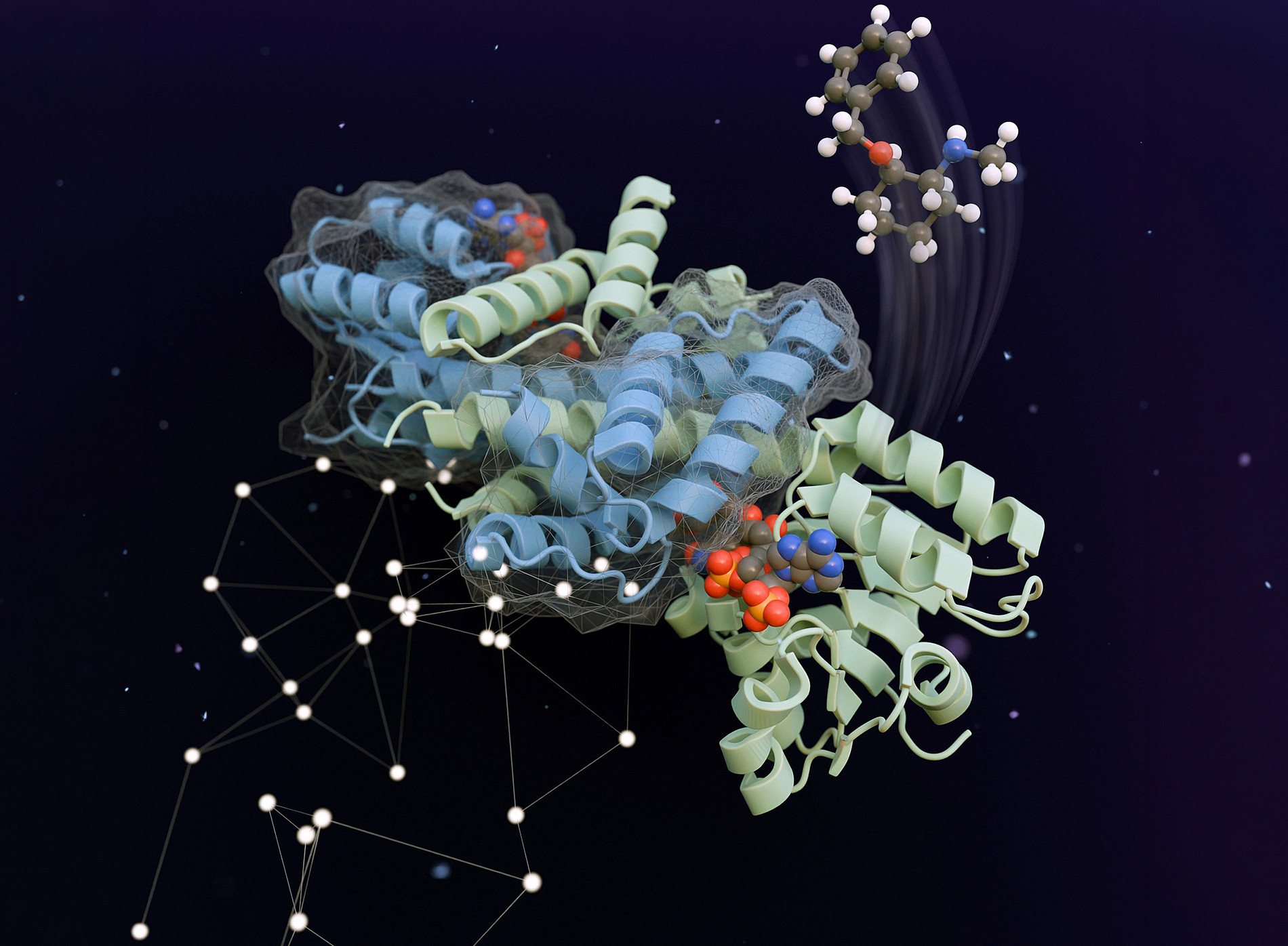



Over 90 per cent of the best-selling medicines today contain nitrogen, and almost half of them feature a chiral amine structure. This means that the molecules exist in two mirror-image variants. For the efficacy and safety of a medicine, it is crucial to produce only one of the two forms during manufacture, as the other may be less effective or even harmful to health.
In the search for biocatalysts for a key chemical reaction in the production of chiral amines, Jörg Schrittwieser and his team at the University of Graz, in collaboration with the Swiss pharmaceutical company F. Hoffmann–La Roche AG and the Graz-based bioinformatics firm Innophore, systematically investigated 175 different enzymes – known as imine reductases (IREDs). “It became apparent that significantly more enzymes than previously assumed can be successfully utilised under industrially relevant conditions. Some of the most efficient IREDs also proved to be exceptionally versatile and were able to convert a broad range of different starting materials,” reports Schrittwieser.
The large volume of experimentally obtained data – collected in nearly 28,000 individual reactions – was subsequently used to predict, with the aid of machine learning, which IREDs might also be suitable for starting materials that had not yet been tested. The results were confirmed experimentally. The time saved through the use of AI is certainly significant: “Collecting the original training dataset had taken over two years and yielded fewer than 25 per cent hits, that is, successful reactions. Based on the machine predictions, we were able to synthesise four target molecules in just four weeks. Instead of having to test the entire collection of 175 IREDs for each compound, it was sufficient to examine 15 enzymes in each case, and the hit rate was 77 per cent,” summarises Schrittwieser, adding: “In addition to the fundamental suitability of the IREDs for the target reaction, we were also able to predict which mirror-image form of the product is preferentially generated.” Selected reactions were also tested on a larger scale and delivered the desired products in high yields and with excellent purity.
The study results and the entire dataset are freely available for further research and could become an internationally utilised tool for accelerating the development of this class of enzymes and, consequently, of new drug structures.
Publication
Data-driven construction of an imine reductase library capable of broad-scope reductive amination at equimolar substrate concentrations
https://doi.org/10.1038/s41467-026-76869-7
Published dataset
https://doi.org/10.17632/jn4sfsrz8x.2