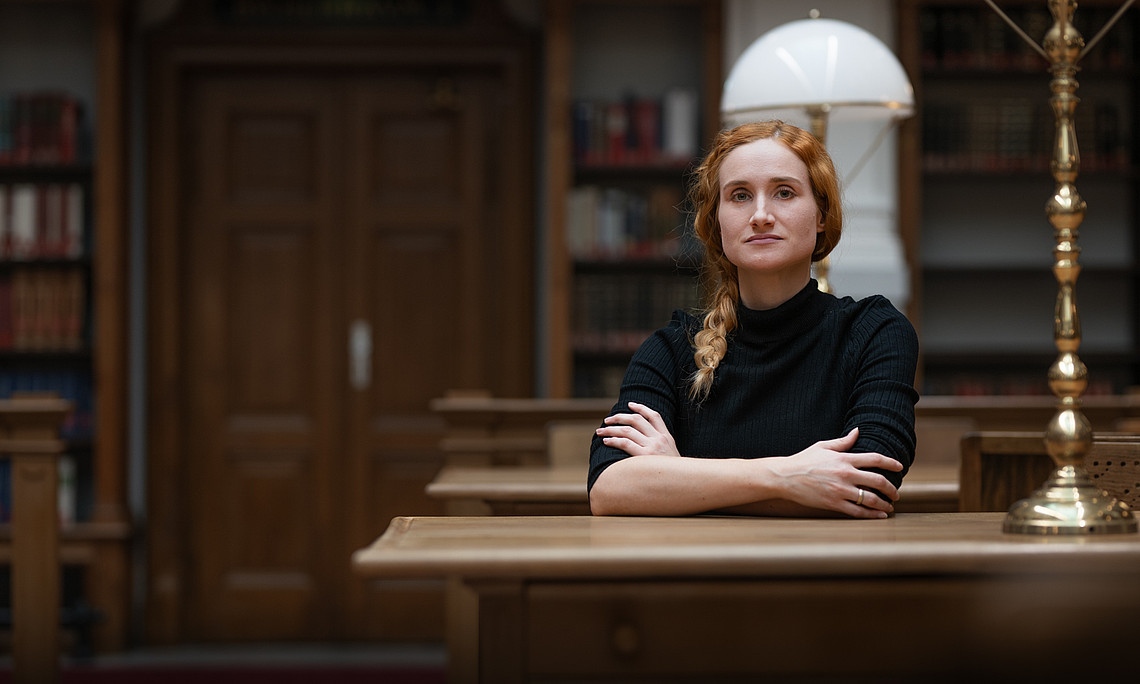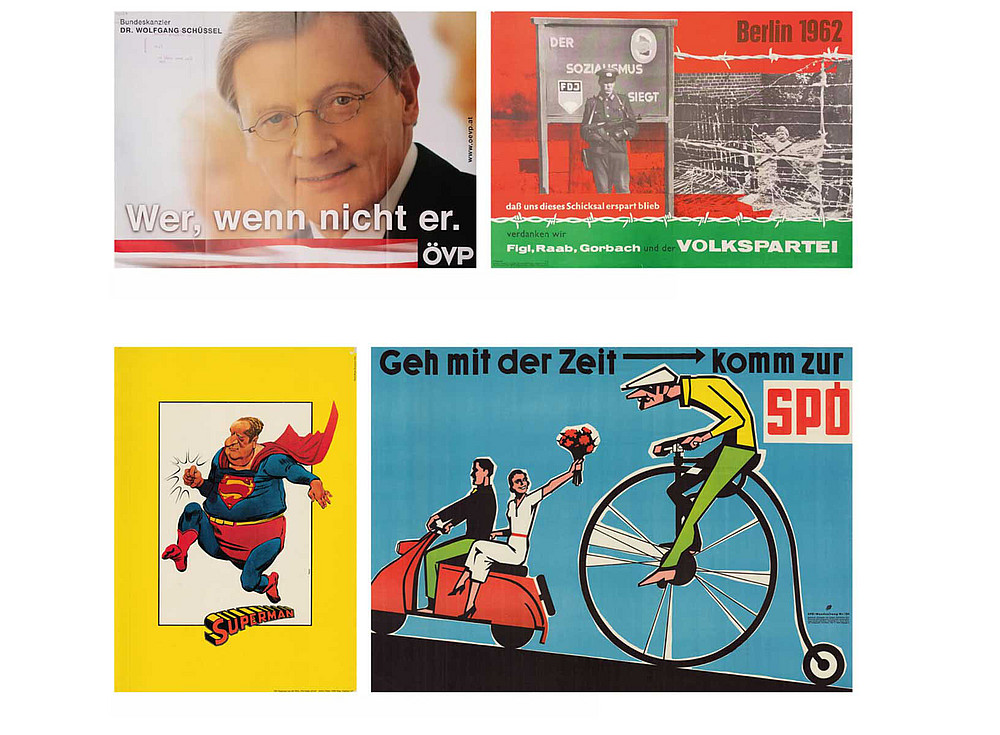
“The collection reflects our history of democracy and party politics since the beginning of the First Republic,” emphasises Anita Ziegerhofer. The researcher not only heads the Institute for the Foundations of Legal Science at the University of Graz. She also chairs the academic advisory board of the Dr Wilfried Haslauer Library, which forms part of the Platform for Contemporary Political Archives. According to Ziegerhofer, the election palaces provide a particularly good insight
into domestic political and social issues. She illustrates the development in fast-forward: after the Second World War, the focus was on Austria’s independence from the four occupying powers. From the State Treaty of 1955 onwards, economic recovery and geopolitical opening dominated, for example with accession to the UN. In the 1970s, gender equality came to the fore, whilst in the 1980s the European dimension played an increasingly important role. In the more recent past, election campaigning has centred primarily on migration and crises. “The posters also reflect the spirit of the times,” sums up the legal and contemporary historian. Thus, it is increasingly the faces of party leaders, rather than the content, that are of significance.
A treasure trove of research and teaching material
The database contains around 10,000 posters and is fed by four institutions: the Karl von Vogelsang Institute, the Kreisky Archive, the Association for the History of the Labour Movement and the Dr Wilfried Haslauer Library. Established in 2011, the platform brings together political posters from 1848 to the present day. plakatarchiv.zeithistorische-archive.at
This vast collection of images is a great treasure trove for research. “It is also easily accessible to the public and freely available, and is ideal for use in history and political education lessons,” says Anita Ziegerhofer, emphasising the powerful message conveyed by the posters.
This will also be the focus of the platform’s presentation on 19 October 2026 at the University of Graz. A discussion will take place featuring, amongst others, political scientist Kathrin Stainer-Hämmerle, University of Graz historian Andrea Strutz, advertising expert Mariusz Jan Demner and former *Profil* editor-in-chief Herbert Lackner. ⇒ Find out more about the event