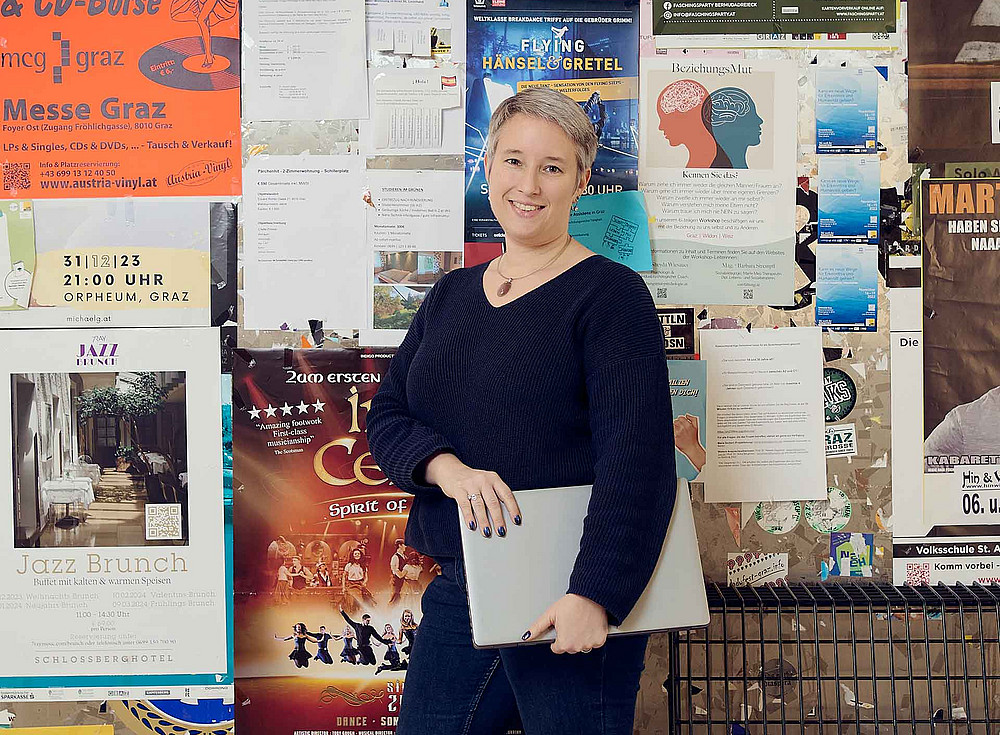
“When I work with social media in school, it’s essential that I know how Instagram and the like work,” emphasises Elke Lackner. Even though textbooks often set the guidelines for lessons, more and more online tools are being used to supplement them. From the perspective of the assistant professor of media didactics and language didactics at the University of Graz, the ideal solution would be a digital, modular textbook that would allow teachers to compile the content themselves.
Virtual reality is currently gaining ground, “because it engages all the senses”, explains Elke Lackner. Overall, photos and films take centre stage on digital platforms. This also explains Lackner’s academic focus: “To understand the images, language is needed to explain contexts and ask the necessary questions.” This knowledge creates the basis for ultimately designing learning environments for individual subjects.
First meeting in Austria
Elke Lackner identifies a significant need in media education research regarding the topic of AI. “Above all, there is a lack of reliable studies.” A conference on 3 and 4 September 2026 at the University of Graz aims, amongst other things, to shed light on how this empirical gap can be closed: The Media Didactics Working Group of the German Society for Educational Research will be meeting in Austria for the first time.
Experts from Germany, Switzerland and Austria will, for example, examine how AI can be used in the writing process or how fake news can be identified on a learning platform.
Digital education will also be a key focus at the Future Education Conference, which will take place in the run-up to the conference, from 1 to 3 September 2026, also at the University of Graz and in close conjunction with the Media Didactics conference.
Teacher training
These and other findings will subsequently be incorporated directly into the degree programme for future teachers, who are trained at the University of Graz in more than 20 subject areas. From the current 2026/2027 winter semester onwards, the corresponding Bachelor’s programme will last six semesters instead of eight, whilst the subsequent Master’s programme will continue to last four semesters.