Begin of page section:
Page sections:

  • Go to contents (Accesskey 1)
  • Go to position marker (Accesskey 2)
  • Go to main navigation (Accesskey 3)
  • Go to sub navigation (Accesskey 4)
  • Go to additional information (Accesskey 5)
  • Go to page settings (user/language) (Accesskey 8)
  • Go to search (Accesskey 9)

End of this page section. Go to overview of page sections

Begin of page section:
Page settings:

English en
Deutsch de
Search
Login

End of this page section. Go to overview of page sections

Begin of page section:
Search:

Search for details about Uni Graz
Close

End of this page section. Go to overview of page sections


Search

Begin of page section:
Main navigation:

Page navigation:

  • University

    University
    • About the University
    • Organisation
    • Faculties
    • Library
    • Working at University of Graz
    • Campus
    Developing solutions for the world of tomorrow - that is our mission. Our students and our researchers take on the great challenges of society and carry the knowledge out.
  • Research Profile

    Research Profile
    • Our Expertise
    • Research Questions
    • Research Portal
    • Promoting Research
    • Research Transfer
    • Ethics in Research
    • Commission for Scientific Integrity
    Scientific excellence and the courage to break new ground. Research at the University of Graz creates the foundations for making the future worth living.
  • Studies

    Studies
    • Prospective Students
    • Students
  • Community

    Community
    • International
    • Location
    • Research and Business
    • Alumni
    The University of Graz is a hub for international research and brings together scientists and business experts. Moreover, it fosters the exchange and cooperation in study and teaching.
  • Spotlight
Topics
  • Sustainable University
  • Researchers answer
  • Work for us
Close menu

End of this page section. Go to overview of page sections

Begin of page section:
You are here:

University of Graz News Wenn Berge bröckeln: Die Erwärmung von Permafrost-Eis erhöht die Instabilität von Felsflanken

End of this page section. Go to overview of page sections

Tuesday, 13 June 2023

Wenn Berge bröckeln: Die Erwärmung von Permafrost-Eis erhöht die Instabilität von Felsflanken

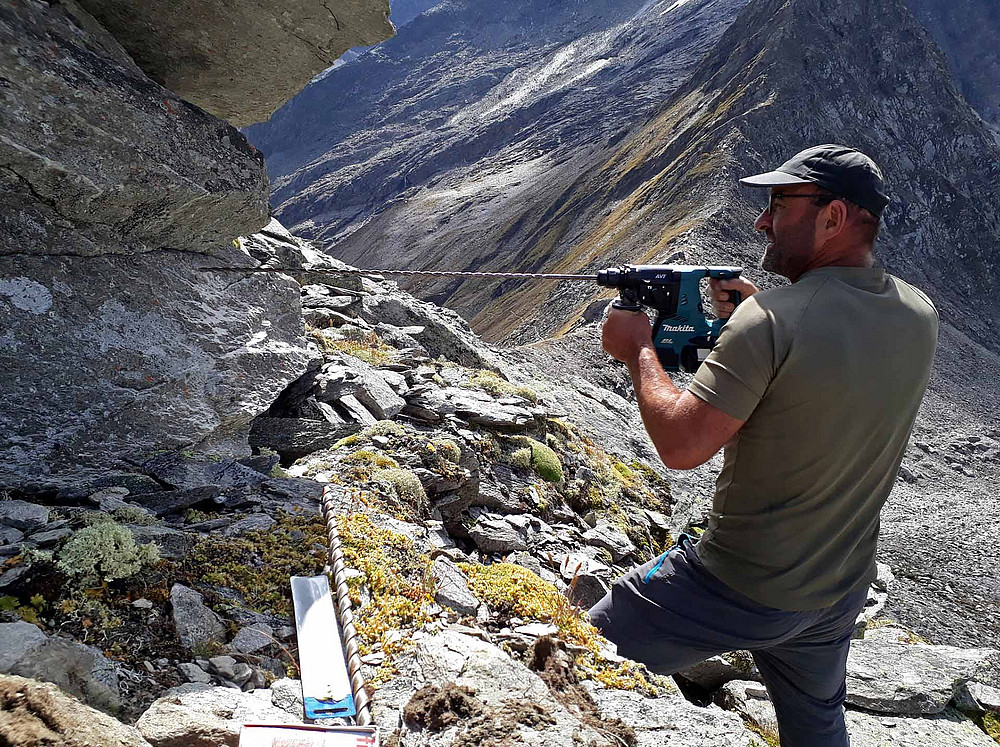
Andreas Kellerer-Pirklbauer bohrt im Gebirge einen Felsen an ©Alexander Doric

Mittels Felsbohrung untersucht Andreas Kellerer-Pirklbauer Permafrost im Hochgebirge. Foto: Alexander Doric

Der kapitale Felssturz am letzten Sonntag im Gemeindegebiet von Galtür/Tirol, bei dem am Fluchthorn ein halber Gipfel weggebrochen ist, wirft einmal mehr die Frage auf, ob Naturgefahren dieser Art im Gebirge zunehmen. „Über Felsstürze gibt es nur selten länger zurückreichende Aufzeichnungen, außer Zweifel steht aber, dass die durch den Klimawandel bedingte Erwärmung von Permafrost-Eis die Instabilität ganzer Felsflanken deutlich erhöht“, sagt Andreas Kellerer-Pirklbauer vom Institut für Geographie und Raumforschung der Universität Graz. Zwischen den Perioden 1891 bis 1920 und 1991 bis 2020 hat sich die Jahresmitteltemperatur um 1,8°C erhöht, die Sommertemperatur sogar um 2,5°C.

Dass Berge bröckeln ist grundsätzlich nichts Außergewöhnliches. Oder wie es Andreas Kellerer-Pirklbauer formuliert: „Das Gebirge hat die natürliche Neigung, kleiner zu werden. Dies kann langsam und unbemerkt, aber auch plötzlich und massiv passieren.“ Auch wenn es in der öffentlichen Wahrnehmung so scheint, als kämen Felsstürze immer häufiger vor, konkrete Zahlen für Österreich gibt es dazu nicht. Eines ist allerdings gewiss: Im Zuge des Klimawandels sind auch in höheren Lagen die Temperaturen gestiegen. Das führt nicht nur zu einem immer rasanteren Abschmelzen der Gletscher, auch das Permafrost-Eis, das den Untergrund wie Zement zusammenhält, erwärmt sich oder wird ganz zum Auftauen gebracht.

„Das Ausschmelzen von Permafrost oder auch das Eindringen von Wasser in Klüfte kann Gestein bis in mehrere Meter Tiefe lockern und in der Folge zu Felsstürzen führen“, erklärt Andreas Kellerer-Pirklbauer. „Wobei schon die bloße Erwärmung des Permafrost-Eises als Ursache ausreichen kann, denn wärmeres Eis ist mobiler, sprich kriecht besser, als kaltes.“ Häufig kommen noch weitere Effekte hinzu, etwa das Abschmelzen von Gletschereis, das den Fels zuvor stützte und Starkniederschläge, welche die Wassermenge und somit den Druck im Felsen erhöhen.

Was bedeutet das für Bewohner:innen und Tourist:innen vor Ort? Lässt sich das Risiko minimieren? „Nur bedingt“, bleibt der Forscher realistisch. „Sturzereignisse sind Teil der Natur im Gebirge. Das gilt auch für Höhenlagen ohne Permafrost. Um etwa Steinschlag auszulösen, brauche es nur tages- bis jahreszeitliche Frostwechsel, die den Untergrund bis in wenige Dezimeter unter die Oberfläche destabilisieren. Größere Felsstürze treten seltener auf, und es bedarf stärkerer Veränderungen im Gesteinsverband, damit solche Massen wie eben am Fluchthorn zu Tal donnern.“ Gefahrenbereiche zu erkennen, sie zu beobachten und entsprechende Sicherungsmaßnahmen zu treffen, wäre eine Möglichkeit, wobei vieles auch nicht vorhersehbar sei. Die Natur bleibt eben immer ein Stück weit unberechenbar.
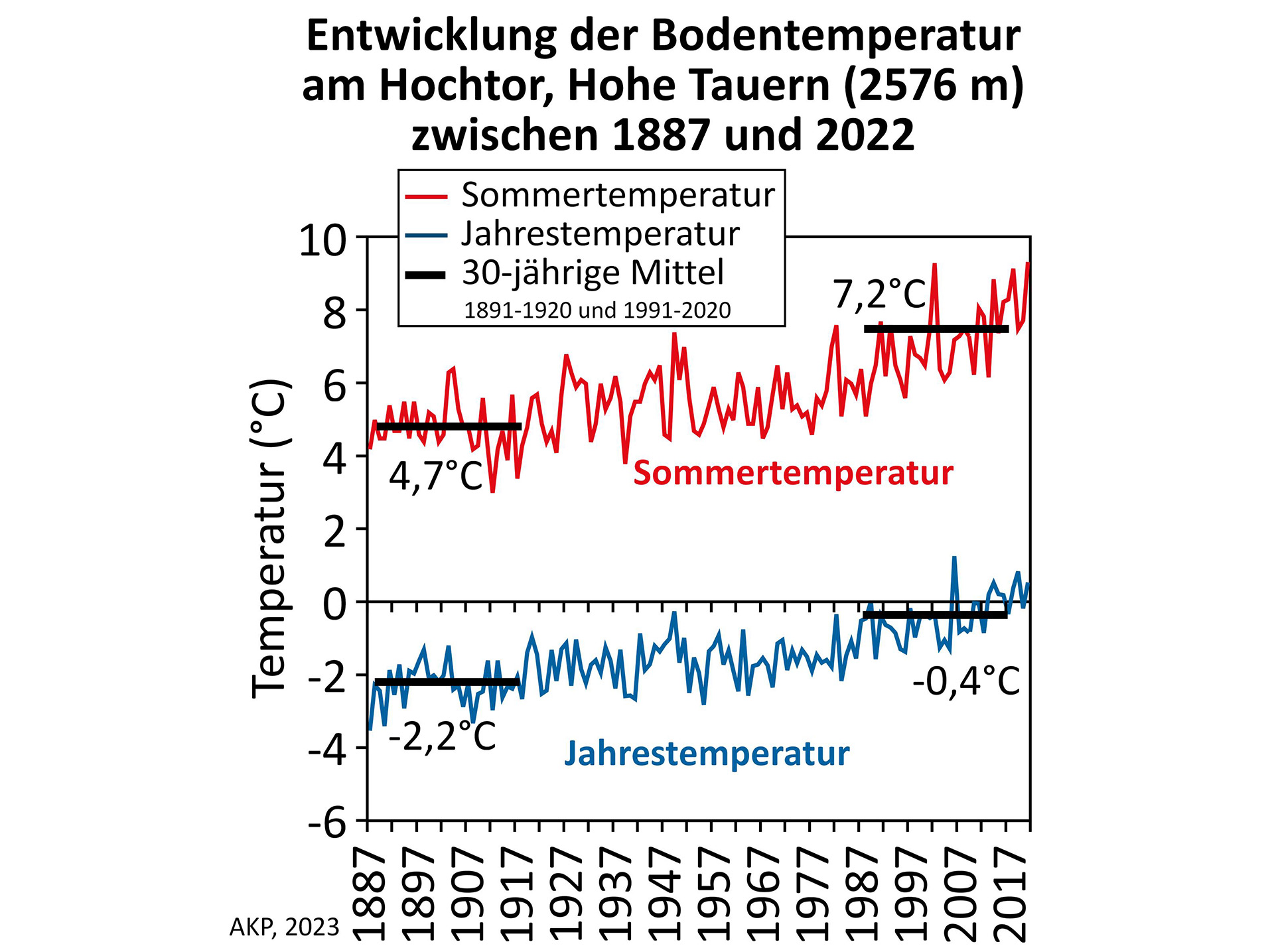
Grafik: Kellerer-Pirklbauer, Uni Graz ©Kellerer-Pirklbauer / Uni Graz
©Kellerer-Pirklbauer / Uni Graz
Grafik: Kellerer-Pirklbauer, Uni Graz
created by Gudrun Pichler

Related news

A special honour for special achievement: six "Sub auspiciis" awards for Graz University of Technology and the University of Graz

Top marks at school, outstanding academic achievement during their studies: six researchers from Graz – from Graz University of Technology and the University of Graz – were awarded their doctorates on 13 March 2026 ‘sub auspiciis Praesidentis rei publicae’. On behalf of the Austrian Federal President, University of Graz Rector Peter Riedler and Graz University of Technology Rector Horst Bischof presided over the conferment ceremony in the auditorium of the Old University of Graz. On 18 March, the candidates Hannah Brunner, Samuel Hörmann and Thomas Steiner (Graz University of Technology) as well as Christian Bundschuh, Peter Hartmann and Lena Parigger (University of Graz) will be presented with the honorary ring at the Hofburg in Vienna – personally by Federal President Alexander Van der Bellen.

Mathematics Day: University of Graz multiplies the fun of arithmetic

Competing in a puzzle contest without the pressure of grades is usually fun even for those who dislike maths. To mark Mathematics Day on 14 March, the University of Graz is hosting the international Naboj competition. At the end of February, more than three hundred lower school pupils competed in the Maths Mix Doubles.

Scientific freedom and neutrality: a question of attitude

How neutral must research be? At the Styrian University Conference at the University of Graz, keynote speaker David Beaver questioned the concept of objectivity. He advocated for bold science that stands by its values in order to remain resilient in times of crisis and actively shape social progress.

University of Graz: Discover the apprentice game and secure jobtraining

The University of Graz not only educates students – it also offers apprenticeships in eight future-oriented professions – even with a school-leaving certificate if desired! From metal technology in the physics workshop to IT systems engineering: discover apprenticeships now and immerse yourself in the world of university apprentices with an interactive game.

Begin of page section:
Additional information:

University of Graz
Universitaetsplatz 3
8010 Graz
Austria
  • Contact
  • Web Editors
  • Moodle
  • UNIGRAZonline
  • Imprint
  • Data Protection Declaration
  • Accessibility Declaration
Weatherstation
Uni Graz

End of this page section. Go to overview of page sections

End of this page section. Go to overview of page sections

Begin of page section:

End of this page section. Go to overview of page sections