



Begin of page section:
Page sections:

  • Go to contents (Accesskey 1)
  • Go to position marker (Accesskey 2)
  • Go to main navigation (Accesskey 3)
  • Go to sub navigation (Accesskey 4)
  • Go to additional information (Accesskey 5)
  • Go to page settings (user/language) (Accesskey 8)
  • Go to search (Accesskey 9)

End of this page section. Go to overview of page sections

Begin of page section:
Page settings:

English en
Deutsch de
Search
Login

End of this page section. Go to overview of page sections

Begin of page section:
Search:

Search for details about Uni Graz
Close

End of this page section. Go to overview of page sections


Search

Begin of page section:
Main navigation:

Page navigation:

  • University

    University
    • About the University
    • Organisation
    • Faculties
    • Library
    • Working at University of Graz
    • Campus
    Developing solutions for the world of tomorrow - that is our mission. Our students and our researchers take on the great challenges of society and carry the knowledge out.
  • Research Profile

    Research Profile
    • Our Expertise
    • Research Questions
    • Research Portal
    • Promoting Research
    • Research Transfer
    • Ethics in Research
    • Commission for Scientific Integrity
    Scientific excellence and the courage to break new ground. Research at the University of Graz creates the foundations for making the future worth living.
  • Studies

    Studies
    • Prospective Students
    • Students
  • Community

    Community
    • International
    • Location
    • Research and Business
    • Alumni
    The University of Graz is a hub for international research and brings together scientists and business experts. Moreover, it fosters the exchange and cooperation in study and teaching.
  • Spotlight
Topics
  • Sustainable University
  • Researchers answer
  • Work for us
Close menu

End of this page section. Go to overview of page sections

Begin of page section:
You are here:

University of Graz News Weniger Verluste

End of this page section. Go to overview of page sections

Thursday, 05 June 2014

Weniger Verluste

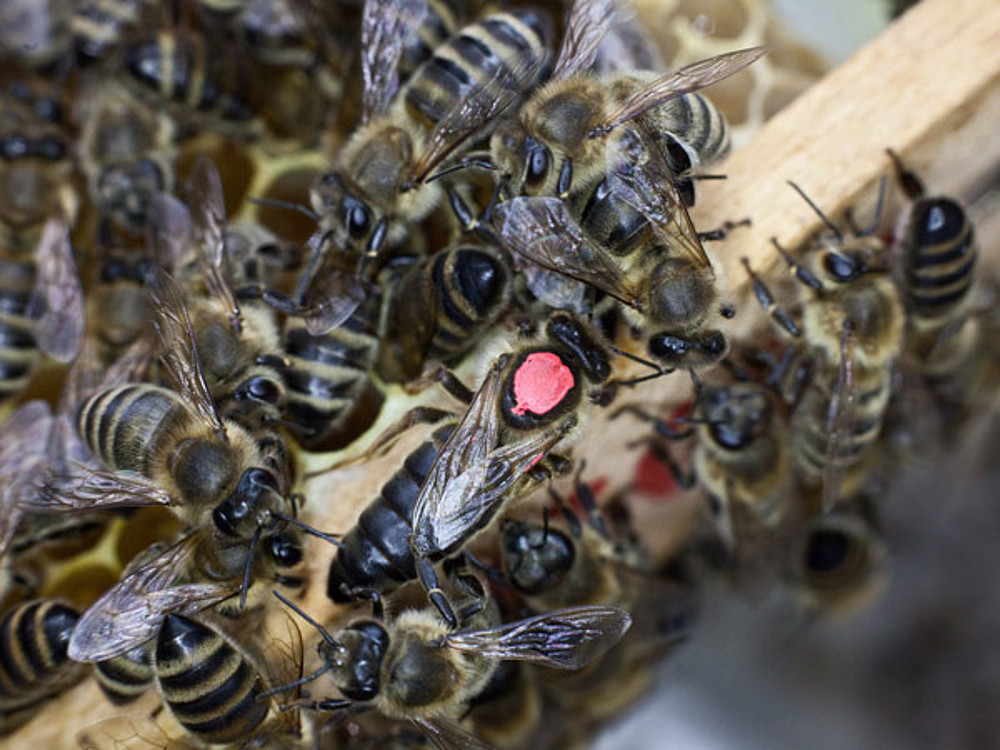
Etwa 12,5 % der österreichischen Bienenvölker verendeten im vergangenen Winter. Foto: Nikola Milatovic

Etwa 12,5 % der österreichischen Bienenvölker verendeten im vergangenen Winter. Foto: Nikola Milatovic

Uni Graz untersucht Wintersterblichkeit von Bienenvölkern

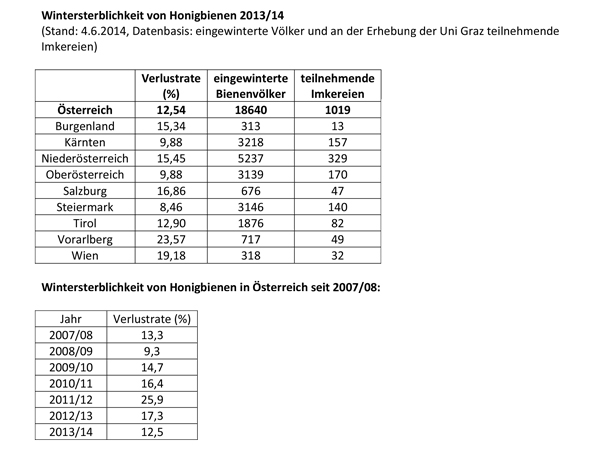
Der milde Winter 2013/2014 war auch mild zu den Honigbienen Österreichs. Die bundesweite Verlustrate lag mit rund 12,5 Prozent deutlich niedriger als in den Wintern davor – allerdings leicht über einer als normal angesehenen Sterblichkeit. Zu diesem Ergebnis kommen Univ.-Prof. Dr. Karl Crailsheim und Dr. Robert Brodschneider vom Institut für Zoologie der Uni Graz nach der Auswertung der aktuellen Daten. Die beiden sammeln seit sieben Jahren Angaben von Imkereien. „Wir haben bisher mehr als 5200 Datensätze erhalten, die wir für weitere epidemiologische Untersuchungen nutzen und als Datenbank auf www.Bienenstand.at auch der Öffentlichkeit zur Verfügung stellen“, erklärt Robert Brodschneider.

Dass etwa zehn Prozent der Bienenvölker in einem Winter in Österreich verenden, wird von vielen Fachleuten als normal angesehen. Im letzten Jahr lagen die Verlustraten in manchen Bundesländern allerdings über den Durchschnittswerten (siehe Tabelle). Um diese regionalen Unterschiede besser zu verstehen und vor allem eine hohe Sterblichkeit – wie im Winter 2011/12 – zu verhindern, forschen die Grazer ZoologInnen im Rahmen des mit 2,4 Millionen Euro dotierten Projekts „Zukunft Biene“ an den genauen Ursachen. „Wir haben die finanziellen Mittel, um in den nächsten Jahren genaue Untersuchungen mit großräumigen Probenahmen sowie Grundlagenforschung durchzuführen“, erklärt Projektleiter Karl Crailsheim. Sein Team arbeitet dabei mit der Agentur für Gesundheit und Ernährungssicherheit (AGES) und dem Wegener Center für Klima und Globalen Wandel der Karl-Franzens-Universität zusammen. Während der Flugsaison wird auch untersucht werden, wie stark die Bienenvölker dem Einfluss von Pflanzenschutzmitteln ausgesetzt sind.
Nähere Infos:
www.zukunft-biene.at
www.coloss.org: Die Untersuchung wird im Rahmen der Vereinigung COLOSS (Prevention of honey bee colony losses) durchgeführt.
Die internationalen Ergebnisse des vorigen Winters (2012/13) wurden im Journal of Apicultural Research publiziert (van der Zee et  al., 2014):  http://www.ibra.org.uk/downloads/20140221_1/download

created by Dagmar Eklaude

Related news

Higher Education Strategy 2040: Austria’s universities on course for the future

Austria has 77 higher education institutions, which is above the EU average – but does this really make sense? The new Higher Education Strategy 2040 focuses on cooperation rather than mergers. As one of the six largest universities in Austria, the University of Graz plays a central role in this.

Climate research in Greenland: Old data provides new insights

The polar explorer and University of Graz professor Alfred Wegener left behind a unique collection of climate data from Greenland. A research team from the University of Graz is now analysing this 100-year-old treasure trove of data and comparing it with current measurements.

Diversity in nature and science: How we talk about plants and each other

Ginkgo, kiwi, hemp: they exist as male and female plants. Anyone who paid attention in biology class will confirm this. But is this categorisation, established by Carl von Linné almost 300 years ago, still valid today? An interdisciplinary team at the University of Graz is questioning these attributions and using this as a starting point to provide food for thought for gender-sensitive interaction between students, scientific and teaching staff.

Around the world in eight stops: the Long Night of Research at the University of Graz

On 24 April from 5 pm, you can take a short trip around the globe at the University of Graz, discovering pecularities of foreign countries or new local features in the entrance hall of the University Library. The itinerary takes you through introduced animal species, political attitudes and the omnipotence of algorithms. There will also be a programme in the historic reading hall, as well as at the UniGraz@Museum and the University Archive.

Begin of page section:
Additional information:

University of Graz
Universitaetsplatz 3
8010 Graz
Austria
  • Contact
  • Web Editors
  • Moodle
  • UNIGRAZonline
  • Imprint
  • Data Protection Declaration
  • Accessibility Declaration
Weatherstation
Uni Graz

End of this page section. Go to overview of page sections

End of this page section. Go to overview of page sections

Begin of page section:

End of this page section. Go to overview of page sections


