Begin of page section:
Page sections:

  • Go to contents (Accesskey 1)
  • Go to position marker (Accesskey 2)
  • Go to main navigation (Accesskey 3)
  • Go to sub navigation (Accesskey 4)
  • Go to additional information (Accesskey 5)
  • Go to page settings (user/language) (Accesskey 8)
  • Go to search (Accesskey 9)

End of this page section. Go to overview of page sections

Begin of page section:
Page settings:

English en
Deutsch de
Search
Login

End of this page section. Go to overview of page sections

Begin of page section:
Search:

Search for details about Uni Graz
Close

End of this page section. Go to overview of page sections


Search

Begin of page section:
Main navigation:

Page navigation:

  • University

    University
    • About the University
    • Organisation
    • Faculties
    • Library
    • Working at University of Graz
    • Campus
    Developing solutions for the world of tomorrow - that is our mission. Our students and our researchers take on the great challenges of society and carry the knowledge out.
  • Research Profile

    Research Profile
    • Our Expertise
    • Research Questions
    • Research Portal
    • Promoting Research
    • Research Transfer
    • Ethics in Research
    Scientific excellence and the courage to break new ground. Research at the University of Graz creates the foundations for making the future worth living.
  • Studies

    Studies
    • Prospective Students
    • Students
  • Community

    Community
    • International
    • Location
    • Research and Business
    • Alumni
    The University of Graz is a hub for international research and brings together scientists and business experts. Moreover, it fosters the exchange and cooperation in study and teaching.
  • Spotlight
Topics
  • Sustainable University
  • Researchers answer
  • Work for us
Close menu

End of this page section. Go to overview of page sections

Begin of page section:
You are here:

University of Graz News Weltweit sichtbar

End of this page section. Go to overview of page sections

Tuesday, 17 November 2020

Weltweit sichtbar

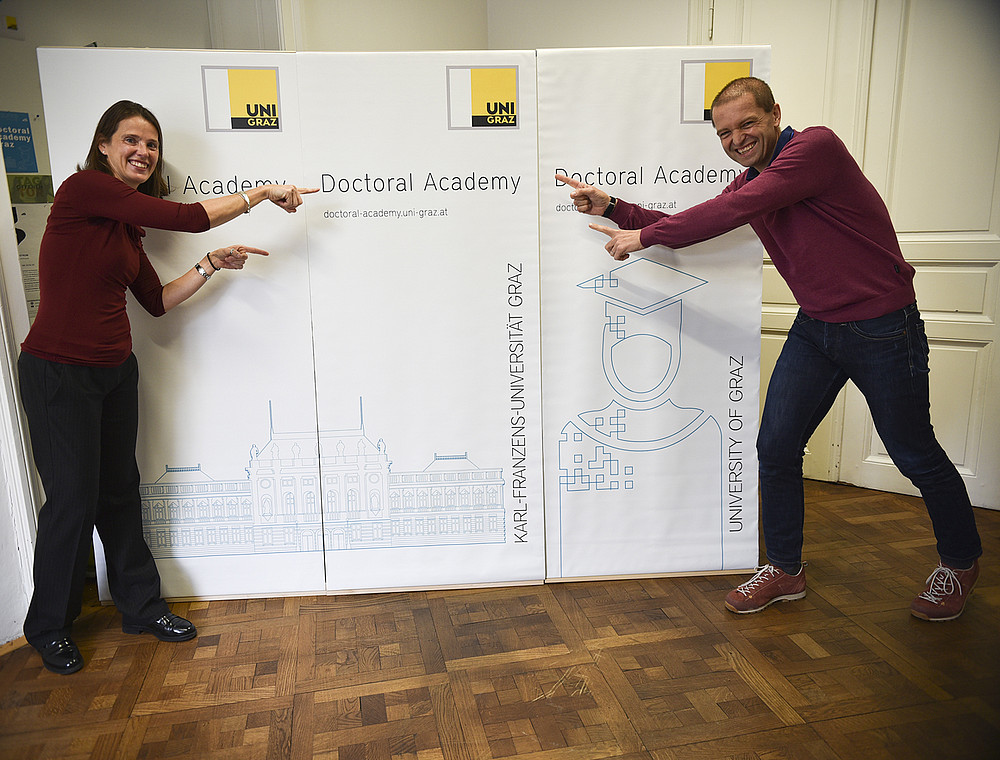
Corona machte es möglich: Der Doctoral Academy Day 2020 ging online über die Bühne. Forschungsvizerektor Christof Gattringer und Gudrun Salmhofer zeigten sich begeistert. Foto: Uni Graz/Leljak

Corona machte es möglich: Der Doctoral Academy Day 2020 ging online über die Bühne. Forschungsvizerektor Christof Gattringer und Gudrun Salmhofer zeigten sich begeistert. Foto: Uni Graz/Leljak

Erstmals als Online-Format: Doctoral Academy Day 2020 zu internationalen Forschungskarrieren

Der fünfte – erstmals online abgehaltene – Doctoral Academy Day am 12. November 2020 widmete sich heuer unter dem Titel „A Hitchhiker's Guide Through Academia“ den Erfolgsbedingungen und Herausforderungen internationaler Forschungskarrieren. Christof Gattringer, Vizerektor für Forschung und Nachwuchsförderung, und Peter Scherrer, Direktor der Doctoral Academy, eröffneten die virtuella Tagung und betontzen in ihren Reden, dass es gerade in Zeiten eingeschränkter Mobilität besonders wichtig sei, die Förderung von Nachwuchsforschenden auch weiterhin in internationalen Kontexten zu betreiben. Welche Aspekte es hier insbesondere bei der institutionellen Unterstützung von NachwuchswissenschaftlerInnen zu berücksichtigen gilt, machte die Geschäftsführerin des Max-Weber-Kollegs an der Universität Erfurt, Bettina Hollstein, in ihrer Keynote deutlich. Hollstein wies unter anderem darauf hin, dass Mobilität nicht nur Einzelpersonen betrifft, sondern die Ermöglichung internationaler wissenschaftlicher Arbeit strukturbildendes Ziel aller Bereiche – Forschung, Lehre und Serviceangebot – einer Graduierteneinrichtung sein sollte.
 

International sichtbar sein: aber wie?
Helmut Eberhart, akademischer Koordinator der European University Alliance Arqus, stellte in seinem Beitrag Fördermöglichkeiten vor, die dieses EU-Projekt international ausgerichteten Nachwuchsforschenden bietet. Auch wenn derzeit die Ausschöpfung dieser Möglichkeiten schwierig sei, so Eberhart, werde das Coronavirus den über Ländergrenzen hinweg erfolgenden Austausch von Forschung und Ideen nicht dauerhaft beeinträchtigen können.

In einer abschließenden Gesprächsrunde reflektierten Monika Oberer, Daniel Boese, Tina Ehrke-Rabel und Florian Bieber – alle vier SprecherInnen von Mitgliedskonsortien der Doctoral Academy – die Bedeutung von persönlicher Mobilität und aktiver internationaler Netzwerkarbeit für ihre wissenschaftliche Laufbahn. In der von Gudrun Salmhofer, Leiterin der Abteilung Lehr- und Studienservices, geleiteten Diskussion wurde auch der Zusammenhang von beständiger Mobilität mit prekären Arbeitsverhältnissen und einem flexibel zu gestaltenden Lebensumfeld aufgezeigt. Nachwuchsforschende müssen sich entscheiden, darüber waren sich die DiskutantInnen einig, ob sie innerhalb dieser herausfordenden Rahmenbedingungen die außerordentlichen fachlichen Entwicklungsmöglichkeiten internationaler Forschungsaufenthalte nutzen möchten.

created by Gerald Lind & Konstantin Tzivanopoulos

Related news

Cosmetics in the environment: University of Graz proves danger to ants

Titanium dioxide, which is found in cosmetics, for example, is increasingly entering the environment in the form of nanoparticles. This could also put insects at risk. If ants ingest the substance in combination with the pesticide glyphosate, it disturbs the development of their offspring. Scientists at the University of Graz are drawing attention to the negative consequences of this toxic cocktail.

How are tech companies changing democracy? Uni Graz designs exhibition for schools

Filtered information, conspiracy theories, fake news – certain groups and corporations are using social media and algorithms to try to influence public opinion in their favour. Their goal: to weaken fundamental rights and diversity of opinion and seize power. In a new exhibition, researchers at the University of Graz are working with pupils to explore the impact of social media and AI on democracy. In accompanying workshops, the scientists want to encourage young people to develop their own ideas for a socially and ecologically viable future and to actively help shape it. The exhibition, designed as a travelling exhibition for schools, will open on 9 March 2026 at the Dreihackengasse Gymnasium in Graz.

Step by step: What motivates Mireille van Poppel as a scientist and vice-rector

Improving people's health and eliminating inequalities: Mireille van Poppel pursues these goals both as a public health researcher and as vice-rector for Internationalisation and Equality. In both roles, she pays particular attention to individual needs.

Master's degree in psychotherapy in Graz: registration opens in March

Graz is becoming a hotspot for psychotherapy: from 2026, the University of Graz and the Medical University of Graz will jointly offer the new master's programme. Registration for the admission procedure for the 140 study places will start in March.

Begin of page section:
Additional information:

University of Graz
Universitaetsplatz 3
8010 Graz
Austria
  • Contact
  • Web Editors
  • Moodle
  • UNIGRAZonline
  • Imprint
  • Data Protection Declaration
  • Accessibility Declaration
Weatherstation
Uni Graz

End of this page section. Go to overview of page sections

End of this page section. Go to overview of page sections

Begin of page section:

End of this page section. Go to overview of page sections