Begin of page section:
Page sections:

  • Go to contents (Accesskey 1)
  • Go to position marker (Accesskey 2)
  • Go to main navigation (Accesskey 3)
  • Go to sub navigation (Accesskey 4)
  • Go to additional information (Accesskey 5)
  • Go to page settings (user/language) (Accesskey 8)
  • Go to search (Accesskey 9)

End of this page section. Go to overview of page sections

Begin of page section:
Page settings:

English en
Deutsch de
Search
Login

End of this page section. Go to overview of page sections

Begin of page section:
Search:

Search for details about Uni Graz
Close

End of this page section. Go to overview of page sections


Search

Begin of page section:
Main navigation:

Page navigation:

  • University

    University
    • About the University
    • Organisation
    • Faculties
    • Library
    • Working at University of Graz
    • Campus
    Developing solutions for the world of tomorrow - that is our mission. Our students and our researchers take on the great challenges of society and carry the knowledge out.
  • Research Profile

    Research Profile
    • Our Expertise
    • Research Questions
    • Research Portal
    • Promoting Research
    • Research Transfer
    • Ethics in Research
    • Commission for Scientific Integrity
    Scientific excellence and the courage to break new ground. Research at the University of Graz creates the foundations for making the future worth living.
  • Studies

    Studies
    • Prospective Students
    • Students
    • Welcome Weeks for First Year Students
  • Community

    Community
    • International
    • Location
    • Research and Business
    • Alumni
    The University of Graz is a hub for international research and brings together scientists and business experts. Moreover, it fosters the exchange and cooperation in study and teaching.
Topics
  • Sustainable University
  • Researchers answer
  • Work for us
Close menu

End of this page section. Go to overview of page sections

Begin of page section:
You are here:

University of Graz News Weltweit sichtbar

End of this page section. Go to overview of page sections

Tuesday, 17 November 2020

Weltweit sichtbar

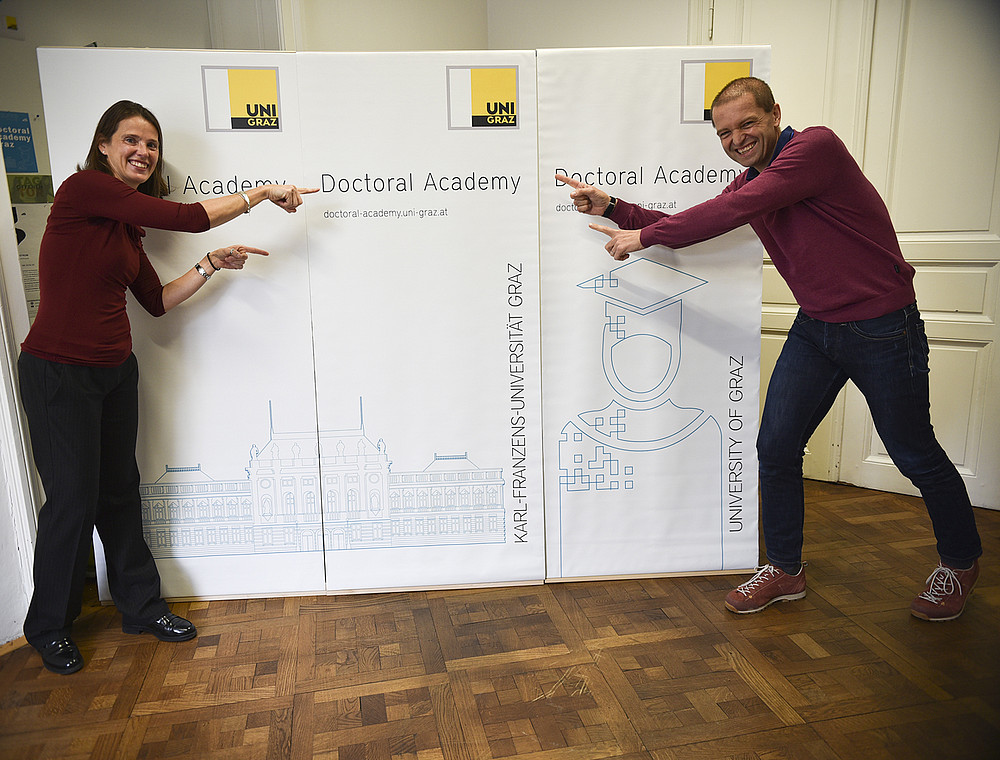
Corona machte es möglich: Der Doctoral Academy Day 2020 ging online über die Bühne. Forschungsvizerektor Christof Gattringer und Gudrun Salmhofer zeigten sich begeistert. Foto: Uni Graz/Leljak

Corona machte es möglich: Der Doctoral Academy Day 2020 ging online über die Bühne. Forschungsvizerektor Christof Gattringer und Gudrun Salmhofer zeigten sich begeistert. Foto: Uni Graz/Leljak

Erstmals als Online-Format: Doctoral Academy Day 2020 zu internationalen Forschungskarrieren

Der fünfte – erstmals online abgehaltene – Doctoral Academy Day am 12. November 2020 widmete sich heuer unter dem Titel „A Hitchhiker's Guide Through Academia“ den Erfolgsbedingungen und Herausforderungen internationaler Forschungskarrieren. Christof Gattringer, Vizerektor für Forschung und Nachwuchsförderung, und Peter Scherrer, Direktor der Doctoral Academy, eröffneten die virtuella Tagung und betontzen in ihren Reden, dass es gerade in Zeiten eingeschränkter Mobilität besonders wichtig sei, die Förderung von Nachwuchsforschenden auch weiterhin in internationalen Kontexten zu betreiben. Welche Aspekte es hier insbesondere bei der institutionellen Unterstützung von NachwuchswissenschaftlerInnen zu berücksichtigen gilt, machte die Geschäftsführerin des Max-Weber-Kollegs an der Universität Erfurt, Bettina Hollstein, in ihrer Keynote deutlich. Hollstein wies unter anderem darauf hin, dass Mobilität nicht nur Einzelpersonen betrifft, sondern die Ermöglichung internationaler wissenschaftlicher Arbeit strukturbildendes Ziel aller Bereiche – Forschung, Lehre und Serviceangebot – einer Graduierteneinrichtung sein sollte.
 

International sichtbar sein: aber wie?
Helmut Eberhart, akademischer Koordinator der European University Alliance Arqus, stellte in seinem Beitrag Fördermöglichkeiten vor, die dieses EU-Projekt international ausgerichteten Nachwuchsforschenden bietet. Auch wenn derzeit die Ausschöpfung dieser Möglichkeiten schwierig sei, so Eberhart, werde das Coronavirus den über Ländergrenzen hinweg erfolgenden Austausch von Forschung und Ideen nicht dauerhaft beeinträchtigen können.

In einer abschließenden Gesprächsrunde reflektierten Monika Oberer, Daniel Boese, Tina Ehrke-Rabel und Florian Bieber – alle vier SprecherInnen von Mitgliedskonsortien der Doctoral Academy – die Bedeutung von persönlicher Mobilität und aktiver internationaler Netzwerkarbeit für ihre wissenschaftliche Laufbahn. In der von Gudrun Salmhofer, Leiterin der Abteilung Lehr- und Studienservices, geleiteten Diskussion wurde auch der Zusammenhang von beständiger Mobilität mit prekären Arbeitsverhältnissen und einem flexibel zu gestaltenden Lebensumfeld aufgezeigt. Nachwuchsforschende müssen sich entscheiden, darüber waren sich die DiskutantInnen einig, ob sie innerhalb dieser herausfordenden Rahmenbedingungen die außerordentlichen fachlichen Entwicklungsmöglichkeiten internationaler Forschungsaufenthalte nutzen möchten.

created by Gerald Lind & Konstantin Tzivanopoulos

Related news

Electrifying: Researchers film the first moments on the way from light to electricity

Physicists at the University of Graz (Austria), in collaboration with colleagues from Marburg University and Forschungszentrum Jülich (Germany), have achieved a scientific breakthrough. For the first time, the generation of electrical energy from light has been filmed and described theoretically. This work is of far-reaching significance, not least for optimising sustainable energy production from photovoltaics. This is because it provides fundamental building blocks for understanding the physical processes that take place, for example, in organic solar cells. The paper was published in the journal Physical Review X, one of the world’s most prestigious physics journals.

University of Graz: Working together to make Styria a sustainable centre of learning

Round table calls for sustainable funding for the 2028–2030 performance agreement period between the five Styrian universities and the federal government.

How can we teach using YouTube and AI? The University of Graz is strengthening media education in schools

A journey through the blood vessels using VR headsets brings biology lessons to life. An interactive quiz brings physics to life. The YouTube video explains the First World War. Whilst mobile phones are increasingly being banned from the classroom, social media platforms, apps and AI are playing an ever-greater role in knowledge transfer at school. But how can teaching with media be made even more effective? What are the challenges in media-based teaching? At the University of Graz, researchers are discussing these issues at a conference being held in Austria for the first time.

Jurassic Sounds: Biologist reconstructs insect songs from 165 million years ago

It was apparently not just the roars of the dinosaurs that made up the soundscape of the animal world during the Jurassic period. Crickets and grasshoppers communicated through a variety of songs and high-pitched sounds, as Thorin Jonsson from the Institute of Biology at the University of Graz discovered together with colleagues from the universities of Lincoln, Bristol (UK), Beijing (China) and Tempe (USA). The findings on what are so far the oldest traces of sound on Earth have just been published in the journal PNAS.

Begin of page section:
Additional information:

University of Graz
Universitaetsplatz 3
8010 Graz
Austria
  • Contact
  • Web Editors
  • Moodle
  • UNIGRAZonline
  • Imprint
  • Data Protection Declaration
  • Accessibility Declaration
Weatherstation
Uni Graz

End of this page section. Go to overview of page sections

End of this page section. Go to overview of page sections

Begin of page section:

End of this page section. Go to overview of page sections