Begin of page section:
Page sections:

  • Go to contents (Accesskey 1)
  • Go to position marker (Accesskey 2)
  • Go to main navigation (Accesskey 3)
  • Go to sub navigation (Accesskey 4)
  • Go to additional information (Accesskey 5)
  • Go to page settings (user/language) (Accesskey 8)
  • Go to search (Accesskey 9)

End of this page section. Go to overview of page sections

Begin of page section:
Page settings:

English en
Deutsch de
Search
Login

End of this page section. Go to overview of page sections

Begin of page section:
Search:

Search for details about Uni Graz
Close

End of this page section. Go to overview of page sections


Search

Begin of page section:
Main navigation:

Page navigation:

  • University

    University
    • About the University
    • Organisation
    • Faculties
    • Library
    • Working at University of Graz
    • Campus
    Developing solutions for the world of tomorrow - that is our mission. Our students and our researchers take on the great challenges of society and carry the knowledge out.
  • Research Profile

    Research Profile
    • Our Expertise
    • Research Questions
    • Research Portal
    • Promoting Research
    • Research Transfer
    • Ethics in Research
    • Commission for Scientific Integrity
    Scientific excellence and the courage to break new ground. Research at the University of Graz creates the foundations for making the future worth living.
  • Studies

    Studies
    • Prospective Students
    • Students
    • Registration for Study Programme (Winter semester 2026/27)
  • Community

    Community
    • International
    • Location
    • Research and Business
    • Alumni
    The University of Graz is a hub for international research and brings together scientists and business experts. Moreover, it fosters the exchange and cooperation in study and teaching.
Topics
  • Sustainable University
  • Researchers answer
  • Work for us
Close menu

End of this page section. Go to overview of page sections

Begin of page section:
You are here:

University of Graz News Weltraum-Wetter: Forscher:innen der Universität Graz entwickeln Methode, um Sonnenausbrüche vorherzusagen

End of this page section. Go to overview of page sections

Thursday, 13 July 2023

Weltraum-Wetter: Forscher:innen der Universität Graz entwickeln Methode, um Sonnenausbrüche vorherzusagen

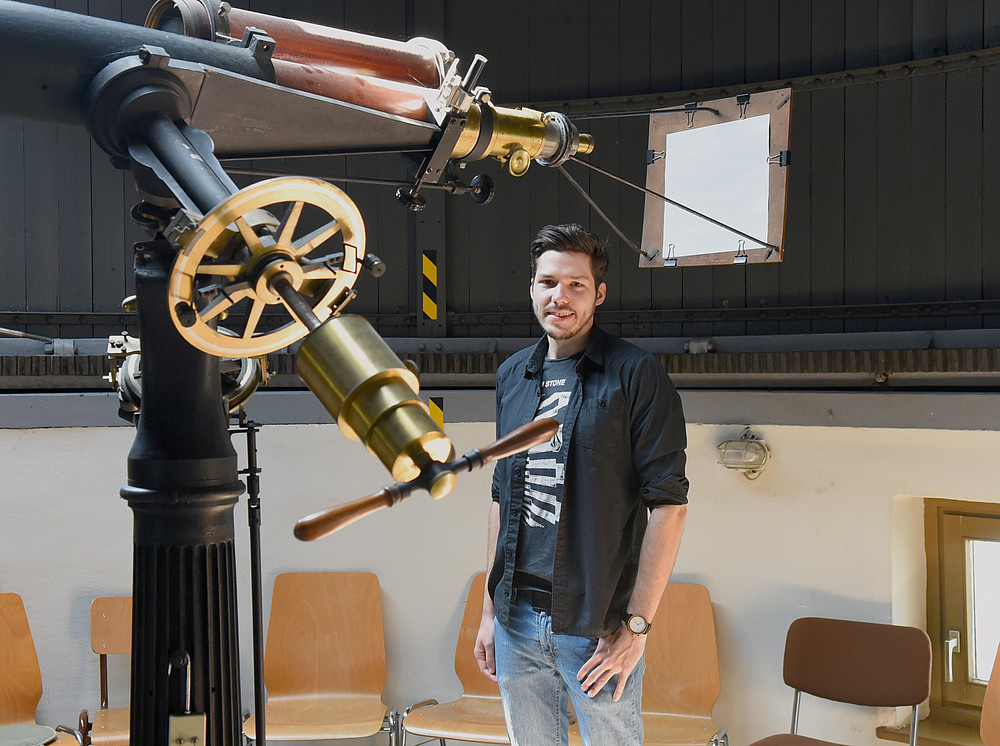
Robert Jarolim im Astronomie-Turm der Universität Graz ©Universität Graz/Vilgut

Robert Jarolim im Astronomie-Turm der Universität Graz Foto: Uni Graz/Vilgut

Sonneneruptionen sind spektakuläre Ausbrüche von Materie und Strahlung und können massive Auswirkungen auf die Erde haben, indem sie beispielsweise Satelliten stören. Forscher:innen der Universität Graz und des Skoltech Institute in Moskau haben eine Methode entwickelt, um solche Ereignisse besser vorhersagen zu können, die das sogenannte Weltraumwetter bestimmen. Die Arbeit wurde in der Juli-Ausgabe des Fachmagazins Nature Astronomy publiziert.

Mithilfe von künstlicher Intelligenz ist es den Wissenschaftler:innen der Universität Graz und des Skoltech Institute in Moskau gelungen, das Magnetfeld in den oberen Schichten der Sonnenatmosphäre zu simulieren, in denen Eruptionen entstehen. „In diesen Bereichen sind Messungen nicht möglich. Wir brauchen daher Modellierungen, um die Vorgänge beschreiben und verstehen zu können“, erklärt Hauptautor Robert Jarolim vom Institut für Physik der Universität Graz.

Um Vorhersagen treffen zu können, beobachten und messen die Forscher:innen die Sonnenflecken. „Das sind Gebiete mit sehr starkem Magnetfeld“, sagt Jarolim. Diese Daten werden mittels künstlicher Intelligenz mit physikalischen Modellen kombiniert, um die Vorgänge in den oberen Schichten der Sonnenatmosphäre zu simulieren.

Bisher dauerte dieser Vorgang viele Stunden. „Mit unserer Methode konnten wir die Dauer der Berechnung deutlich reduzieren. Das ermöglicht es uns, fast in Echtzeit neue Daten einzupflegen und dadurch können wir Sonnenstürme wesentlich besser vorhersagen, die auf die Erde treffen“, unterstreicht der Astrophysiker.

Die Ergebnisse der Simulationen verbessern das Verständnis für das Magnetfeld der Sonne und das Weltraumwetter. Damit sind sie auch für die Raum- und Luftfahrt bedeutend, ergänzt Jarolim: „Bereits wenige Minuten nach einer Sonneneruption kommen hochgeladene Teilchen auf der Erde an. Diese sind eine Gefahr für Astronaut:innen und können ein erhöhtes Strahlungsrisiko für Flugzeugpassagiere bedeuten.“

Publikation

R. Jarolim, J. K. Thalmann, A. M. Veronig, T. Podladchikova. Probing the solar coronal magnetic field with physics-informed neuronal networks. Nature Astronomy, Volume 7, No. 6, 2023

https://www.nature.com/articles/s41550-023-02030-9
 

created by Roman Vilgut

Related news

Complying with the norm: Why Do Standards Shape Our Lives, Elisabeth Staudegger?

Standards determine whether a sheet of paper fits in a printer or whether a charging plug can power multiple devices. These standards shape our everyday lives. But who actually sets these standards? Where are the weaknesses, and how could science help to improve them? Elisabeth Staudegger, Head of the ‘Law and IT’ Department at the Institute for Legal Foundations at the University of Graz, host the Academic Standards Day on 16 June. Here she relays how sciences can contribute to the topic of standardisation and reveals her personal favourite standard.

More body awareness than a culture war

In Italy, sex education lessons will in future only be permitted with parental consent, and will be banned entirely in nurseries and primary schools. At the same time, Pride Month highlights why knowledge about the body, relationships, boundaries and diversity is important for young people. A study by the University of Graz shows how important knowledge about the body, contraception, relationship skills and protection against violence is

Will Austria win the World Cup? Mathematician reveals calculation method

Michael Fischer uses the football tournament as a practical example for highschool lessons.

Survival strategies: How plants respond to drought

According to Geosphere Austria, this spring was the driest in Austria since records began around 170 years ago. The low rainfall put particular pressure on the agricultural sector. And climate change is set to make the situation even worse in the coming decades. We asked Johannes Liesche, a professor at the Department of Biology at the University of Graz, how plants react to water shortages and how they survive periods of drought.

Begin of page section:
Additional information:

University of Graz
Universitaetsplatz 3
8010 Graz
Austria
  • Contact
  • Web Editors
  • Moodle
  • UNIGRAZonline
  • Imprint
  • Data Protection Declaration
  • Accessibility Declaration
Weatherstation
Uni Graz

End of this page section. Go to overview of page sections

End of this page section. Go to overview of page sections

Begin of page section:

End of this page section. Go to overview of page sections