Begin of page section:
Page sections:

  • Go to contents (Accesskey 1)
  • Go to position marker (Accesskey 2)
  • Go to main navigation (Accesskey 3)
  • Go to sub navigation (Accesskey 4)
  • Go to additional information (Accesskey 5)
  • Go to page settings (user/language) (Accesskey 8)
  • Go to search (Accesskey 9)

End of this page section. Go to overview of page sections

Begin of page section:
Page settings:

English en
Deutsch de
Search
Login

End of this page section. Go to overview of page sections

Begin of page section:
Search:

Search for details about Uni Graz
Close

End of this page section. Go to overview of page sections


Search

Begin of page section:
Main navigation:

Page navigation:

  • University

    University
    • About the University
    • Organisation
    • Faculties
    • Library
    • Working at University of Graz
    • Campus
    Developing solutions for the world of tomorrow - that is our mission. Our students and our researchers take on the great challenges of society and carry the knowledge out.
  • Research Profile

    Research Profile
    • Our Expertise
    • Research Questions
    • Research Portal
    • Promoting Research
    • Research Transfer
    • Ethics in Research
    Scientific excellence and the courage to break new ground. Research at the University of Graz creates the foundations for making the future worth living.
  • Studies

    Studies
    • Prospective Students
    • Students
  • Community

    Community
    • International
    • Location
    • Research and Business
    • Alumni
    The University of Graz is a hub for international research and brings together scientists and business experts. Moreover, it fosters the exchange and cooperation in study and teaching.
  • Spotlight
Topics
  • Our digital Advent calendar
  • Sustainable University
  • Researchers answer
  • Work for us
Close menu

End of this page section. Go to overview of page sections

Begin of page section:
You are here:

University of Graz News The lightning-fast rattling of rattlesnakes: A protein gets muscles up to speed

End of this page section. Go to overview of page sections

Tuesday, 09 January 2024

The lightning-fast rattling of rattlesnakes: A protein gets muscles up to speed

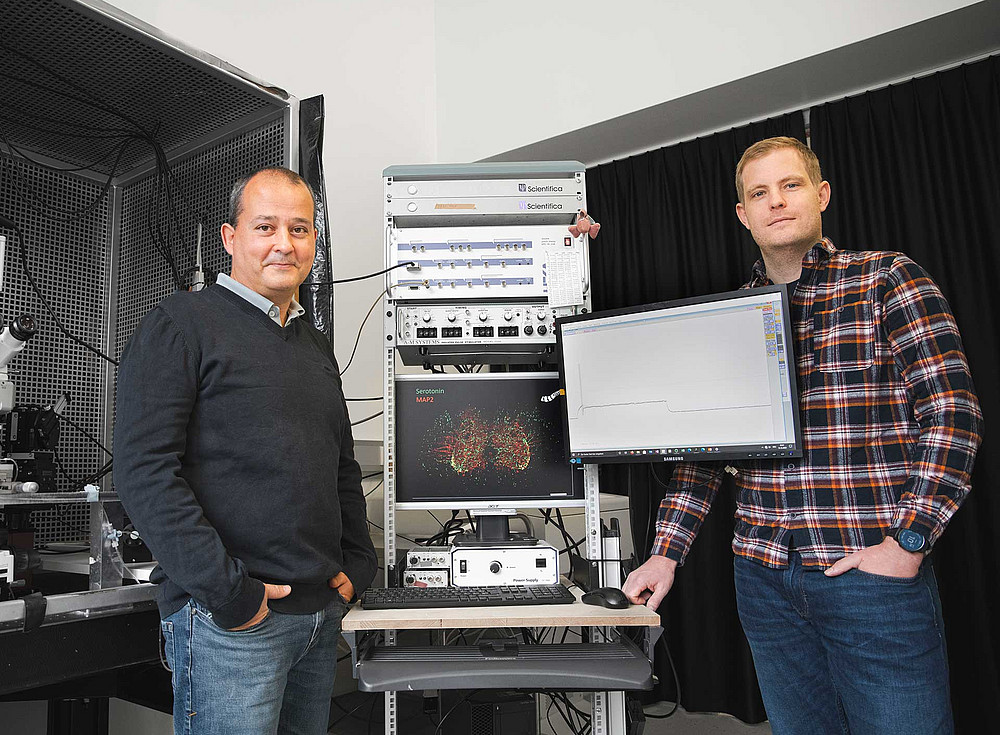
Boris Chagnaud (left) and Maximilian Bothe ©Uni Graz/Tzivanopoulos

Boris Chagnaud (left) and Maximilian Bothe have investigated the network of nerves in the spinal cord of rattlesnakes. Photo: Uni Graz/Tzivanopoulos

Cheetahs, sloths, snakes: they all move at vastly different speeds but the network of nerves in their spinal cords responsible for their movement is structurally quite similar. Led by the University of Graz, an international team of researchers has now figured out evolution’s trick for speeding up vertebrates. It turns out that specific proteins significantly influence the rapid processing of motor commands.

Researchers were able to unravel the mystery with the help of the rattlesnake. “A rattlesnake slides forward quite slowly yet is also capable of very fast movements with its famous rattle at the end of its tail”, explain Maximilian Bothe and Boris Chagnaud from the Department of Biology at the University of Graz. The two have discovered that certain physiological differences in nerve cells can have a decisive influence on muscle control. This makes it possible to manage precisely how and when a muscle contracts. The so-called KV7 ion channels play a vital role in this regard. These channels are special proteins contained in the motor neurons of the spinal cord – the interface between the brain and the body – and determine the timing of motor activity. “They are also important for the precision of movement”, emphasizes Maximilian Bothe.

The neurobiologists have also succeeded in increasing the influence of these proteins and thus reversing movement properties from slow to fast. But the researchers are quick to stress that adding these proteins will not turn anyone into a sprinter ‒ not slow vertebrates and certainly not us humans. “The processing of movement sequences is a complex interaction of many different factors”, explains Bothe. The findings could, however, provide further insights into how new forms of movement can emerge in the animal kingdom in the course of evolution.

Video clip


Maximilian Bothe and Boris Chagnaud published the results of their joint research with biologists from the Technical University of Munich and LMU Munich, the University of Veterinary Medicine Hannover and Michigan State University in Current Biology, a specialist journal published by Cell Press – Current Biology.

created by Andreas Schweiger

Related news

Chemical Christmas show at the University of Graz: An explosive evening at the Schauspielh

At the beginning of December, the University of Graz transformed the theater into a laboratory: as part of “Chemical Life,” teacher training students staged a chemical Christmas show for Styrian school classes—complete with ethanol rockets, nitrogen snow, and glowing effects. An evening designed to inspire interest in studying chemistry.

Train by train: Koralm railway accelerates exchange between the Universities

Lectures at the University of Klagenfurt in the morning, seminars at the University of Graz in the afternoon: Austria's longest tunnel and a journey time of around 45 minutes make it easy. The Koralm railway increases the speed of networking between the two university locations. The collaboration builds on existing cooperation - for example in the areas of teacher training, Slavic studies and as employers, the universities are well coordinated.

On the trail of the Big Bang: University of Graz receives 1.5 million euros for doctoral programmes

The Austrian Science Fund FWF has selected the Doctoral Programme in Theoretical Particle Physics at the University of Graz for funding from the Doc.funds. Six young scientists will be funded for 3.5 years. They will gain fundamentally new insights into the origins of the world.

From trans women and knee prostheses: sports science prizes awarded

Walking better with a prosthesis, successfully getting rid of excess weight, training more effectively, more fairness for trans people in sport: these were the topics addressed by the students at the University of Graz who were awarded the sports science prizes for their Master's theses on 3 December 2025.

Begin of page section:
Additional information:

University of Graz
Universitaetsplatz 3
8010 Graz
Austria
  • Contact
  • Web Editors
  • Moodle
  • UNIGRAZonline
  • Imprint
  • Data Protection Declaration
  • Accessibility Declaration
Weatherstation
Uni Graz

End of this page section. Go to overview of page sections

End of this page section. Go to overview of page sections

Begin of page section:

End of this page section. Go to overview of page sections