Begin of page section:
Page sections:

  • Go to contents (Accesskey 1)
  • Go to position marker (Accesskey 2)
  • Go to main navigation (Accesskey 3)
  • Go to sub navigation (Accesskey 4)
  • Go to additional information (Accesskey 5)
  • Go to page settings (user/language) (Accesskey 8)
  • Go to search (Accesskey 9)

End of this page section. Go to overview of page sections

Begin of page section:
Page settings:

English en
Deutsch de
Search
Login

End of this page section. Go to overview of page sections

Begin of page section:
Search:

Search for details about Uni Graz
Close

End of this page section. Go to overview of page sections


Search

Begin of page section:
Main navigation:

Page navigation:

  • University

    University
    • About the University
    • Organisation
    • Faculties
    • Library
    • Working at University of Graz
    • Campus
    Developing solutions for the world of tomorrow - that is our mission. Our students and our researchers take on the great challenges of society and carry the knowledge out.
  • Research Profile

    Research Profile
    • Our Expertise
    • Research Questions
    • Research Portal
    • Promoting Research
    • Research Transfer
    • Ethics in Research
    Scientific excellence and the courage to break new ground. Research at the University of Graz creates the foundations for making the future worth living.
  • Studies

    Studies
    • Prospective Students
    • Students
  • Community

    Community
    • International
    • Location
    • Research and Business
    • Alumni
    The University of Graz is a hub for international research and brings together scientists and business experts. Moreover, it fosters the exchange and cooperation in study and teaching.
  • Spotlight
Topics
  • Our digital Advent calendar
  • Sustainable University
  • Researchers answer
  • Work for us
Close menu

End of this page section. Go to overview of page sections

Begin of page section:
You are here:

University of Graz News From micro to nano: the plastics slipping through our sewage plants

End of this page section. Go to overview of page sections

Tuesday, 16 September 2025

From micro to nano: the plastics slipping through our sewage plants

Raquel Gonzalez de Vega

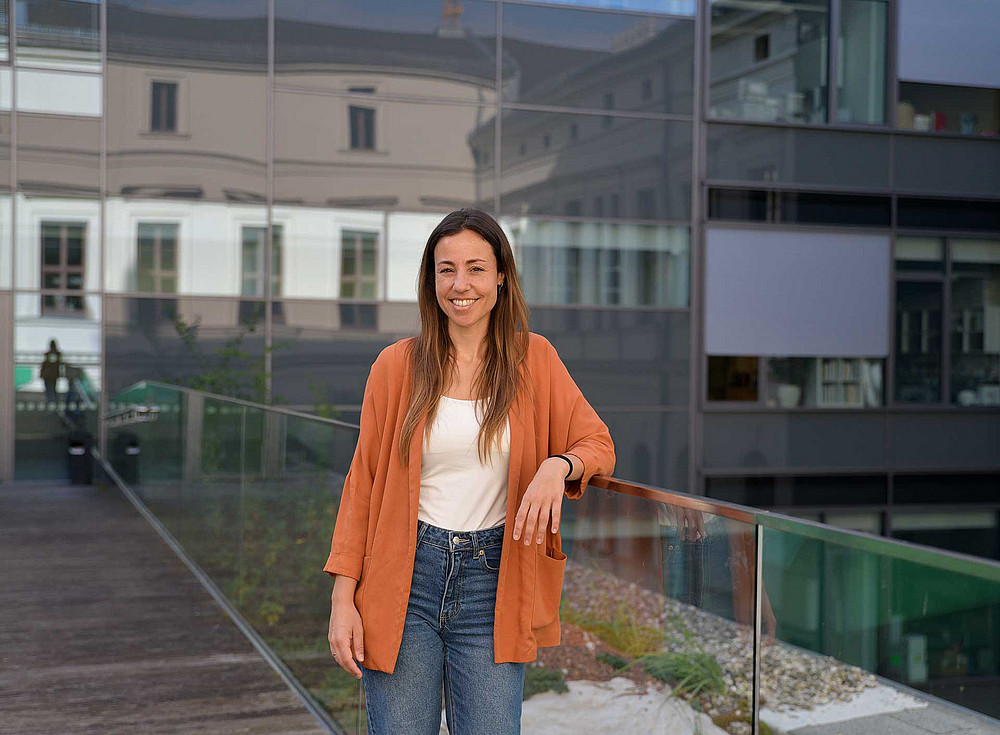
Raquel Gonzalez de Vega studies microplastics in sewage treatment plants. Photo: Uni Graz/Schweiger

First, the good news: Advance treatment like ozone can break down microplastics in waste water. The catch, as a team from the University of Graz and Med Uni Graz led by chemist Raquel Gonzalez de Vega has discovered: When broken down with the help of ozone, even smaller, persistent nanoparticles are created, which can re-enter the water cycle.

Not only is our environment full of them, microplastics are also accumulating in sewage treatment plants. “Up to 95 per cent of larger plastic pieces can be removed using existing methods,” reports chemist Raquel Gonzalez de Vega. “However, tiny particles smaller than 20 micrometres are often overlooked,” confirms the scientist from the department of Chemistry at the University of Graz. 
In the future, an additional treatment step will be required to better target these contaminants. A new EU wastewater directive obliges large sewage treatment plants to add a fourth stage, which includes the use of ozone, among other methods, to remove micropollutants such as residues from cosmetics and medicines, for example.
“But the microplastics do not disappear. They become smaller and smaller due to ozone, which causes oxidation of the plastic,” Gonzalez de Vega found in the course of her analyses.

Small particles, great effect

These plastic-nanoparticles are not only tiny, they are also extremely mobile. “The smaller they become, the greater their potential environmental impact,” warns the chemist, “because they may interact more readily with organisms and ecosystems.” The paradox here is that sewage treatment plants intended to protect the environment from plastic waste, may also act as a source of new microparticles.
Building on this findings, Gonzalez de Vega and her team plan to tackle this problem in further research. “We want to combine ozone with UV light and test the use of other catalysts to better assess and control micro- and nanoplastic formation” says Raquel Gonzalez de Vega.

The findings were recently published in the Journal of Analytical Atomic Spectrometry which highlights Raquel Gonzalez de Vega as an emerging analytical scientist.

created by Andreas Schweiger

Related news

On the trail of the Big Bang: University of Graz receives 1.5 million euros for doctoral programmes

The Austrian Science Fund FWF has selected the Doctoral Programme in Theoretical Particle Physics at the University of Graz for funding from the Doc.funds. Six young scientists will be funded for 3.5 years. They will gain fundamentally new insights into the origins of the world.

From trans women and knee prostheses: sports science prizes awarded

Walking better with a prosthesis, successfully getting rid of excess weight, training more effectively, more fairness for trans people in sport: these were the topics addressed by the students at the University of Graz who were awarded the sports science prizes for their Master's theses on 3 December 2025.

Influential: Rupert Baumgartner and Holger Hoff among the highly cited researchers

The number of publications in scientific journals is considered to be a measure of a researcher's scientific achievement. How often these works are cited by colleagues provides information about the relevance of the publications. Sustainability researcher Rupert Baumgartner and transdisciplinarity expert Holger Hoff from the University of Graz are among the top 1 per cent of the most cited scientists in their fields of research.

Nobel Lecture 2025: How evolution enters chemistry

During the Nobel Lecture at BioTechMed-Graz, Nobel Prize winner in Chemistry Frances H. Arnold provided insight into her research on the directed evolution of enzymes.

Begin of page section:
Additional information:

University of Graz
Universitaetsplatz 3
8010 Graz
Austria
  • Contact
  • Web Editors
  • Moodle
  • UNIGRAZonline
  • Imprint
  • Data Protection Declaration
  • Accessibility Declaration
Weatherstation
Uni Graz

End of this page section. Go to overview of page sections

End of this page section. Go to overview of page sections

Begin of page section:

End of this page section. Go to overview of page sections