Begin of page section:
Page sections:

  • Go to contents (Accesskey 1)
  • Go to position marker (Accesskey 2)
  • Go to main navigation (Accesskey 3)
  • Go to sub navigation (Accesskey 4)
  • Go to additional information (Accesskey 5)
  • Go to page settings (user/language) (Accesskey 8)
  • Go to search (Accesskey 9)

End of this page section. Go to overview of page sections

Begin of page section:
Page settings:

English en
Deutsch de
Search
Login

End of this page section. Go to overview of page sections

Begin of page section:
Search:

Search for details about Uni Graz
Close

End of this page section. Go to overview of page sections


Search

Begin of page section:
Main navigation:

Page navigation:

  • University

    University
    • About the University
    • Organisation
    • Faculties
    • Library
    • Working at University of Graz
    • Campus
    Developing solutions for the world of tomorrow - that is our mission. Our students and our researchers take on the great challenges of society and carry the knowledge out.
  • Research Profile

    Research Profile
    • Our Expertise
    • Research Questions
    • Research Portal
    • Promoting Research
    • Research Transfer
    • Ethics in Research
    • Commission for Scientific Integrity
    Scientific excellence and the courage to break new ground. Research at the University of Graz creates the foundations for making the future worth living.
  • Studies

    Studies
    • Prospective Students
    • Students
  • Community

    Community
    • International
    • Location
    • Research and Business
    • Alumni
    The University of Graz is a hub for international research and brings together scientists and business experts. Moreover, it fosters the exchange and cooperation in study and teaching.
Topics
  • Sustainable University
  • Researchers answer
  • Work for us
Close menu

End of this page section. Go to overview of page sections

Begin of page section:
You are here:

University of Graz News From micro to nano: the plastics slipping through our sewage plants

End of this page section. Go to overview of page sections

Tuesday, 16 September 2025

From micro to nano: the plastics slipping through our sewage plants

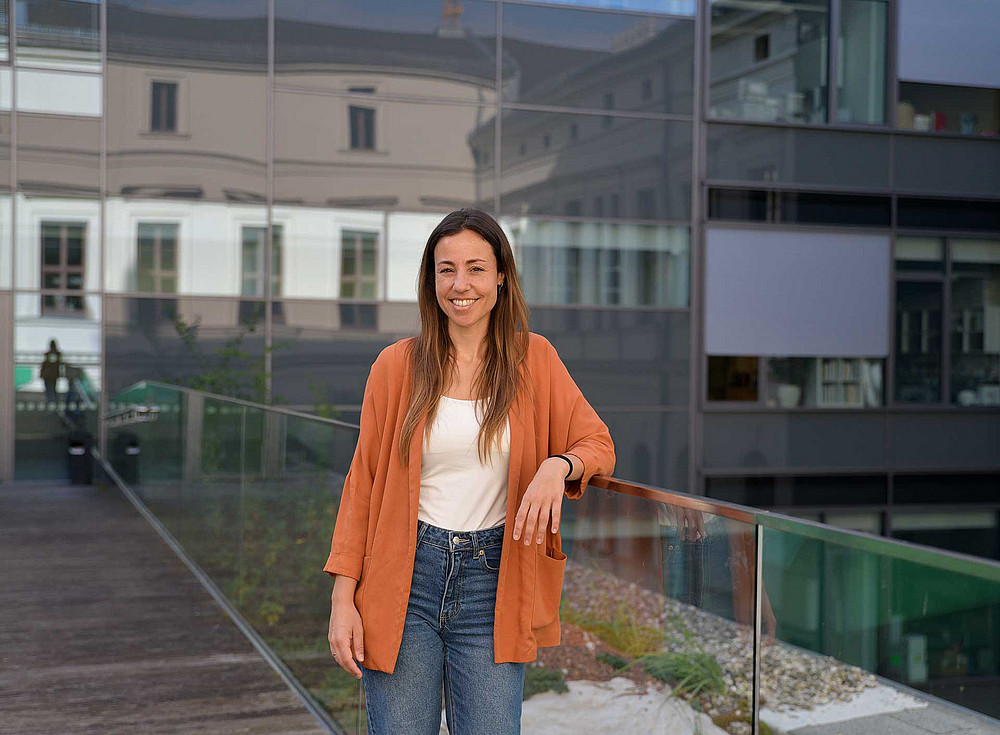
Raquel Gonzalez de Vega

Raquel Gonzalez de Vega studies microplastics in sewage treatment plants. Photo: Uni Graz/Schweiger

First, the good news: Advance treatment like ozone can break down microplastics in waste water. The catch, as a team from the University of Graz and Med Uni Graz led by chemist Raquel Gonzalez de Vega has discovered: When broken down with the help of ozone, even smaller, persistent nanoparticles are created, which can re-enter the water cycle.

Not only is our environment full of them, microplastics are also accumulating in sewage treatment plants. “Up to 95 per cent of larger plastic pieces can be removed using existing methods,” reports chemist Raquel Gonzalez de Vega. “However, tiny particles smaller than 20 micrometres are often overlooked,” confirms the scientist from the department of Chemistry at the University of Graz. 
In the future, an additional treatment step will be required to better target these contaminants. A new EU wastewater directive obliges large sewage treatment plants to add a fourth stage, which includes the use of ozone, among other methods, to remove micropollutants such as residues from cosmetics and medicines, for example.
“But the microplastics do not disappear. They become smaller and smaller due to ozone, which causes oxidation of the plastic,” Gonzalez de Vega found in the course of her analyses.

Small particles, great effect

These plastic-nanoparticles are not only tiny, they are also extremely mobile. “The smaller they become, the greater their potential environmental impact,” warns the chemist, “because they may interact more readily with organisms and ecosystems.” The paradox here is that sewage treatment plants intended to protect the environment from plastic waste, may also act as a source of new microparticles.
Building on this findings, Gonzalez de Vega and her team plan to tackle this problem in further research. “We want to combine ozone with UV light and test the use of other catalysts to better assess and control micro- and nanoplastic formation” says Raquel Gonzalez de Vega.

The findings were recently published in the Journal of Analytical Atomic Spectrometry which highlights Raquel Gonzalez de Vega as an emerging analytical scientist.

created by Andreas Schweiger

Related news

The digital world of tomorrow: University of Graz works with people to shape the future

Digitalisation is supposed to make everything better: artificial intelligence that even organises travel. The car that drives itself. Robots that care for us in our old age. But what kind of future do people actually want? What role should technology play in this? The University of Graz is exploring these questions through a new research facility. At the Graz Sociodigital and Participatory Futures Studio – or GraSP Futures Studio for short – young and old work together with researchers to design visions of the future that also critically examine technical innovations.

Superti-Furga will becomefounding director of the CORI Institute in Graz

The Austrian Academy of Sciences (ÖAW) is establishing a new flagship centre for research into metabolic diseases in collaboration with the three universities in Graz. This innovative research approach combines mathematics and experimental biology with artificial intelligence

A match for life

Stem cell donations save lives. However, the only way to determine who is ultimately compatible with whom is through a testing process. Pharmacist Marion Mußbacher explains the mechanisms behind this. On 6 May 2026, the ÖH and the charity “Geben für Leben” are calling for people to come forward for typing at the University of Graz.

Mild Research Night: Around 750 visitors travelled around the world at the university

Lovely weather and a wide range of research topics drew visitors to the University of Graz last Friday. Highlights included a journey around the globe in eight stops, a ‘speed-dating’ session with books, insights into Alfred Wegener’s Greenland expedition, and guided tours of the democracy exhibition at the UniGraz@Museum.

Begin of page section:
Additional information:

University of Graz
Universitaetsplatz 3
8010 Graz
Austria
  • Contact
  • Web Editors
  • Moodle
  • UNIGRAZonline
  • Imprint
  • Data Protection Declaration
  • Accessibility Declaration
Weatherstation
Uni Graz

End of this page section. Go to overview of page sections

End of this page section. Go to overview of page sections

Begin of page section:

End of this page section. Go to overview of page sections