Begin of page section:
Page sections:

  • Go to contents (Accesskey 1)
  • Go to position marker (Accesskey 2)
  • Go to main navigation (Accesskey 3)
  • Go to sub navigation (Accesskey 4)
  • Go to additional information (Accesskey 5)
  • Go to page settings (user/language) (Accesskey 8)
  • Go to search (Accesskey 9)

End of this page section. Go to overview of page sections

Begin of page section:
Page settings:

English en
Deutsch de
Search
Login

End of this page section. Go to overview of page sections

Begin of page section:
Search:

Search for details about Uni Graz
Close

End of this page section. Go to overview of page sections


Search

Begin of page section:
Main navigation:

Page navigation:

  • University

    University
    • About the University
    • Organisation
    • Faculties
    • Library
    • Working at University of Graz
    • Campus
    Developing solutions for the world of tomorrow - that is our mission. Our students and our researchers take on the great challenges of society and carry the knowledge out.
  • Research Profile

    Research Profile
    • Our Expertise
    • Research Questions
    • Research Portal
    • Promoting Research
    • Research Transfer
    • Ethics in Research
    Scientific excellence and the courage to break new ground. Research at the University of Graz creates the foundations for making the future worth living.
  • Studies

    Studies
    • Prospective Students
    • Students
  • Community

    Community
    • International
    • Location
    • Research and Business
    • Alumni
    The University of Graz is a hub for international research and brings together scientists and business experts. Moreover, it fosters the exchange and cooperation in study and teaching.
  • Spotlight
Topics
  • Sustainable University
  • Researchers answer
  • Work for us
Close menu

End of this page section. Go to overview of page sections

Begin of page section:
You are here:

University of Graz News Vom Schreibtisch aufs Podest

End of this page section. Go to overview of page sections

Friday, 08 May 2015

Vom Schreibtisch aufs Podest

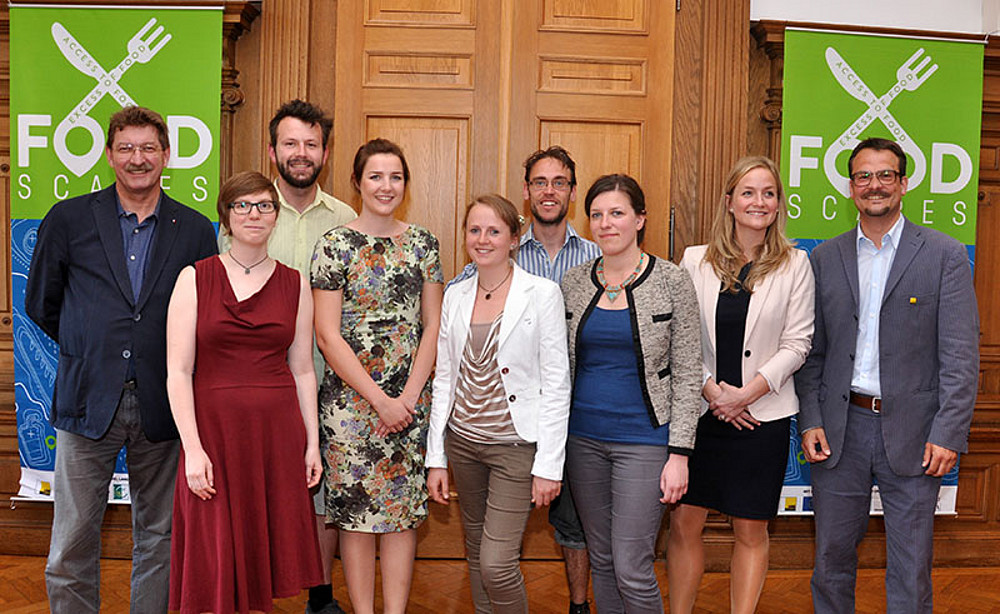
Vizerektor Peter Scherrer (ganz links) und Foodscapes-Award-Initiator Ulrich Ermann (ganz rechts) mit den PreisträgerInnen 2014. Foto: Uni Graz/Tzivanopoulos.

Vizerektor Peter Scherrer (ganz links) und Foodscapes-Award-Initiator Ulrich Ermann (ganz rechts) mit den PreisträgerInnen 2014. Foto: Uni Graz/Tzivanopoulos.

Der Foodscapes Award ehrt vorbildliche Abschlussarbeiten zum Thema Produktion und Konsum von Lebensmitteln

Wie kann man sich heute noch moralisch einwandfrei ernähren? Welche Alternativen zu Massentierhaltung und Monokulturen gibt es überhaupt? Wohin führen Trends wie Globalisierung und Regionalisierung des Essens? Was bedeutet qualitätsvolle Nahrung?


Mit diesen und ähnlichen Fragen setzen sich jene neun Abschlussarbeiten auseinander, die gestern im Alten Senatssaal der Uni Graz mit dem Foodscapes Award 2014 ausgezeichnet wurden. Der erstmals vergebene Förderpreis ehrt vorbildliche Abschlussarbeiten zum Thema Produktion und Konsum von Lebensmitteln. Die Jury unter Vorsitz von Vizerektor Peter Scherrer, der auch WissenschafterInnen  unterschiedlicher Fachbereiche sowie VertreterInnen der Steirischen Landesregierung und der EU-LEADER-Regionen Almenland und Steirisches Vulkanland angehörten, kürte folgende GewinnerInnen:


Hauptpreise in der Kategorie Bachelorarbeit:

Gabriele Krotschek (Universität Graz, Umweltsystemwissenschaften, Schwerpunkt BWL)
Marie-Kristin Mandl (Pädagogische Hochschule Steiermark, Humanwissenschaften)
David Steinwender  (Universität Graz, Umweltsystemwissenschaften, Schwerpunkt Geographie)


Sonderpreise in der Kategorie Bachelorarbeit
Christina Reithofer (Universität Graz, Geographie)
Veronika Rogenhofer (Universität Graz, Germanistik)


Hauptpreise in der Kategorie Master- und Diplomarbeit
Ulrike Ehgartner (Universität Graz, Erziehungswissenschaften)
Simone Mayer (Universität Graz, Umweltsystemwissenschaften, International Joint Master’s Programme in Sustainable Development)
Iris Anna Maria Ragger (TU Graz, Biotechnologie)


Sonderpreis in der Kategorie Master- und Diplomarbeit

Sascha Vanicek (Universität Graz, Pflanzenwissenschaften)


Die GewinnerInnen werden mit Geldpreisen zwischen 500 und 1.500 Euro (jeweils die ersten Plätze pro Kategorie) gewürdigt. Nach der Eröffnung von Univ.-Prof. Dr. Ulrich Ermann vom Institut für Geographie und Raumforschung der Uni Graz und Michael Fend, Leader-Region „Steirisches Vulkanland“, hielt Prof. Henry Buller, PhD, von der University of Exeter einen Vortrag zum Thema "Food Studies and Animal Geographies". Vizerektor Scherrer unterstrich in seinen Begrüßungsworten die Bedeutung des Preises, der Freude bereiten und Motivation für weitere wissenschaftliche Arbeiten schaffen soll.


Der Förderpreis wird von der Karl-Franzens-Universität Graz gemeinsam mit den EU-LEADER-Regionen Almenland und Steirisches Vulkanland sowie der Steirischen Landesregierung vergeben.

created by Gerhild Kastrun

Related news

Diversity buddies at the University of Graz: Support on equal terms

The University of Graz is strengthening its commitment to equal opportunities with its new Diversity Buddies. University members can find easily accessible contact persons here for questions relating to equality and diversity. All employees can get involved and take action.

When parents find it difficult to have a say

In her dissertation, translation scholar Marie Tschurtschenthaler examines how communication between compulsory schools and parents whose first language is not German works – and what role professional language mediation plays in this. Initial insights show that it is not just about language, but also about resources, responsibilities and the institutional framework.

AI in schools: Maria Bertel drafts legal guidelines for teachers

The legal expert and her team analysed the legal situation regarding the use of artificial intelligence in education as part of an EU project and answered open questions from practice.

Cosmetics in the environment: University of Graz proves danger to ants

Titanium dioxide, which is found in cosmetics, for example, is increasingly entering the environment in the form of nanoparticles. This could also put insects at risk. If ants ingest the substance in combination with the pesticide glyphosate, it disturbs the development of their offspring. Scientists at the University of Graz are drawing attention to the negative consequences of this toxic cocktail.

Begin of page section:
Additional information:

University of Graz
Universitaetsplatz 3
8010 Graz
Austria
  • Contact
  • Web Editors
  • Moodle
  • UNIGRAZonline
  • Imprint
  • Data Protection Declaration
  • Accessibility Declaration
Weatherstation
Uni Graz

End of this page section. Go to overview of page sections

End of this page section. Go to overview of page sections

Begin of page section:

End of this page section. Go to overview of page sections