Begin of page section:
Page sections:

  • Go to contents (Accesskey 1)
  • Go to position marker (Accesskey 2)
  • Go to main navigation (Accesskey 3)
  • Go to sub navigation (Accesskey 4)
  • Go to additional information (Accesskey 5)
  • Go to page settings (user/language) (Accesskey 8)
  • Go to search (Accesskey 9)

End of this page section. Go to overview of page sections

Begin of page section:
Page settings:

English en
Deutsch de
Search
Login

End of this page section. Go to overview of page sections

Begin of page section:
Search:

Search for details about Uni Graz
Close

End of this page section. Go to overview of page sections


Search

Begin of page section:
Main navigation:

Page navigation:

  • University

    University
    • About the University
    • Organisation
    • Faculties
    • Library
    • Working at University of Graz
    • Campus
    Developing solutions for the world of tomorrow - that is our mission. Our students and our researchers take on the great challenges of society and carry the knowledge out.
  • Research Profile

    Research Profile
    • Our Expertise
    • Research Questions
    • Research Portal
    • Promoting Research
    • Research Transfer
    • Ethics in Research
    • Commission for Scientific Integrity
    Scientific excellence and the courage to break new ground. Research at the University of Graz creates the foundations for making the future worth living.
  • Studies

    Studies
    • Prospective Students
    • Students
    • Registration for Study Programme (Winter semester 2026/27)
  • Community

    Community
    • International
    • Location
    • Research and Business
    • Alumni
    The University of Graz is a hub for international research and brings together scientists and business experts. Moreover, it fosters the exchange and cooperation in study and teaching.
Topics
  • Sustainable University
  • Researchers answer
  • Work for us
Close menu

End of this page section. Go to overview of page sections

Begin of page section:
You are here:

University of Graz News Vom Schreibtisch aufs Podest

End of this page section. Go to overview of page sections

Friday, 08 May 2015

Vom Schreibtisch aufs Podest

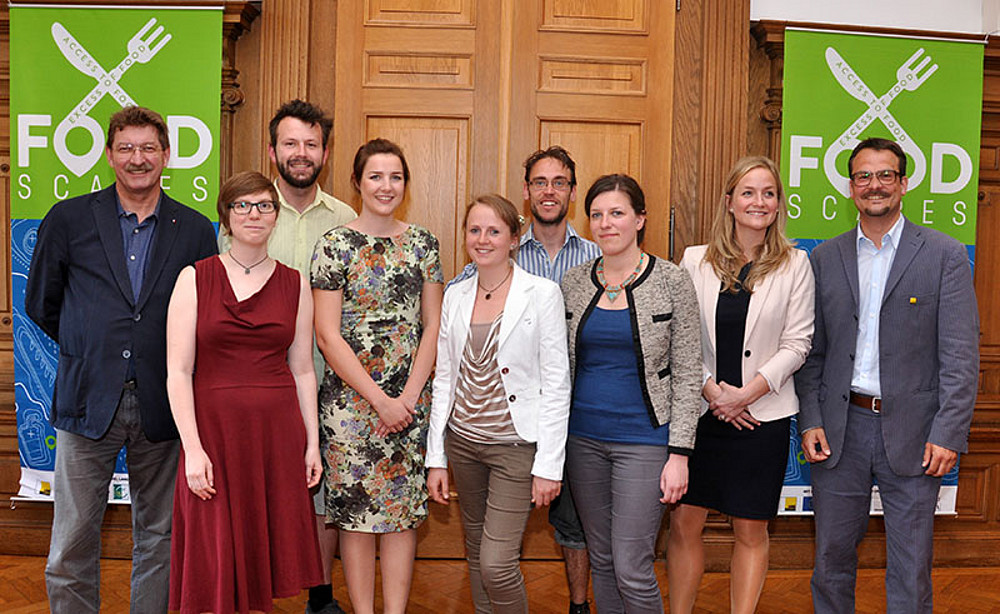
Vizerektor Peter Scherrer (ganz links) und Foodscapes-Award-Initiator Ulrich Ermann (ganz rechts) mit den PreisträgerInnen 2014. Foto: Uni Graz/Tzivanopoulos.

Vizerektor Peter Scherrer (ganz links) und Foodscapes-Award-Initiator Ulrich Ermann (ganz rechts) mit den PreisträgerInnen 2014. Foto: Uni Graz/Tzivanopoulos.

Der Foodscapes Award ehrt vorbildliche Abschlussarbeiten zum Thema Produktion und Konsum von Lebensmitteln

Wie kann man sich heute noch moralisch einwandfrei ernähren? Welche Alternativen zu Massentierhaltung und Monokulturen gibt es überhaupt? Wohin führen Trends wie Globalisierung und Regionalisierung des Essens? Was bedeutet qualitätsvolle Nahrung?


Mit diesen und ähnlichen Fragen setzen sich jene neun Abschlussarbeiten auseinander, die gestern im Alten Senatssaal der Uni Graz mit dem Foodscapes Award 2014 ausgezeichnet wurden. Der erstmals vergebene Förderpreis ehrt vorbildliche Abschlussarbeiten zum Thema Produktion und Konsum von Lebensmitteln. Die Jury unter Vorsitz von Vizerektor Peter Scherrer, der auch WissenschafterInnen  unterschiedlicher Fachbereiche sowie VertreterInnen der Steirischen Landesregierung und der EU-LEADER-Regionen Almenland und Steirisches Vulkanland angehörten, kürte folgende GewinnerInnen:


Hauptpreise in der Kategorie Bachelorarbeit:

Gabriele Krotschek (Universität Graz, Umweltsystemwissenschaften, Schwerpunkt BWL)
Marie-Kristin Mandl (Pädagogische Hochschule Steiermark, Humanwissenschaften)
David Steinwender  (Universität Graz, Umweltsystemwissenschaften, Schwerpunkt Geographie)


Sonderpreise in der Kategorie Bachelorarbeit
Christina Reithofer (Universität Graz, Geographie)
Veronika Rogenhofer (Universität Graz, Germanistik)


Hauptpreise in der Kategorie Master- und Diplomarbeit
Ulrike Ehgartner (Universität Graz, Erziehungswissenschaften)
Simone Mayer (Universität Graz, Umweltsystemwissenschaften, International Joint Master’s Programme in Sustainable Development)
Iris Anna Maria Ragger (TU Graz, Biotechnologie)


Sonderpreis in der Kategorie Master- und Diplomarbeit

Sascha Vanicek (Universität Graz, Pflanzenwissenschaften)


Die GewinnerInnen werden mit Geldpreisen zwischen 500 und 1.500 Euro (jeweils die ersten Plätze pro Kategorie) gewürdigt. Nach der Eröffnung von Univ.-Prof. Dr. Ulrich Ermann vom Institut für Geographie und Raumforschung der Uni Graz und Michael Fend, Leader-Region „Steirisches Vulkanland“, hielt Prof. Henry Buller, PhD, von der University of Exeter einen Vortrag zum Thema "Food Studies and Animal Geographies". Vizerektor Scherrer unterstrich in seinen Begrüßungsworten die Bedeutung des Preises, der Freude bereiten und Motivation für weitere wissenschaftliche Arbeiten schaffen soll.


Der Förderpreis wird von der Karl-Franzens-Universität Graz gemeinsam mit den EU-LEADER-Regionen Almenland und Steirisches Vulkanland sowie der Steirischen Landesregierung vergeben.


created by Gerhild Kastrun

Related news

Sport beyond the World Cup: the TV channel “Welt der Wunder” features diabetes research from the University of Graz

Keeping blood sugar levels in check during physical exertion is a particular challenge for people with type 1 diabetes. Othmar Moser examines how those affected manage to balance physical activity, sport and their metabolic disorder.

"Mathematics explains the world"

How can life be quantified? And what can science reveal that remains hidden from the naked eye? The 14th European Conference on Mathematical and Theoretical Biology at the University of Graz is dedicated to these questions. From 13 to 17 July, around 1,300 researchers from all over the world will gather on campus to discuss models, biological processes and the future of data-driven medicine. Klemens Fellner, Dean of the Faculty of Natural Sciences and Mathematics and a mathematician, talks about the language that explains the world

Internationally up-to-date: University of Graz offers new degree programmes in art studies

From the Old Masters to AI art – three newly designed degree programmes offer students at the University of Graz fresh perspectives on artistic production. In addition to historical art, the programmes place a greater emphasis on contemporary and global developments. The registration period is open.

The Nazi elite school Napola: Historian seeks memories and personal documents

They were to be brought up to become the future elite of National Socialism: boys and girls aged ten and over who, following the ‘Anschluss’ of Austria to the German Reich, attended a so-called Napola (short for Nationalpolitische Lehranstalt; also known as NPEA, Nationalpolitische Erziehungsanstalt). There were nine such institutions in what is now Austria between 1939 and 1945.

Begin of page section:
Additional information:

University of Graz
Universitaetsplatz 3
8010 Graz
Austria
  • Contact
  • Web Editors
  • Moodle
  • UNIGRAZonline
  • Imprint
  • Data Protection Declaration
  • Accessibility Declaration
Weatherstation
Uni Graz

End of this page section. Go to overview of page sections

End of this page section. Go to overview of page sections

Begin of page section:

End of this page section. Go to overview of page sections