Begin of page section:
Page sections:

  • Go to contents (Accesskey 1)
  • Go to position marker (Accesskey 2)
  • Go to main navigation (Accesskey 3)
  • Go to sub navigation (Accesskey 4)
  • Go to additional information (Accesskey 5)
  • Go to page settings (user/language) (Accesskey 8)
  • Go to search (Accesskey 9)

End of this page section. Go to overview of page sections

Begin of page section:
Page settings:

English en
Deutsch de
Search
Login

End of this page section. Go to overview of page sections

Begin of page section:
Search:

Search for details about Uni Graz
Close

End of this page section. Go to overview of page sections


Search

Begin of page section:
Main navigation:

Page navigation:

  • University

    University
    • About the University
    • Organisation
    • Faculties
    • Library
    • Working at University of Graz
    • Campus
    Developing solutions for the world of tomorrow - that is our mission. Our students and our researchers take on the great challenges of society and carry the knowledge out.
  • Research Profile

    Research Profile
    • Our Expertise
    • Research Questions
    • Research Portal
    • Promoting Research
    • Research Transfer
    • Ethics in Research
    Scientific excellence and the courage to break new ground. Research at the University of Graz creates the foundations for making the future worth living.
  • Studies

    Studies
    • Prospective Students
    • Students
  • Community

    Community
    • International
    • Location
    • Research and Business
    • Alumni
    The University of Graz is a hub for international research and brings together scientists and business experts. Moreover, it fosters the exchange and cooperation in study and teaching.
  • Spotlight
Topics
  • StudiGPT is here! Try it out!
  • Sustainable University
  • Researchers answer
  • Work for us
Close menu

End of this page section. Go to overview of page sections

Begin of page section:
You are here:

University of Graz News Census on the ground: searching for insects with schoolchildren

End of this page section. Go to overview of page sections

Thursday, 14 August 2025

Census on the ground: searching for insects with schoolchildren

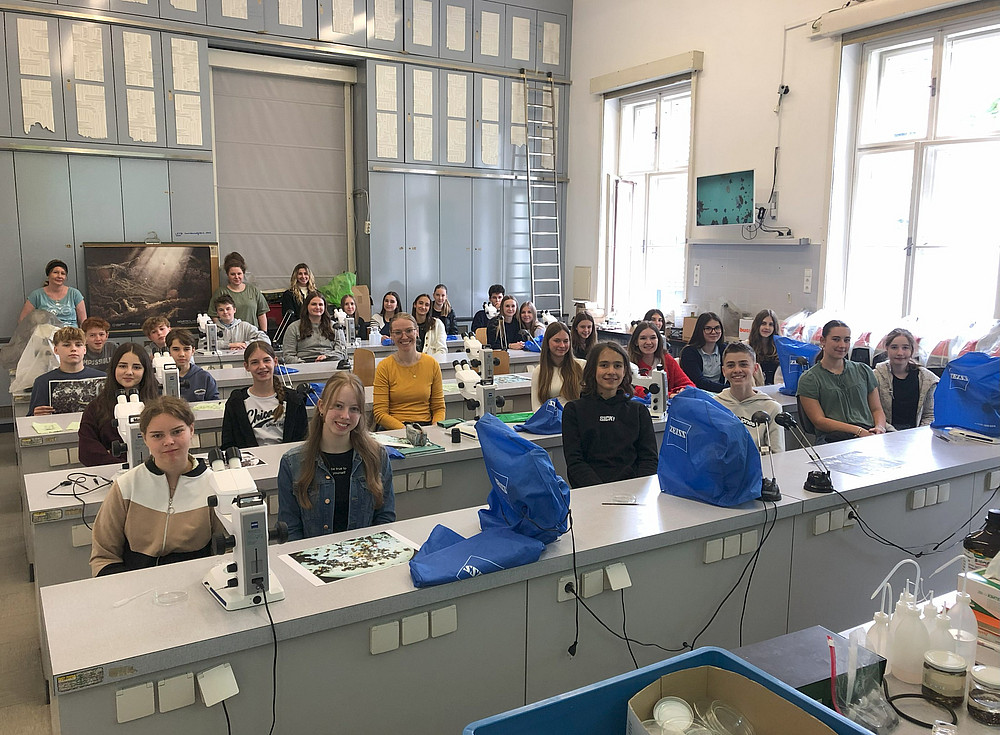
A group of students in a German high school laboratory, sitting at their desks and smiling for a photo with blue-bagged science supplies on top of each desk. In front is an electric microscope that shines light into a small plastic box filled with organic material.

Students from the Bad Gleichenberg private high school examine their samples at the University of Graz. Photo: University of Graz/Schäffer

In the research project “Pillars of Soils,” the University of Graz is investigating microorganisms in the soil that have hardly been studied before. Together with school students, they are searching for millipedes, springtails, and horn mites at various locations. Interest in further partner schools is welcome.

When walking through meadows or forests, you immerse yourself in a complex ecosystem without even noticing it. Thousands upon thousands of tiny creatures crawl and scurry through the soil, decomposing dead biomass and thus ensuring a healthy natural environment. These fascinating but little-studied soil dwellers are the focus of the Pillars of Soils project, which is being carried out by the University of Graz in collaboration with the Austrian Academy of Sciences.

“When it comes to soil quality, most people think of earthworms, but the real VIPs in the soil are actually horn mites, springtails, and millipedes,” says biologist Sylvia Schäffer. “They also occur where there are hardly any earthworms.” A census of the soil is therefore currently being carried out at 18 locations in Styria and Lower Austria.

New territory

“The exciting thing about this is that this data on different soil types does not yet exist. It's uncharted territory,” says Michaela Bodner. “It's important that we always examine soils that are close to nature and soils that have been influenced by humans at the various locations.” It will take several years to determine how the “population” at these locations is changing and why. But at least one finding is already clear: “There are fewer different species in cultivated areas than in untouched areas, but they are more numerous,” says Bodner. “Less biodiversity does not therefore automatically mean poorer soil quality.”

An important part of the project is also the collaboration with school students. A first partner school has already been found: the Bad Gleichenberg private high school. “The young people collected soil samples in three different subjects,” explains Schäffer. “In chemistry class, they analyzed the mineral content, in technical studies, they built Berlese filters to extract the tiny organisms from the soil, and in biology, they counted and examined the different species.” A particular highlight was a day spent in the laboratories at the University of Graz.

Search for schools

“This is a real flagship project for us,” say the biologists. “Both the teachers and the students were enthusiastic. The students not only acquired new skills, but also overcame their fear of creepy-crawlies.” The scientists now want to establish the high school as a permanent monitoring site and hope to inspire other schools to join the project. “The students learn how to work as researchers and discover how exciting science is,” Schäffer sums up.

And if, like the students, you want to see the world through new eyes, the University of Graz, with its wide range of science subjects, is the right place for you.

Would you like to be part of projects like this, experience science up close, and see the world through new eyes? Discover the diversity of science studies at the University of Graz and start your own research journey!

created by Roman Vilgut

Related news

Bio-plastics and baroque theatre: Awards for two researchers from the University of Graz

Chemist Katalin Barta Weissert received this year's "Forschungspreis des Landes Steiermark", while Germanist Christian Neuhuber received the "Erzherzog-Johann-Forschungspreis". The awards are endowed with 12,000 euros each and are presented for outstanding achievements in the field of science and research. Provincial Councillor Willibald Ehrenhöfer presented the awards on 7 November 2025 in the White Hall of Graz Castle.

EU supports team led by molecular biologist Brigitte Pertschy with around ten million euro

The European Research Council (ERC) is funding the snoOPERA project with around ten million euros to research the structure of cellular protein factories. The four researchers involved want to clarify how tiny RNA-protein complexes control the formation of ribosomes—a key to understanding diseases such as cancer and Alzheimer's.

Maths made easy: how gaming elements motivate children to practise

Where does the six belong on a number line from one to ten? This task is a challenge for children with dyscalculia. For fear of failure, many are reluctant to tackle the exercise in the first place. A playful approach can remove this obstacle and give the affected pupils more self-confidence, as psychologist Manuel Ninaus found out in a study.

How artificial intelligence is changing the digital future in Europe

On November 20, 2025, the Technology Impact Summit at the Seifenfabrik in Graz will bring together experts from politics, business, and science. The focus will be on how artificial intelligence is transforming our working world and which specific AI solutions are already being used successfully today.

Begin of page section:
Additional information:

University of Graz
Universitaetsplatz 3
8010 Graz
Austria
  • Contact
  • Web Editors
  • Moodle
  • UNIGRAZonline
  • Imprint
  • Data Protection Declaration
  • Accessibility Declaration
Weatherstation
Uni Graz

End of this page section. Go to overview of page sections

End of this page section. Go to overview of page sections

Begin of page section:

End of this page section. Go to overview of page sections