



Begin of page section:
Page sections:

  • Go to contents (Accesskey 1)
  • Go to position marker (Accesskey 2)
  • Go to main navigation (Accesskey 3)
  • Go to sub navigation (Accesskey 4)
  • Go to additional information (Accesskey 5)
  • Go to page settings (user/language) (Accesskey 8)
  • Go to search (Accesskey 9)

End of this page section. Go to overview of page sections

Begin of page section:
Page settings:

English en
Deutsch de
Search
Login

End of this page section. Go to overview of page sections

Begin of page section:
Search:

Search for details about Uni Graz
Close

End of this page section. Go to overview of page sections


Search

Begin of page section:
Main navigation:

Page navigation:

  • University

    University
    • About the University
    • Organisation
    • Faculties
    • Library
    • Working at University of Graz
    • Campus
    Developing solutions for the world of tomorrow - that is our mission. Our students and our researchers take on the great challenges of society and carry the knowledge out.
  • Research Profile

    Research Profile
    • Our Expertise
    • Research Questions
    • Research Portal
    • Promoting Research
    • Research Transfer
    • Ethics in Research
    • Commission for Scientific Integrity
    Scientific excellence and the courage to break new ground. Research at the University of Graz creates the foundations for making the future worth living.
  • Studies

    Studies
    • Prospective Students
    • Students
    • Registration for Study Programme (Winter semester 2026/27)
    • Welcome Weeks for First Year Students
  • Community

    Community
    • International
    • Location
    • Research and Business
    • Alumni
    The University of Graz is a hub for international research and brings together scientists and business experts. Moreover, it fosters the exchange and cooperation in study and teaching.
Topics
  • Sustainable University
  • Researchers answer
  • Work for us
Close menu

End of this page section. Go to overview of page sections

Begin of page section:
You are here:

University of Graz News Vice-Rector van Poppel: "Bringing the best minds together"

End of this page section. Go to overview of page sections

Tuesday, 30 January 2024

Vice-Rector van Poppel: "Bringing the best minds together"

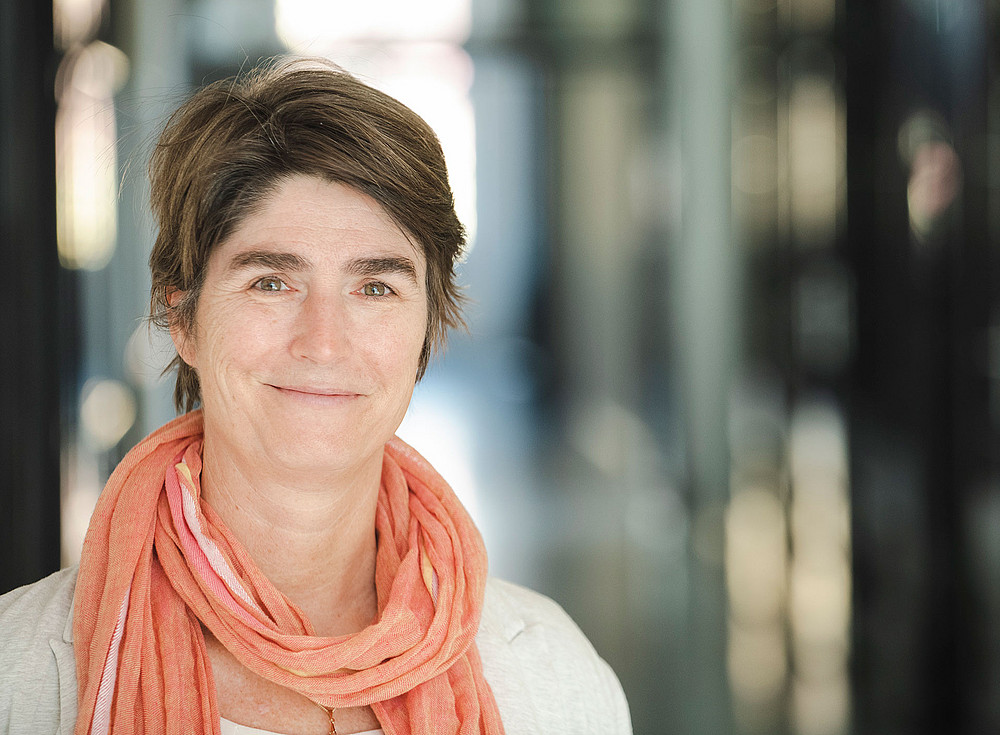
Mireille van Poppel ©Uni Graz/Tzivanopoulos
©Uni Graz/Tzivanopoulos

Vice-Rector van Poppel: "We are working on expanding English language skills at the university." Photo: Uni Graz/Tzivanopoulos

As a worldwide orientated research and educational institution, the University of Graz provides a network with renowned partner institutions. Collaboration is continuously being expanded and intensified. Mireille van Poppel, Vice-Rector for Internationalisation and Gender Equality, explains why the exchange with colleagues from other countries and cultures is so important and how the University of Graz wants to become even more attractive for students and excellent researchers from abroad.

The University of Graz is an active partner in various international networks, such as the COIMBRA Group. The cooperation in the European university alliance ARQUS is particularly far-reaching. How does the University of Graz specifically benefit from this alliance?  
Van Poppel: In my opinion, the added value of ARQUS lies above all in the fact that this alliance of nine European universities also includes the non-scientific sector. Researchers have more opportunities to exchange ideas, for example at international conferences. ARQUS should also motivate university employees from the administration to visit colleagues from other universities and get ideas on how they deal with current challenges and solve problems.
 
What are the benefits of a stay at another university for students?  
Van Poppel: For doctoral students who want to pursue a career in science, it is incredibly important to be able to show that you have worked internationally.In the Bachelor's and Master's programmes, a semester abroad does not help many students significantly in terms of content. Nevertheless, it is a personal enrichment and very valuable for later life.If you work or study somewhere else for a while, you have to integrate and exchange ideas.Then you may have more understanding for people who have different habits, look different, speak a different language.It helps to learn to appreciate diversity and to overcome any fears you may have.This is an added value of internationalisation not only for universities, but also for society as a whole.


created by Gudrun Pichler

Related news

How formulas are making medicine more personalised

When Federica Caforio talks about the heart, it doesn’t sound like an operating theatre, but rather like equations, parameters and simulations. Yet this is precisely where the medical promise of her research lies: one day, clinical data will be used to create a digital twin of the heart – a virtual model that will enable a better understanding of diseases and allow for more personalised treatment plans. She will be presenting her research at the ‘ECMTB 2026’ mathematics conference.

University Spin-Off Company “Innovation Hub Graz” works to make Spin-Offs investor ready

The Medical University of Graz, University of Graz and TU Graz are once again joining forces to establish a joint Innovation Hub Graz (iHub Graz). At this transfer centre, selected, particularly promising university spin-offs are specifically prepared to be investor ready.

Adhesive force: Researchers demonstrate how cells determine their function

How does a single cell develop into an organism with skin, muscles, intestines, a heart and other specialised tissues? Two studies published in leading journals have identified a mechanism that links genes, chemical signals and the physical properties of tissues. Scientists from London, Heidelberg and Graz were involved in the research.

Vitamin E is the key: a pharmacist has discovered a substance that ‘switches off’ inflammation

Alzheimer’s, obesity or atherosclerosis: many lifestyle-related diseases are driven by or accompanied by inflammation. “Treatments usually aim to halt the progression of inflammation. However, for a long-term cure, it must be completely resolved,” explains Andreas Koeberle, a pharmacist at the University of Graz. Normally, the body carries out this work itself. However, if this process does not function properly, chronic inflammation can develop, which can contribute to conditions such as cardiovascular disease or cancer.

Begin of page section:
Additional information:

University of Graz
Universitaetsplatz 3
8010 Graz
Austria
  • Contact
  • Web Editors
  • Moodle
  • UNIGRAZonline
  • Imprint
  • Data Protection Declaration
  • Accessibility Declaration
Weatherstation
Uni Graz

End of this page section. Go to overview of page sections

End of this page section. Go to overview of page sections

Begin of page section:

End of this page section. Go to overview of page sections