Begin of page section:
Page sections:

  • Go to contents (Accesskey 1)
  • Go to position marker (Accesskey 2)
  • Go to main navigation (Accesskey 3)
  • Go to sub navigation (Accesskey 4)
  • Go to additional information (Accesskey 5)
  • Go to page settings (user/language) (Accesskey 8)
  • Go to search (Accesskey 9)

End of this page section. Go to overview of page sections

Begin of page section:
Page settings:

English en
Deutsch de
Search
Login

End of this page section. Go to overview of page sections

Begin of page section:
Search:

Search for details about Uni Graz
Close

End of this page section. Go to overview of page sections


Search

Begin of page section:
Main navigation:

Page navigation:

  • University

    University
    • About the University
    • Organisation
    • Faculties
    • Library
    • Working at University of Graz
    • Campus
    Developing solutions for the world of tomorrow - that is our mission. Our students and our researchers take on the great challenges of society and carry the knowledge out.
  • Research Profile

    Research Profile
    • Our Expertise
    • Research Questions
    • Research Portal
    • Promoting Research
    • Research Transfer
    • Ethics in Research
    • Commission for Scientific Integrity
    Scientific excellence and the courage to break new ground. Research at the University of Graz creates the foundations for making the future worth living.
  • Studies

    Studies
    • Prospective Students
    • Students
    • Post-registration Law
  • Community

    Community
    • International
    • Location
    • Research and Business
    • Alumni
    The University of Graz is a hub for international research and brings together scientists and business experts. Moreover, it fosters the exchange and cooperation in study and teaching.
Topics
  • Sustainable University
  • Researchers answer
  • Work for us
Close menu

End of this page section. Go to overview of page sections

Begin of page section:
You are here:

University of Graz News Invasion: American oak lace bug is spreading in Styria

End of this page section. Go to overview of page sections

Friday, 19 July 2024

Invasion: American oak lace bug is spreading in Styria

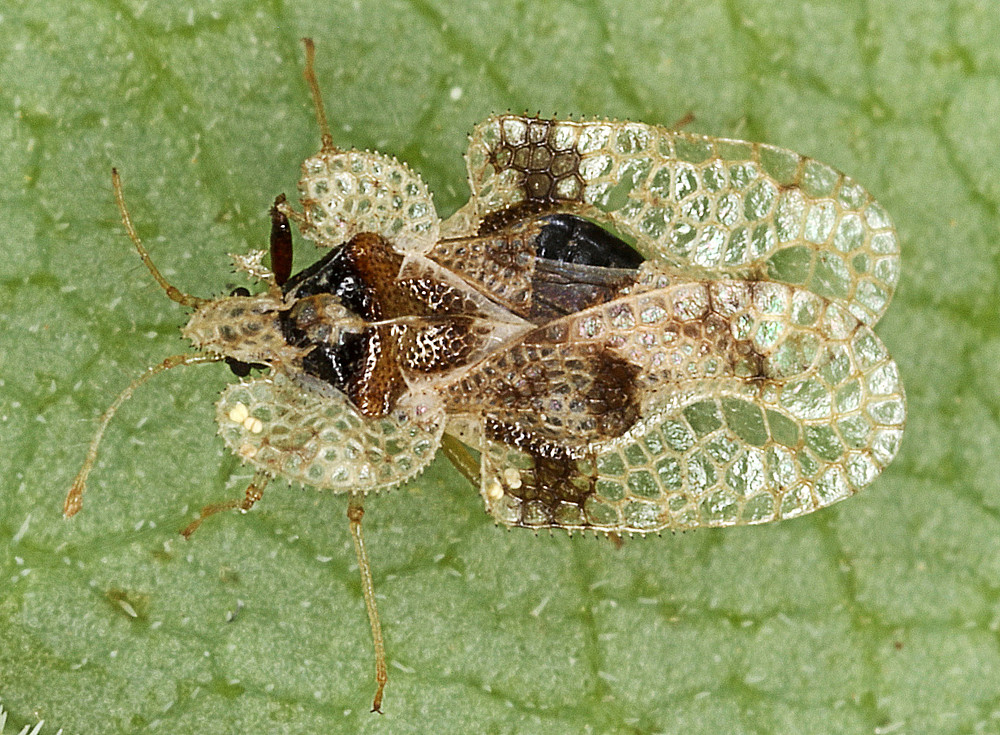
Macro photograph of an oak lace bug on a leaf ©University of Graz/Kunz

The American oak lace bug is "the most invasive species in Central Europe" according to entomologist Gernot Kunz. Photo: University of Graz/Kunz

They may be tiny, but there are many, many of them. Oak lace bugs imported from North America are currently flooding Styria by the billions. Some media have already reported on the explosive multiplication of the little creatures, which are only three millimetres in size. Gernot Kunz, an insect researcher at the University of Graz, has been observing and documenting their spread and the damage they cause to native oak trees for four years.

Many of us have encountered oak lace bugs in the last few days: outside in nature, on the balcony, on laundry hung out to dry, even in the home. Or up close and personal: when they try to see if there is anything to suck on us, it can be a little painful for a short time. There are even reports of itching and redness on the internet. But that seems to be it. Because "the most invasive species in Central Europe", as Gernot Kunz says, is not targeting humans, but - as its name suggests - our oak trees. "Their leaves are already turning brown," observes the insect researcher at the Institute of Biology at the University of Graz. "Thousands of them are sucking on the undersides of the leaves. But only on our native oak, ironically not on the American red oak behind it," says Kunz.

On the advance

In 2019, the American oak lace bug (Corythucha arcuata) was discovered for the first time in Austria in south-east Styria. However, Gernot Kunz suspects that it was already widespread there at the time. "We are far too few experts in this field and don't manage to keep an eye on everything," explains the researcher. The first European record dates back to the year 2000 in Italy. The species has since spread across southern and south-eastern Europe. It was probably introduced with timber transport, among other things. Now it also travels with the wind. The bugs themselves are not particularly good at flying.

"In the coming years, they will spread much further north and west in Austria. The greater the occurrence of native oaks, the more the pest will spread," predicts Kunz. The reason why their numbers have exploded so much this year is probably due to the warm winter and the lack of natural enemies. "The specimens we are now seeing on the leaves are already the second or third generation this year. More may follow," says the biologist. Bugs usually go through five nymphal stages before they are able to fly and become sexually mature. In the case of the oak lace bug, it takes about a month from hatching from the egg to laying eggs again.

Unstoppable yet

"The invasive species' biggest enemy is cold spells with prolonged, very low temperatures. But these are becoming increasingly rare," says the scientist, citing one of the main reasons for their rapid proliferation. The biologist knows that the pests are eaten by birds and spiders. Possibly also by certain insect larvae, the so-called aphid lions. However, there is no evidence of this in our country as yet. Only predators and parasites specialising in oak lace bugs could decimate them. These have not yet been seen here. "But they will certainly come," Kunz is convinced. "Just like the Asian ladybird or the invasive green rice bug. The ecosystem will adapt to the invaders. But it will take a few more years," estimates the biologist. In North America, other predatory bug species and above all small parasitic wasps are preventing the strong spread of Corythucha arcuata.

And until then? Kunz warns against using poison: "The use of insecticides should be strictly avoided, as they have an unspecific effect and are blown away by the wind." Instead, you should wait for natural enemies and then help out a little if necessary: "A specialised parasitic wasp is known from North America, for example. If breeding is successful, this could be actively used for biological pest control." However, this would first have to be authorised by AGES, the Austrian Agency for Health and Food Safety. "It is important to ensure that these wasps do not also infest our native lace bugs. There are almost 70 of these species, some of which are very rare and relevant from a nature conservation perspective," explains Kunz.

Consequences for nature

The biologist is convinced that our forest will survive. "Infected oaks will not die, even if the damage to their leaves leads to a significant reduction in photosynthesis and therefore to reduced growth. Young oaks in particular are much more at risk due to a high density of game, especially the roe deer," the biologist points out. Kunz believes it is unlikely that other tree species will also be attacked by the North American pest at these densities in the future. "It is very rare for a species that specialises in one plant or plant genus to switch hosts. If you see them on other trees and shrubs, as is the case now, the wind is probably responsible for that. Reports of observations on sweet chestnut and Norway maple must first be verified." With a view to future-oriented forestry, the researcher sees the danger that more emphasis will be placed on red oak from North America instead of native oaks, as originally planned. This is because the former is spared from Corythucha arcuata.

The native insect world is particularly hard hit by the mass spread of the American oak lace bug. As the leaves sucked by the invaders already turn brown in summer, they are no longer available as food in autumn, especially for the typhlocybine leafhoppers and mirid bugs. "When we recently netted an oak tree, we had only very few of these insects in our nets. It used to be different. It would be interesting to investigate the current situation and further development in an area that will soon be flooded by oak lace bugs, such as Upper Austria," Kunz suggests urgently needed research.
Distribution of the oak lace bug in Austria

Distribution of the oak lace bug worldwide

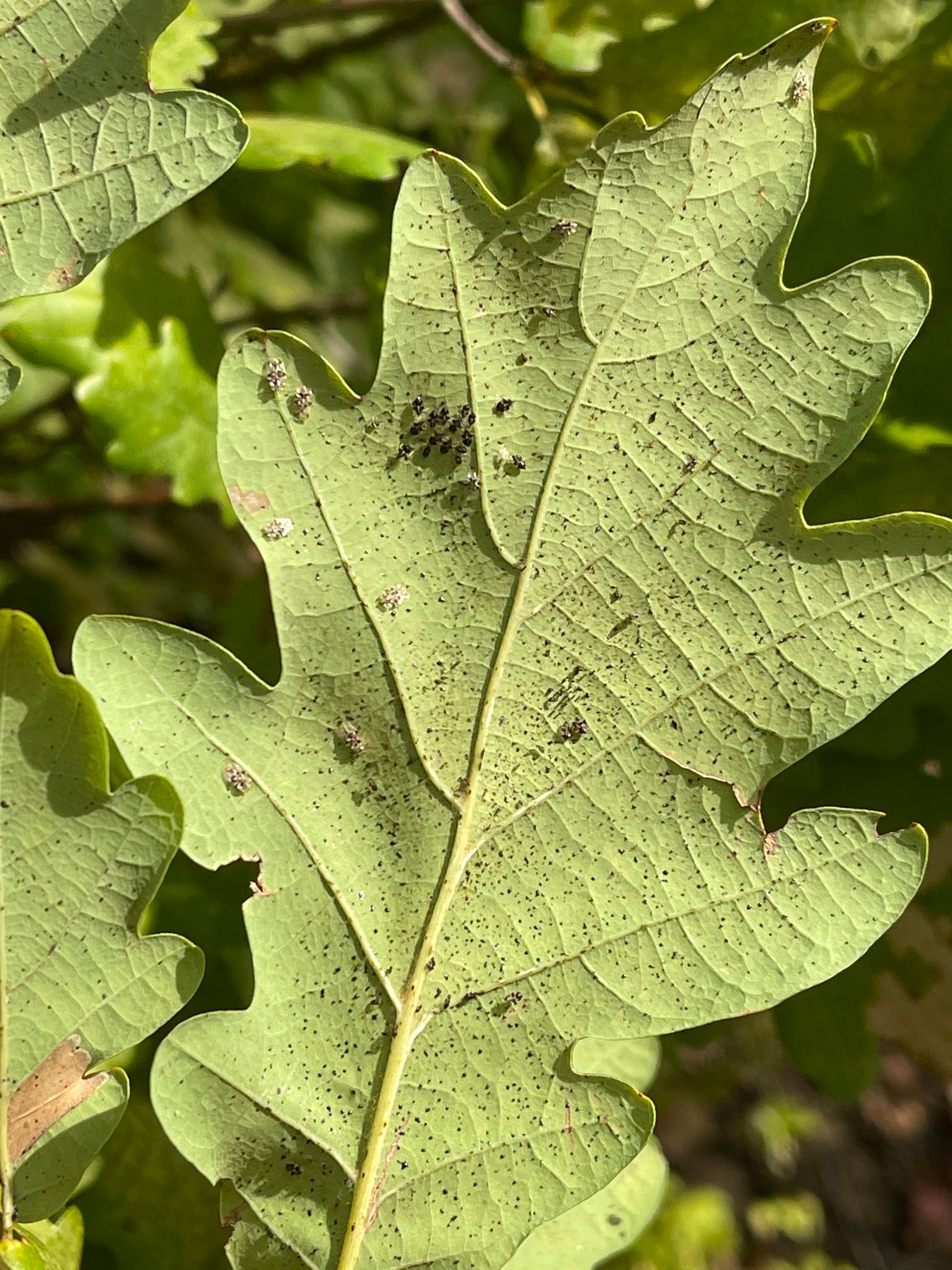
Oak leaf with black eggs of the oak lace bug ©University of Graz/Kunz
©University of Graz/Kunz
The oak lace bug lays its eggs in groups on the underside of oak leaves. Photo: University of Graz/Kunz
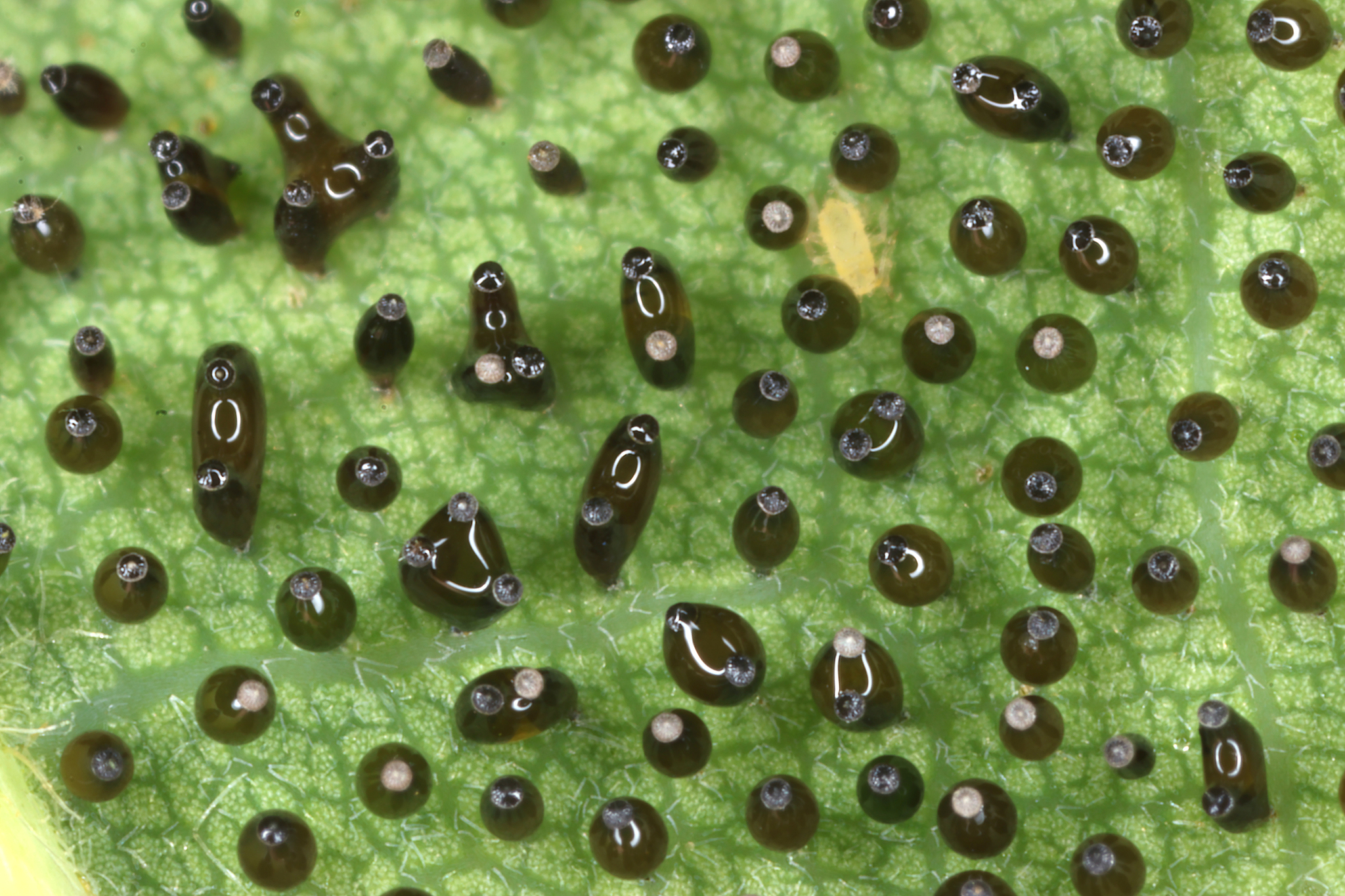
The black eggs of the oak lace bug on a green leaf ©University of Graz/Kunz
©University of Graz/Kunz
Flightless larvae hatch from the spindle-shaped eggs. The empty egg cases stick to the leaf. Photo: University of Graz/Kunz
created by Gudrun Pichler

Related news

Record of reported species: Styria wins the global City Nature Challenge

Observers in Styria recorded 4,660 different animals, plants and fungi as part of the international City Nature Challenge between 24 and 27 April 2026. This saw the region take first place in the "species" category. Ostrava in the Czech Republic made the most observations, with just under 140,000, whilst the San Francisco Bay Area had the highest number of participants, namely 3,019.

Studying at the University of Graz: How to enrol

Ready for a new chapter in your life with the start of your studies at the University of Graz in the winter semester 2026/27? Here you will find information on deadlines, admission procedures, registration, and everything else you need to successfully start your studies in the fall.

Europe Day: Strengthening international expertise with Arqus

On 9 May, the spotlight will be on Europe. At the University of Graz, European cooperation is also a tangible part of everyday student life – not least through the Arqus university alliance. Master’s and PhD students can currently register for the Arqus micro-credential in ‘Advanced Creative Thinking and Communication’.

A substantial community: the key role of soil crusts in the earth system

They are often overshadowed by the plant world: lichens, fungi, mosses and bacteria, which form unique communities on rocks and trees or as soil crusts. Bettina Weber from the University of Graz is bringing this biological alliance into the research spotlight. Her research shows that these communities form an essential part of the Earth’s critical zone and play a key role in the interactions between land and atmosphere. Bettina Weber was honoured by the European Geosciences Union for her groundbreaking research at the beginning of May.

Begin of page section:
Additional information:

University of Graz
Universitaetsplatz 3
8010 Graz
Austria
  • Contact
  • Web Editors
  • Moodle
  • UNIGRAZonline
  • Imprint
  • Data Protection Declaration
  • Accessibility Declaration
Weatherstation
Uni Graz

End of this page section. Go to overview of page sections

End of this page section. Go to overview of page sections

Begin of page section:

End of this page section. Go to overview of page sections