Begin of page section:
Page sections:

  • Go to contents (Accesskey 1)
  • Go to position marker (Accesskey 2)
  • Go to main navigation (Accesskey 3)
  • Go to sub navigation (Accesskey 4)
  • Go to additional information (Accesskey 5)
  • Go to page settings (user/language) (Accesskey 8)
  • Go to search (Accesskey 9)

End of this page section. Go to overview of page sections

Begin of page section:
Page settings:

English en
Deutsch de
Search
Login

End of this page section. Go to overview of page sections

Begin of page section:
Search:

Search for details about Uni Graz
Close

End of this page section. Go to overview of page sections


Search

Begin of page section:
Main navigation:

Page navigation:

  • University

    University
    • About the University
    • Organisation
    • Faculties
    • Library
    • Working at University of Graz
    • Campus
    Developing solutions for the world of tomorrow - that is our mission. Our students and our researchers take on the great challenges of society and carry the knowledge out.
  • Research Profile

    Research Profile
    • Our Expertise
    • Research Questions
    • Research Portal
    • Promoting Research
    • Research Transfer
    • Ethics in Research
    Scientific excellence and the courage to break new ground. Research at the University of Graz creates the foundations for making the future worth living.
  • Studies

    Studies
    • Prospective Students
    • Students
  • Community

    Community
    • International
    • Location
    • Research and Business
    • Alumni
    The University of Graz is a hub for international research and brings together scientists and business experts. Moreover, it fosters the exchange and cooperation in study and teaching.
  • Spotlight
Topics
  • Sustainable University
  • Researchers answer
  • Work for us
Close menu

End of this page section. Go to overview of page sections

Begin of page section:
You are here:

University of Graz News Vielfalt als Chance

End of this page section. Go to overview of page sections

Wednesday, 29 September 2021

Vielfalt als Chance

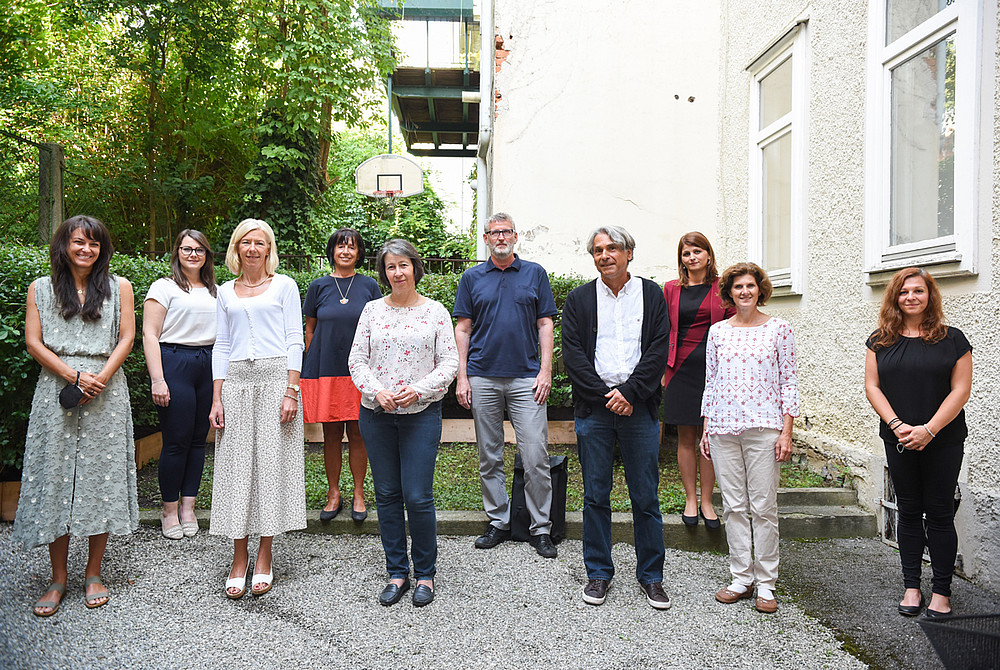
Das Team des Forschungszentrums Inklusive Bildung hat zusammen mit ihren PartnerInnen einen MOOC gestaltet. Urbi-Dekan Rudolf Egger (4.v.r.) besuchte die neuen Räumlichkeiten des Zentrums in der Strassoldogasse. Foto: Uni Graz/Schweiger

Das Team des Forschungszentrums Inklusive Bildung hat zusammen mit ihren PartnerInnen einen MOOC gestaltet. Urbi-Dekan Rudolf Egger (4.v.r.) besuchte die neuen Räumlichkeiten des Zentrums in der Strassoldogasse. Foto: Uni Graz/Schweiger

Neuer MOOC zum gesellschaftlich hochrelevanten Thema Inklusion

Das Forschungszentrum für Inklusive Bildung (FZIB) hat einen neuen Massive Open Online Course (MOOC) zu dem gesellschaftlich hochrelevanten Thema Inklusion entwickelt. Technisch betreut vom Zentrum für Digitales Lehren und Lernen der Uni Graz und dem iMoox Team der TU Graz wird dieser MOOC am 1.10.2021 erstmalig auf www.imoox.at  starten.

Was erwartet die NutzerInnen des MOOC?
Der MOOC stellt in drei Online-Modulen vor, was inklusive Bildung bedeutet, welche Rolle die UN-Behindertenrechtskonvention spielt, wie sich Inklusion im Bildungssystem historisch entwickelt hat und wie es gelingen kann, die Unterschiedlichkeit und Vielfalt von Menschen als Chance für alle Lern- und Bildungsprozesse zu sehen. Das Besondere an diesem MOOC ist, dass hier nicht nur WissenschafterInnen und ExpertInnen aus verschiedensten Ländern zu Wort kommen, sondern auch Menschen mit Behinderungen sowie PraktikerInnen aus inklusiven Einrichtungen, die mit ihren Erfahrungsberichten den MOOC bereichern.

Der MOOC wurde unter der Leitung von Barbara Gasteiger-Klicpera (Universität Graz), Andrea Holzinger (PH Steiermark) und David Wohlhart (PPH Augustinum) entwickelt, von Edvina Bešić und Mathias Krammer (PH Steiermark), Martina Kalcher (PPH Augustinum) und Lisa Paleczek (Universität Graz) inhaltlich erarbeitet und von Heidi Kinast (FZIB) und Roland Radlinger (Uni Graz) realisiert.

Die Kursmaterialien im MOOC Inklusion sind alle mit einer CC BY SA 4.0 Lizenz versehen und können somit als Open Educational Resource für die Lehre verwendet und an Interessierte weitergegeben werden.

An wen richtet sich der MOOC Inklusion?
Der MOOC „Inklusion - Vielfalt als Chance! - Grundlagen inklusiver Pädagogik“ richtet sich an alle, die an dem Thema Inklusion im gesellschaftlichen Zusammenleben interessiert sind und die für ihr berufliches oder privates Umfeld menschenrechtliche und pädagogische Grundlagen zu Inklusion kennenlernen möchten. Interessiert? Auf imoox.at/course/Inklusion gibt es die Kursübersicht, den FZIB Trailer zum MOOC auf youtu.be/VnghlivIdZc

Das Forschungszentrum für Inklusive Bildung – FZIB (www.fzib.at) ist ein Kooperationsprojekt der Universität Graz, der Pädagogischen Hochschule Steiermark und der Privaten Pädagogischen Hochschule Augustinum (vormals KPH Graz). Das FZIB hat das Ziel bei nationalen und internationalen Forschungsprojekten zu Themen der Digitalisierung und Inklusion zu kooperieren, sowie den wissenschaftlichen Nachwuchs in der Inklusionsforschung zu fördern.

created by Kommunikation & Öffentlichkeitsarbeit

Related news

Cosmetics in the environment: University of Graz proves danger to ants

Titanium dioxide, which is found in cosmetics, for example, is increasingly entering the environment in the form of nanoparticles. This could also put insects at risk. If ants ingest the substance in combination with the pesticide glyphosate, it disturbs the development of their offspring. Scientists at the University of Graz are drawing attention to the negative consequences of this toxic cocktail.

How are tech companies changing democracy? Uni Graz designs exhibition for schools

Filtered information, conspiracy theories, fake news – certain groups and corporations are using social media and algorithms to try to influence public opinion in their favour. Their goal: to weaken fundamental rights and diversity of opinion and seize power. In a new exhibition, researchers at the University of Graz are working with pupils to explore the impact of social media and AI on democracy. In accompanying workshops, the scientists want to encourage young people to develop their own ideas for a socially and ecologically viable future and to actively help shape it. The exhibition, designed as a travelling exhibition for schools, will open on 9 March 2026 at the Dreihackengasse Gymnasium in Graz.

Step by step: What motivates Mireille van Poppel as a scientist and vice-rector

Improving people's health and eliminating inequalities: Mireille van Poppel pursues these goals both as a public health researcher and as vice-rector for Internationalisation and Equality. In both roles, she pays particular attention to individual needs.

Master's degree in psychotherapy in Graz: registration opens in March

Graz is becoming a hotspot for psychotherapy: from 2026, the University of Graz and the Medical University of Graz will jointly offer the new master's programme. Registration for the admission procedure for the 140 study places will start in March.

Begin of page section:
Additional information:

University of Graz
Universitaetsplatz 3
8010 Graz
Austria
  • Contact
  • Web Editors
  • Moodle
  • UNIGRAZonline
  • Imprint
  • Data Protection Declaration
  • Accessibility Declaration
Weatherstation
Uni Graz

End of this page section. Go to overview of page sections

End of this page section. Go to overview of page sections

Begin of page section:

End of this page section. Go to overview of page sections