



Begin of page section:
Page sections:

  • Go to contents (Accesskey 1)
  • Go to position marker (Accesskey 2)
  • Go to main navigation (Accesskey 3)
  • Go to sub navigation (Accesskey 4)
  • Go to additional information (Accesskey 5)
  • Go to page settings (user/language) (Accesskey 8)
  • Go to search (Accesskey 9)

End of this page section. Go to overview of page sections

Begin of page section:
Page settings:

English en
Deutsch de
Search
Login

End of this page section. Go to overview of page sections

Begin of page section:
Search:

Search for details about Uni Graz
Close

End of this page section. Go to overview of page sections


Search

Begin of page section:
Main navigation:

Page navigation:

  • University

    University
    • About the University
    • Organisation
    • Faculties
    • Library
    • Working at University of Graz
    • Campus
    Developing solutions for the world of tomorrow - that is our mission. Our students and our researchers take on the great challenges of society and carry the knowledge out.
  • Research Profile

    Research Profile
    • Our Expertise
    • Research Questions
    • Research Portal
    • Promoting Research
    • Research Transfer
    • Ethics in Research
    • Commission for Scientific Integrity
    Scientific excellence and the courage to break new ground. Research at the University of Graz creates the foundations for making the future worth living.
  • Studies

    Studies
    • Prospective Students
    • Students
    • Registration for Study Programme (Winter semester 2026/27)
  • Community

    Community
    • International
    • Location
    • Research and Business
    • Alumni
    The University of Graz is a hub for international research and brings together scientists and business experts. Moreover, it fosters the exchange and cooperation in study and teaching.
Topics
  • Sustainable University
  • Researchers answer
  • Work for us
Close menu

End of this page section. Go to overview of page sections

Begin of page section:
You are here:

University of Graz News Vielfalt als Chance

End of this page section. Go to overview of page sections

Wednesday, 29 September 2021

Vielfalt als Chance

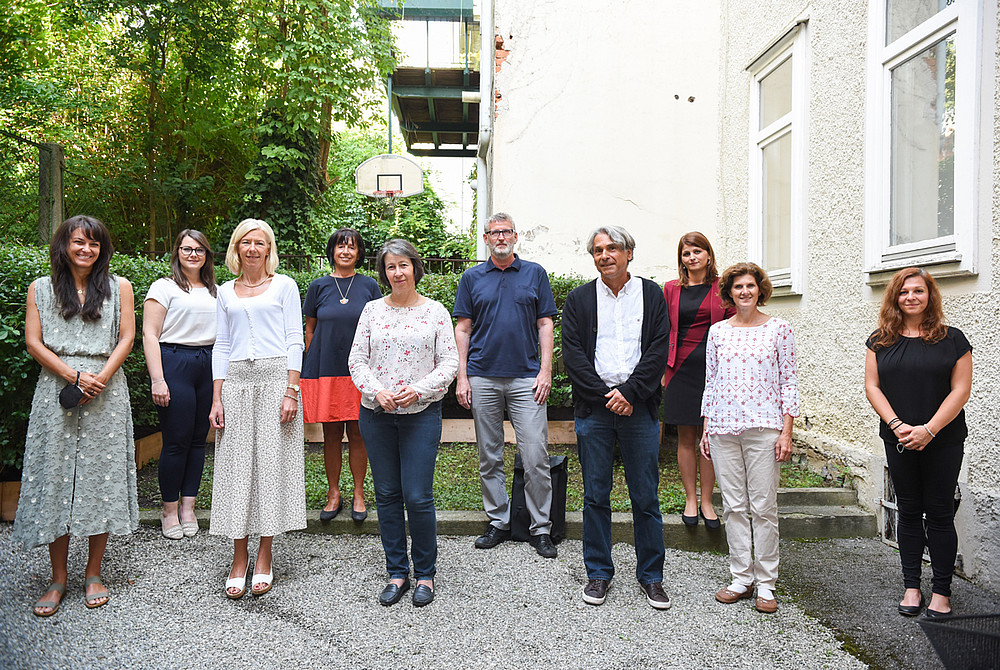
Das Team des Forschungszentrums Inklusive Bildung hat zusammen mit ihren PartnerInnen einen MOOC gestaltet. Urbi-Dekan Rudolf Egger (4.v.r.) besuchte die neuen Räumlichkeiten des Zentrums in der Strassoldogasse. Foto: Uni Graz/Schweiger

Das Team des Forschungszentrums Inklusive Bildung hat zusammen mit ihren PartnerInnen einen MOOC gestaltet. Urbi-Dekan Rudolf Egger (4.v.r.) besuchte die neuen Räumlichkeiten des Zentrums in der Strassoldogasse. Foto: Uni Graz/Schweiger

Neuer MOOC zum gesellschaftlich hochrelevanten Thema Inklusion

Das Forschungszentrum für Inklusive Bildung (FZIB) hat einen neuen Massive Open Online Course (MOOC) zu dem gesellschaftlich hochrelevanten Thema Inklusion entwickelt. Technisch betreut vom Zentrum für Digitales Lehren und Lernen der Uni Graz und dem iMoox Team der TU Graz wird dieser MOOC am 1.10.2021 erstmalig auf www.imoox.at  starten.

Was erwartet die NutzerInnen des MOOC?
Der MOOC stellt in drei Online-Modulen vor, was inklusive Bildung bedeutet, welche Rolle die UN-Behindertenrechtskonvention spielt, wie sich Inklusion im Bildungssystem historisch entwickelt hat und wie es gelingen kann, die Unterschiedlichkeit und Vielfalt von Menschen als Chance für alle Lern- und Bildungsprozesse zu sehen. Das Besondere an diesem MOOC ist, dass hier nicht nur WissenschafterInnen und ExpertInnen aus verschiedensten Ländern zu Wort kommen, sondern auch Menschen mit Behinderungen sowie PraktikerInnen aus inklusiven Einrichtungen, die mit ihren Erfahrungsberichten den MOOC bereichern.

Der MOOC wurde unter der Leitung von Barbara Gasteiger-Klicpera (Universität Graz), Andrea Holzinger (PH Steiermark) und David Wohlhart (PPH Augustinum) entwickelt, von Edvina Bešić und Mathias Krammer (PH Steiermark), Martina Kalcher (PPH Augustinum) und Lisa Paleczek (Universität Graz) inhaltlich erarbeitet und von Heidi Kinast (FZIB) und Roland Radlinger (Uni Graz) realisiert.

Die Kursmaterialien im MOOC Inklusion sind alle mit einer CC BY SA 4.0 Lizenz versehen und können somit als Open Educational Resource für die Lehre verwendet und an Interessierte weitergegeben werden.

An wen richtet sich der MOOC Inklusion?
Der MOOC „Inklusion - Vielfalt als Chance! - Grundlagen inklusiver Pädagogik“ richtet sich an alle, die an dem Thema Inklusion im gesellschaftlichen Zusammenleben interessiert sind und die für ihr berufliches oder privates Umfeld menschenrechtliche und pädagogische Grundlagen zu Inklusion kennenlernen möchten. Interessiert? Auf imoox.at/course/Inklusion gibt es die Kursübersicht, den FZIB Trailer zum MOOC auf youtu.be/VnghlivIdZc

Das Forschungszentrum für Inklusive Bildung – FZIB (www.fzib.at) ist ein Kooperationsprojekt der Universität Graz, der Pädagogischen Hochschule Steiermark und der Privaten Pädagogischen Hochschule Augustinum (vormals KPH Graz). Das FZIB hat das Ziel bei nationalen und internationalen Forschungsprojekten zu Themen der Digitalisierung und Inklusion zu kooperieren, sowie den wissenschaftlichen Nachwuchs in der Inklusionsforschung zu fördern.

created by Kommunikation & Öffentlichkeitsarbeit

Related news

Complying with the norm: Why Do Standards Shape Our Lives, Elisabeth Staudegger?

Standards determine whether a sheet of paper fits in a printer or whether a charging plug can power multiple devices. These standards shape our everyday lives. But who actually sets these standards? Where are the weaknesses, and how could science help to improve them? Elisabeth Staudegger, Head of the ‘Law and IT’ Department at the Institute for Legal Foundations at the University of Graz, host the Academic Standards Day on 16 June. Here she relays how sciences can contribute to the topic of standardisation and reveals her personal favourite standard.

More body awareness than a culture war

In Italy, sex education lessons will in future only be permitted with parental consent, and will be banned entirely in nurseries and primary schools. At the same time, Pride Month highlights why knowledge about the body, relationships, boundaries and diversity is important for young people. A study by the University of Graz shows how important knowledge about the body, contraception, relationship skills and protection against violence is

Will Austria win the World Cup? Mathematician reveals calculation method

Michael Fischer uses the football tournament as a practical example for highschool lessons.

Survival strategies: How plants respond to drought

According to Geosphere Austria, this spring was the driest in Austria since records began around 170 years ago. The low rainfall put particular pressure on the agricultural sector. And climate change is set to make the situation even worse in the coming decades. We asked Johannes Liesche, a professor at the Department of Biology at the University of Graz, how plants react to water shortages and how they survive periods of drought.

Begin of page section:
Additional information:

University of Graz
Universitaetsplatz 3
8010 Graz
Austria
  • Contact
  • Web Editors
  • Moodle
  • UNIGRAZonline
  • Imprint
  • Data Protection Declaration
  • Accessibility Declaration
Weatherstation
Uni Graz

End of this page section. Go to overview of page sections

End of this page section. Go to overview of page sections

Begin of page section:

End of this page section. Go to overview of page sections

