Begin of page section:
Page sections:

  • Go to contents (Accesskey 1)
  • Go to position marker (Accesskey 2)
  • Go to main navigation (Accesskey 3)
  • Go to sub navigation (Accesskey 4)
  • Go to additional information (Accesskey 5)
  • Go to page settings (user/language) (Accesskey 8)
  • Go to search (Accesskey 9)

End of this page section. Go to overview of page sections

Begin of page section:
Page settings:

English en
Deutsch de
Search
Login

End of this page section. Go to overview of page sections

Begin of page section:
Search:

Search for details about Uni Graz
Close

End of this page section. Go to overview of page sections


Search

Begin of page section:
Main navigation:

Page navigation:

  • University

    University
    • About the University
    • Organisation
    • Faculties
    • Library
    • Working at University of Graz
    • Campus
    Developing solutions for the world of tomorrow - that is our mission. Our students and our researchers take on the great challenges of society and carry the knowledge out.
  • Research Profile

    Research Profile
    • Our Expertise
    • Research Questions
    • Research Portal
    • Promoting Research
    • Research Transfer
    • Ethics in Research
    • Commission for Scientific Integrity
    Scientific excellence and the courage to break new ground. Research at the University of Graz creates the foundations for making the future worth living.
  • Studies

    Studies
    • Prospective Students
    • Students
    • Registration for Study Programme (Winter semester 2026/27)
  • Community

    Community
    • International
    • Location
    • Research and Business
    • Alumni
    The University of Graz is a hub for international research and brings together scientists and business experts. Moreover, it fosters the exchange and cooperation in study and teaching.
Topics
  • Sustainable University
  • Researchers answer
  • Work for us
Close menu

End of this page section. Go to overview of page sections

Begin of page section:
You are here:

University of Graz News Start-ups: How the University of Graz promotes entrepreneurial spirit

End of this page section. Go to overview of page sections

Tuesday, 18 November 2025

Start-ups: How the University of Graz promotes entrepreneurial spirit

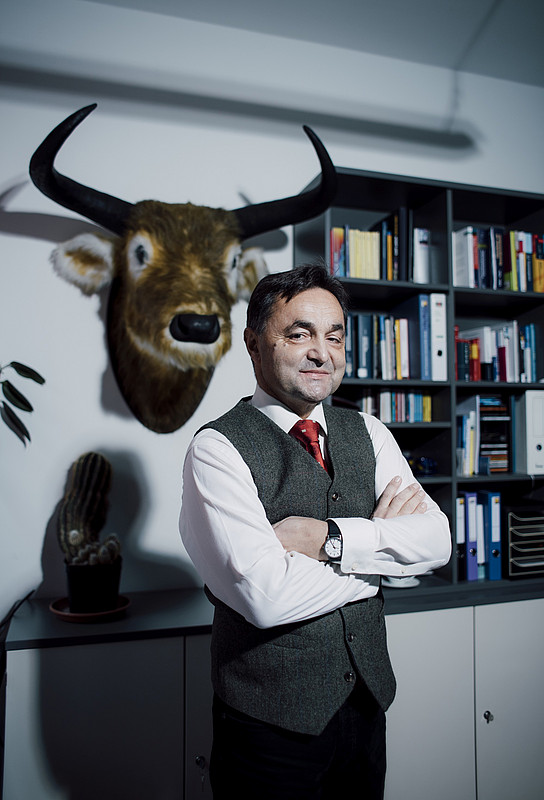
A person in formal attire with their arms crossed stands in front of a bookshelf, an artificial animal head hangs on the wall, and a cactus in a pot stands on a cabinet.

Alfred Gutschelhofer founded the Center for Entrepreneurship at the University of Graz. Photo: University of Graz/Kanizaj

Since 15 years, the University of Graz has been supporting students in their transition to self-employment. The Center for Entrepreneurship offers workshops, coaching, and programs to help students take their first steps in business in a safe environment—without pressure and with plenty of room for innovative ideas.

Graduation is within reach, but what comes next? Of course, you can go through endless job application marathons and pursue a traditional career path. But there is an exciting alternative: self-employment, founding a start-up. It's a step that requires a lot of courage and also carries the risk of failure. And failure is still considered a no-go in Austria.

Why is this still the case today? “For a long time, starting a business was not a big issue in this country; security was the top priority,” explains Alfred Gutschelhofer from the Center for Entrepreneurship at the University of Graz. “This also has to do with the country's history. After World War II, entrepreneurship focused mainly on supply and reliability.” For decades, Austria's economy was geared toward risk reduction.

During the Cold War, this system became further entrenched in neutral Austria. But after the fall of the Iron Curtain, accession to the EU, and the globalization of supply chains, the weaknesses of this system became apparent. “Austria has become a kind of fully comprehensive insurance society,” says Gutschelhofer.

Safe space for start-ups

To counteract this mindset, the University of Graz founded the Center for Entrepreneurship 15 years ago. “As a university, it is our job to show students the possibility of self-employment,” explains Gutschelhofer. “The university can be a safe space for young people, where they can venture their first attempts at entrepreneurship without pressure and with room for dreams.”

Gutschelhofer is confident that the cultural shift towards greater entrepreneurial spirit is already underway. “A lot has already been achieved. Young people are no longer so afraid of taking the step into self-employment and are going through with it.” Austrian students regularly demonstrate their skills in international programs, where they meet colleagues from the US and develop business plans together. This reveals an interesting difference: “While Austrians are often strong in financial planning, Americans score points with creative marketing.” Financial knowledge is of course a great virtue, Gutschelhofer emphasizes. “But when it comes to marketing, we can learn a lot from US start-ups.”

For Gutschelhofer, it is important to spark enthusiasm for entrepreneurship at an early age. When young people are exposed to the idea of starting a business at a young age, self-employment becomes a real career option for them. This is confirmed by a survey conducted by Start-up Monitor: more than half of those surveyed said they had already had the idea of starting a business while still in education. “For this spark to become a viable path, the fundamentals of entrepreneurial thinking and action are needed: personal responsibility and self-determination – skills that are consciously promoted in the university environment,” explains Gutschelhofer.

Taking risks

In the initial phase, there is also a lot of support for young entrepreneurs in Austria. This is where the University of Graz comes in. The Center for Entrepreneurship offers workshops, coaching, and programs for researchers, students, and employees, regardless of how far along their start-up idea is. And when things get serious, there are dedicated start-up incubators. “In these corporate incubators, young founders can take their first entrepreneurial steps in a safe environment,” says Gutschelhofer.

After this so-called seed phase, however, things become more difficult in Austria. There are too few courageous investors who can turn a good idea into a growing company. “Many investors here are not risk-averse enough,” says Gutschelhofer. Many start-ups also see this as one of the biggest stumbling blocks to success in Austria.

This affects the deep tech sector even more, i.e., those start-ups that develop from scientific research. “The good companies then migrate away,” warns Gutschelhofer. “As a society, we should really make sure that we keep such people in the country. If we promote entrepreneurs, we should ensure that they maintain a connection to Austria.”

This is particularly important in economically challenging times. But how? This is precisely what will be discussed at the Graz Economic Talks. Experts will look back on the past three years and explore the possibilities of regional and national location policy. On November 25, 2025, starting at 6:00 p.m. in the auditorium of the University of Graz.

For anyone who may have a brilliant idea or simply wants to know more about starting a business, the Center for Entrepreneurship has knowledgeable people to talk to. https://entrepreneurship.uni-graz.at/en/


created by Roman Vilgut

Related news

Complying with the norm: Why Do Standards Shape Our Lives, Elisabeth Staudegger?

Standards determine whether a sheet of paper fits in a printer or whether a charging plug can power multiple devices. These standards shape our everyday lives. But who actually sets these standards? Where are the weaknesses, and how could science help to improve them? Elisabeth Staudegger, Head of the ‘Law and IT’ Department at the Institute for Legal Foundations at the University of Graz, host the Academic Standards Day on 16 June. Here she relays how sciences can contribute to the topic of standardisation and reveals her personal favourite standard.

More body awareness than a culture war

In Italy, sex education lessons will in future only be permitted with parental consent, and will be banned entirely in nurseries and primary schools. At the same time, Pride Month highlights why knowledge about the body, relationships, boundaries and diversity is important for young people. A study by the University of Graz shows how important knowledge about the body, contraception, relationship skills and protection against violence is

Will Austria win the World Cup? Mathematician reveals calculation method

Michael Fischer uses the football tournament as a practical example for highschool lessons.

Survival strategies: How plants respond to drought

According to Geosphere Austria, this spring was the driest in Austria since records began around 170 years ago. The low rainfall put particular pressure on the agricultural sector. And climate change is set to make the situation even worse in the coming decades. We asked Johannes Liesche, a professor at the Department of Biology at the University of Graz, how plants react to water shortages and how they survive periods of drought.

Begin of page section:
Additional information:

University of Graz
Universitaetsplatz 3
8010 Graz
Austria
  • Contact
  • Web Editors
  • Moodle
  • UNIGRAZonline
  • Imprint
  • Data Protection Declaration
  • Accessibility Declaration
Weatherstation
Uni Graz

End of this page section. Go to overview of page sections

End of this page section. Go to overview of page sections

Begin of page section:

End of this page section. Go to overview of page sections