



Begin of page section:
Page sections:

  • Go to contents (Accesskey 1)
  • Go to position marker (Accesskey 2)
  • Go to main navigation (Accesskey 3)
  • Go to sub navigation (Accesskey 4)
  • Go to additional information (Accesskey 5)
  • Go to page settings (user/language) (Accesskey 8)
  • Go to search (Accesskey 9)

End of this page section. Go to overview of page sections

Begin of page section:
Page settings:

English en
Deutsch de
Search
Login

End of this page section. Go to overview of page sections

Begin of page section:
Search:

Search for details about Uni Graz
Close

End of this page section. Go to overview of page sections


Search

Begin of page section:
Main navigation:

Page navigation:

  • University

    University
    • About the University
    • Organisation
    • Faculties
    • Library
    • Working at University of Graz
    • Campus
    Developing solutions for the world of tomorrow - that is our mission. Our students and our researchers take on the great challenges of society and carry the knowledge out.
  • Research Profile

    Research Profile
    • Our Expertise
    • Research Questions
    • Research Portal
    • Promoting Research
    • Research Transfer
    • Ethics in Research
    • Commission for Scientific Integrity
    Scientific excellence and the courage to break new ground. Research at the University of Graz creates the foundations for making the future worth living.
  • Studies

    Studies
    • Prospective Students
    • Students
    • Welcome Weeks for First Year Students
  • Community

    Community
    • International
    • Location
    • Research and Business
    • Alumni
    The University of Graz is a hub for international research and brings together scientists and business experts. Moreover, it fosters the exchange and cooperation in study and teaching.
Topics
  • Sustainable University
  • Researchers answer
  • Work for us
Close menu

End of this page section. Go to overview of page sections

Begin of page section:
You are here:

University of Graz News University of Graz strengthens international research cooperation in China

End of this page section. Go to overview of page sections

Wednesday, 23 October 2024

University of Graz strengthens international research cooperation in China

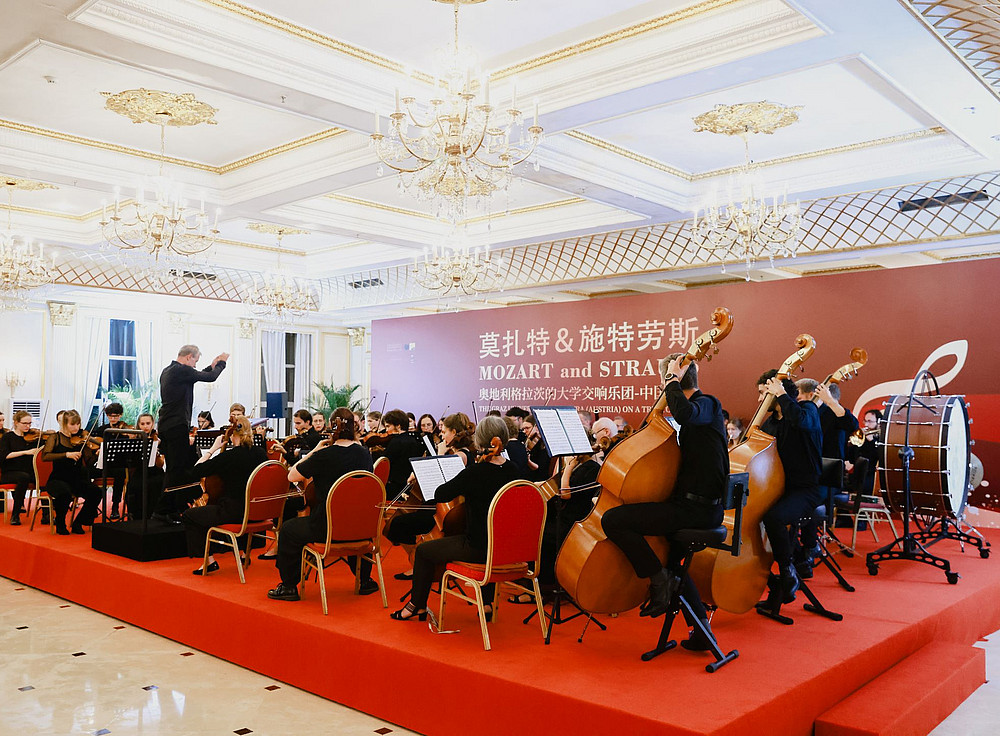
 A photo of an orchestra playing on a stage, and musical instruments such as cellos, drums, flutes, chairs arranged for audience seats, a red carpet leading to the scene from one side, all set against luxurious wall hangings and chandeliers. The background is decorated with large Chinese-style banners showing a performance called "Mozart & Strauss"

The university orchestra thrilled the audience at two concerts during the delegation trip to China. Photo: University of Graz

The University of Graz intensified its international contacts with a successful delegation trip to China. Rector Peter Riedler and Vice-Rector Mireille van Poppel visited Shanghai and Beijing to intensify co-operation with renowned universities. Special highlights were the concerts by the Graz University Orchestra, which promoted cultural exchange. During another visit to Graz by a delegation from China, an agreement was signed to establish a joint research laboratory with Beijing Forestry University.

To achieve excellent research results, a university must not only have the best scientists, but also good international contacts. The aim of a recent Rectorate delegation trip to China was to intensify these contacts. Accompanied by the head of the Confucius Institute, Wan Jie Chen, Rector Peter Riedler and Vice-Rector Mirelle van Poppel travelled to Shanghai and Beijing. During a visit to the East China Normal University, the existing cooperation was further intensified. Subsequently, visits were made to other universities in the country and the scientific exchange in the fields of ‘virtual learning space’, ‘European Studies’ and ‘ Chinese Studies’ as well as TCM and pharmacy was intensified. 

The concerts by the Graz University Orchestra, which was also part of the Chinese delegation, were a special event for the hosts. In front of an audience of 1,000 in Shanghai, the orchestra performed a piece of traditional Kunqu opera that had been specially adapted for the collaboration, together with musicians from the East China Normal University. The exchange between science and culture met with great approval from the numerous guests, including rectors and professors from the East China Normal University and the East China University of Political Science and Law.

The second performance took place in Beijing just four days later. Around 500 listeners attended the event at the Chateau Laffitte Hotel, whose concert hall is modelled on a European castle. The concerts not only served to present the Graz University Orchestra abroad, but also to maintain and expand academic and cultural relations between China and Austria.

Research on biobased plastics

A visit by a delegation from Beijing Forestry University (BIFU) to the University of Graz just a few weeks after the delegation trip was also characterised by a strong focus on research. The scientists from the People's Republic of China were particularly interested in the activities of the University of Graz in the field of ‘green chemistry’.

This was followed by a tour of the university's laboratories, where research into lignocellulosic biomass (wood chips and shavings) is carried out. Prof. Zhuohua Sun, a member of the BIFU delegation, gave a presentation on his expertise in the field of heterogeneous catalysis. The successful visit paves the way for future collaborations in the field of sustainable chemistry and overarching projects on the circular economy. Subsequently, an agreement was signed between the University of Graz and Beijing Forestry University to establish a joint research laboratory.

created by Roman Vilgut

Related news

Legal scholar Clarissa Groß on European values at the EU’s external borders

The tense situation in the Spanish exclave of Ceuta has been making headlines for weeks. The exodus of thousands of Moroccans has once again placed migration and border policy at the very top of the EU’s agenda. Clarissa Groß, a research assistant at the Institute for European Law, is examining the reform of the Common European Asylum System (CEAS), the design and practical implementation of the new border procedures, and their compatibility with the right to personal liberty as part of her doctoral thesis. She recently visited the Greek island of Lesbos, which remains a migration hotspot, to assess the situation on the ground.

Graz is a magnet for 750 physicists: international conference on campus

Whether in mobile phones, medical devices or solar power systems: physical phenomena are part of our everyday lives. The vast scope of this discipline will be explored at a major conference taking place at the University of Graz from 20 to 25 September 2026. More than 750 scientists will transform the campus into a European hub for physics.

A fresh start, a calling, holidays: what draws people from other career paths to teaching

They used to develop software; now they teach maths in the classroom. Career changers are expected to help address the shortage of qualified teachers in Austria’s schools. In their doctoral theses at the Institute for Educational Research and Teacher Training at the University of Graz, Melanie Gürentz and Claudia Mair examined how these new teachers perceive their new professional roles.

Talent Talks bridge the gap in career guidance

The Styrian Chamber of Commerce (WKO Steiermark), the Styrian Chamber of Labour (AK Steiermark) and the AMS are joining forces when it comes to training young people and, through the “Talent Talks”, are creating a seamless pathway to career guidance. This takes preparation and follow-up support – just in time for the start of the term and the scheme’s tenth anniversary – to a whole new level. A new survey conducted by the Talent Centre among 2,687 former participants to mark the anniversary shows just how important this development is. Of the young people who received follow-up support from the Talent Report, 74.6 per cent stated that they had a good understanding of their own strengths and talents following the Talent Check. Without follow-up support, the figure was 66.5 per cent – a significant difference of 8.1 percentage points.

Begin of page section:
Additional information:

University of Graz
Universitaetsplatz 3
8010 Graz
Austria
  • Contact
  • Web Editors
  • Moodle
  • UNIGRAZonline
  • Imprint
  • Data Protection Declaration
  • Accessibility Declaration
Weatherstation
Uni Graz

End of this page section. Go to overview of page sections

End of this page section. Go to overview of page sections

Begin of page section:

End of this page section. Go to overview of page sections