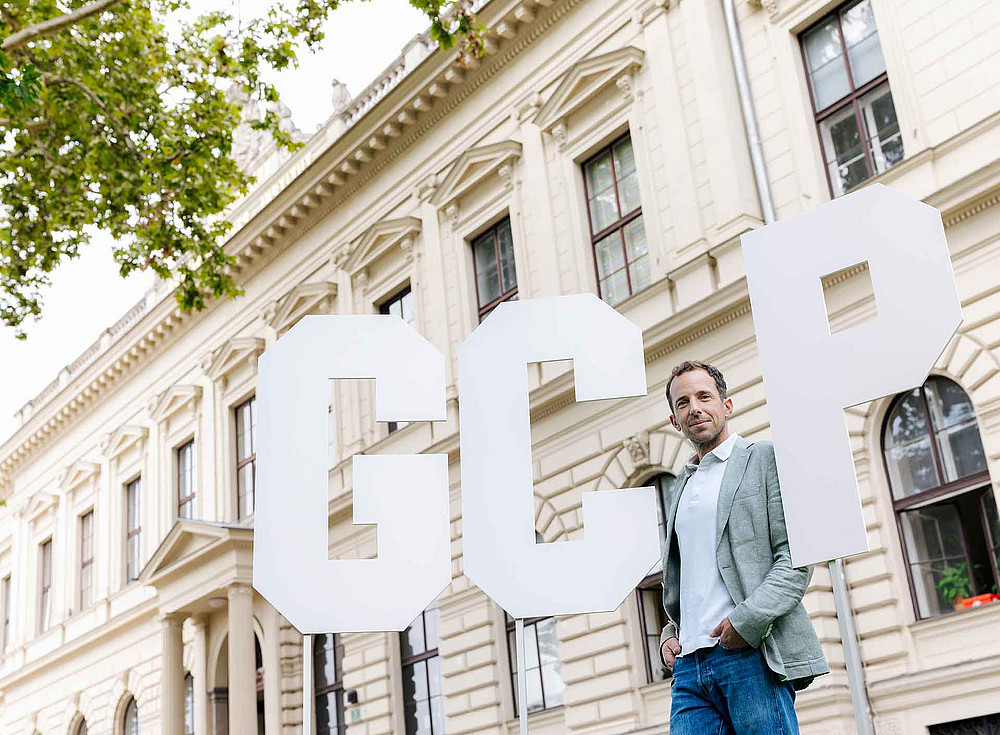
The Austrian Physical Society (ÖPG) is holding its 75th conference and has chosen Graz as the venue. “The anniversary will therefore be celebrated in the very place where the Association for the Promotion of Physical Sciences in Research, Development and Education was founded in 1950,” reports Martin Sterrer from the Institute of Physics at the University of Graz. Sterrer and his colleague Roland Resel from Graz University of Technology are jointly responsible for organising the scientific conference. Both universities have been working together for more than 20 years as part of the NAWI Graz consortium, which will celebrate another milestone in 2030 with the opening of the Graz Centre of Physics. The building is still under construction, but this ambitious project is already making its presence felt through the jointly organised conference.
“This flagship European project is generating considerable international interest,” says Sterrer. The Austrian Federal Real Estate Agency (BIG) is currently constructing the 50,000-square-metre building for the University of Graz and Graz University of Technology. This will bring together the physics departments of both universities under one roof and accommodate around 1,700 students and some 600 staff – with modern laboratories, workshops and spacious teaching areas.
Public lecture on climate change
Around 750 participants from across Europe have registered to take part in the professional exchange, as the congress marking the ÖPG’s anniversary is being organised in cooperation with the Condensed Matter Section of the European Physical Society (EPS). In addition to dozens of scientific workshops, the programme includes a public lecture for interested members of the public: Douglas Maraun from the Wegener Centre at the University of Graz will speak on climate change on 22 September 2026 at 6.30 pm at Graz University of Technology in Lecture Theatre P1, Petersgasse 16. The scientist will address three key questions: How has the climate already changed? What are the causes of this development? And what can we expect for the future? Admission is free; no registration is required.
⇒ Find out more about the conference