Begin of page section:
Page sections:

  • Go to contents (Accesskey 1)
  • Go to position marker (Accesskey 2)
  • Go to main navigation (Accesskey 3)
  • Go to sub navigation (Accesskey 4)
  • Go to additional information (Accesskey 5)
  • Go to page settings (user/language) (Accesskey 8)
  • Go to search (Accesskey 9)

End of this page section. Go to overview of page sections

Begin of page section:
Page settings:

English en
Deutsch de
Search
Login

End of this page section. Go to overview of page sections

Begin of page section:
Search:

Search for details about Uni Graz
Close

End of this page section. Go to overview of page sections


Search

Begin of page section:
Main navigation:

Page navigation:

  • University

    University
    • About the University
    • Organisation
    • Faculties
    • Library
    • Working at University of Graz
    • Campus
    Developing solutions for the world of tomorrow - that is our mission. Our students and our researchers take on the great challenges of society and carry the knowledge out.
  • Research Profile

    Research Profile
    • Our Expertise
    • Research Questions
    • Research Portal
    • Promoting Research
    • Research Transfer
    • Ethics in Research
    • Commission for Scientific Integrity
    Scientific excellence and the courage to break new ground. Research at the University of Graz creates the foundations for making the future worth living.
  • Studies

    Studies
    • Prospective Students
    • Students
  • Community

    Community
    • International
    • Location
    • Research and Business
    • Alumni
    The University of Graz is a hub for international research and brings together scientists and business experts. Moreover, it fosters the exchange and cooperation in study and teaching.
  • Spotlight
Topics
  • Sustainable University
  • Researchers answer
  • Work for us
Close menu

End of this page section. Go to overview of page sections

Begin of page section:
You are here:

University of Graz News University of Graz launches project to share green know-how with Southeast Asia

End of this page section. Go to overview of page sections

Friday, 14 March 2025

University of Graz launches project to share green know-how with Southeast Asia

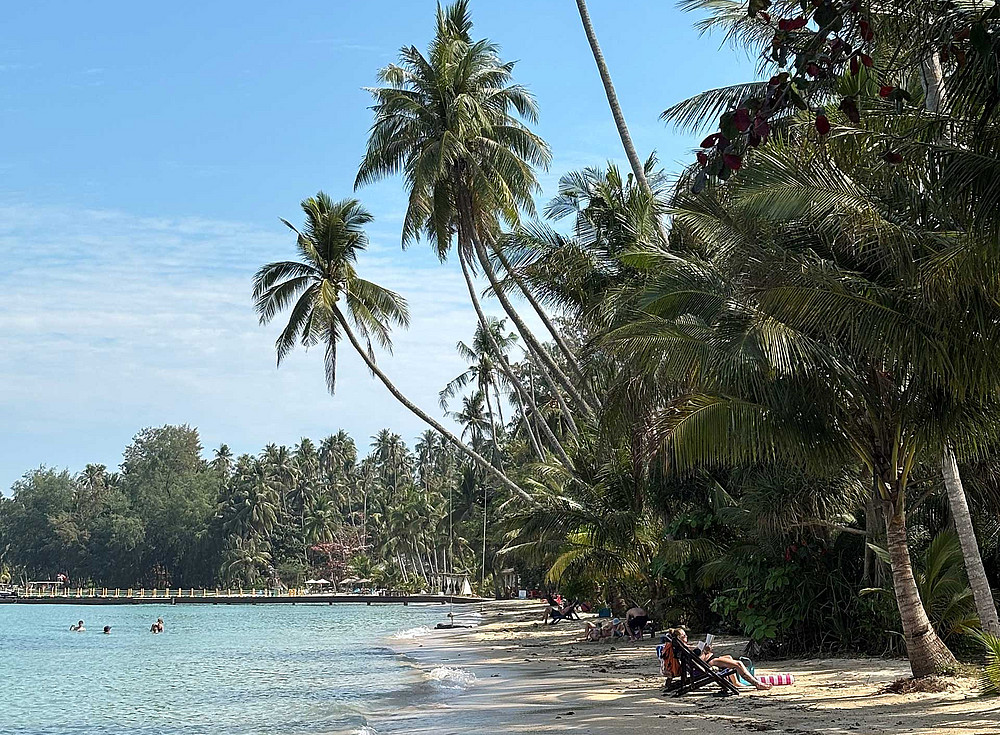
Beach in Thailand

An EU project led by the University of Graz aims to make agriculture and tourism in Thailand and Vietnam more ecological. Photo: Uni Graz/Schweiger

Thailand and Vietnam are not only among the top tourist destinations. According to the Global Carbon Atlas, they are also among the regions with the highest carbon emissions worldwide. A new EU project led by the University of Graz aims to show how the two countries can make fruit and rice growing and tourism more environmentally friendly. At the beginning of March, representatives of the twelve participating institutions met at the University of Graz and at Schloss Seggau to initiate the first measures.

‘Green-Edu-Seeds’ is the name of the EU-funded project that aims to grow green know-how in Southeast Asia. As part of the ‘ERASMUS + Capacity Building in Higher Education’ initiative, educational programmes are to be developed to promote the transformation to a sustainable economy and society. The expertise for this is being provided, among others, by the Wegener Center for Climate and Global Change at the University of Graz, which hosted the kick-off event. On 4 March 2025, project manager Dagmar Henner and vice rector Mireille van Poppel welcomed project partners from universities and technology companies in Vietnam, Thailand, Austria, Italy and Germany to the launch of the initiative. ‘We have taken important decisions for the further course of the project and for the successful design of the collaboration,’ summarised Henner.

A total of 45 modules are planned over the next three years. The first courses are to start this year as online formats or on site at the four universities in Thailand and Vietnam and in collaboration with the commercial training partners and will be open to students, start-ups and political decision-makers.
‘Regenerative economic activity and the preservation of healthy ecosystem services can go hand in hand,’ Dagmar Henner is convinced. At the same time, the scientist points to the enormous potential of the sector. ’Sustainability in agriculture, food production and tourism is an increasingly sought-after aspect. In addition, more than 16 million new jobs will be created by 2030.’ 
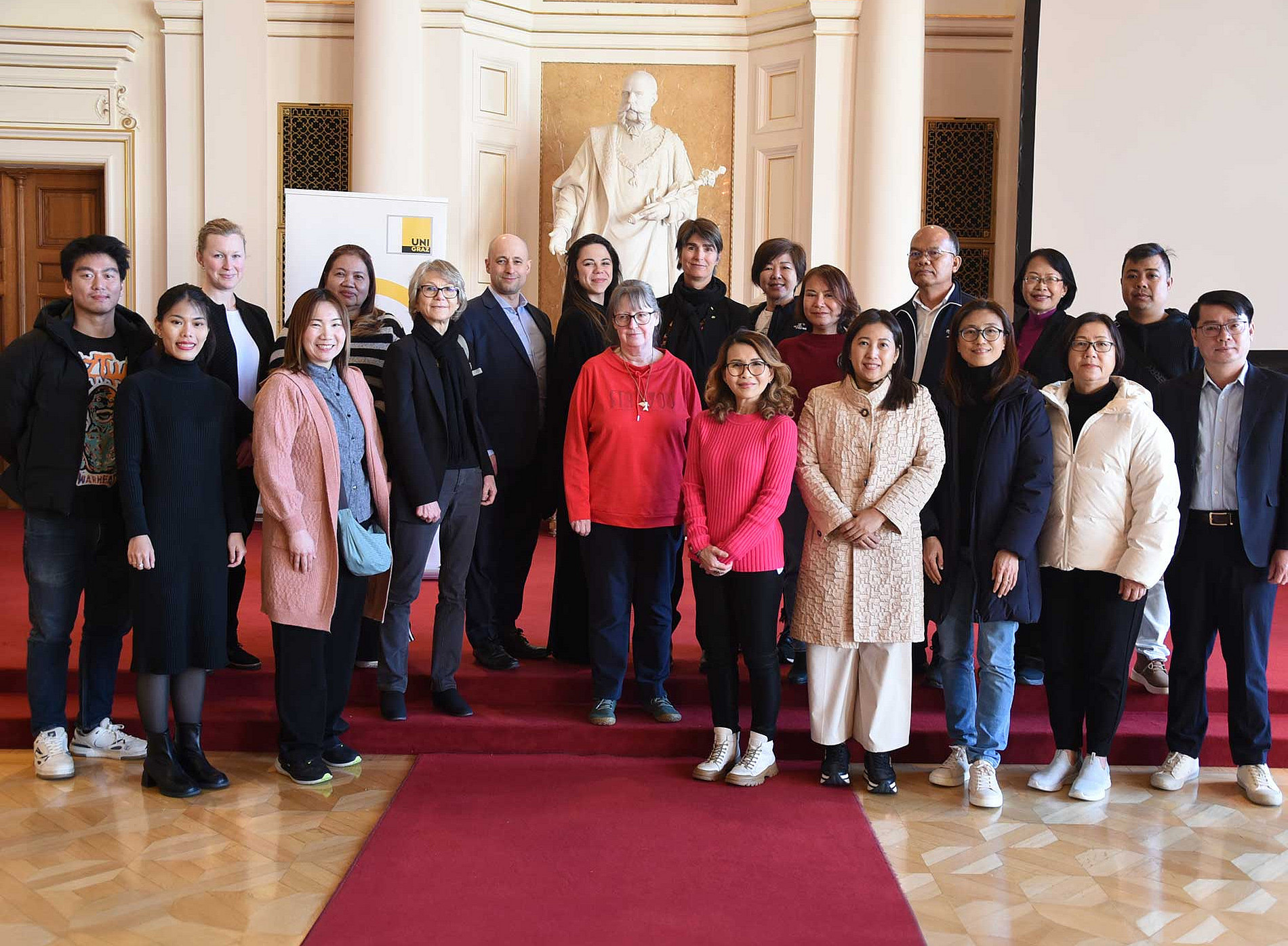
Group of project partners
Vice Rector van Poppel welcomed the project partners from universities and technology companies from Vietnam, Thailand, Austria, Italy and Germany to the launch. Photo: University of Graz/Schweiger
created by Andreas Schweiger

Related news

Around the world in eight stops: the Long Night of Research at the University of Graz

On 24 April from 5 pm, you can take a short trip around the globe at the University of Graz, discovering pecularities of foreign countries or new local features in the entrance hall of the University Library. The itinerary takes you through introduced animal species, political attitudes and the omnipotence of algorithms. There will also be a programme in the historic reading hall, as well as at the UniGraz@Museum and the University Archive.

Studying at the University of Graz: How to enrol

Ready for a new chapter in your life with the start of your studies at the University of Graz in the winter semester 2026/27? Here you will find information on deadlines, admission procedures, registration, and everything else you need to successfully start your studies in the fall.

Interpreting data: Why studies sometimes get it wrong

Hilmar Brohmer and Ziva Korda from the Institute of Psychology, together with 500 international colleagues, have re-evaluated a hundred scientific publications and have often come to different conclusions.

Crystal-clear: AI method revolutionises solar observation

The Sun makes life on Earth possible. However, its magnetic fields can also cause massive disruption. This makes it all the more important to gain a better understanding of the processes taking place on our nearest star. A research team from the University of Graz and the High Altitude Observatory in Boulder (USA) has succeeded in doing just that. The astrophysicists have developed an AI-supported method that makes even the smallest structures on the Sun visible. The scientists are convinced that this will bring about a lasting change in solar observation and that the new method can be used for the planned European Solar Telescope.

Begin of page section:
Additional information:

University of Graz
Universitaetsplatz 3
8010 Graz
Austria
  • Contact
  • Web Editors
  • Moodle
  • UNIGRAZonline
  • Imprint
  • Data Protection Declaration
  • Accessibility Declaration
Weatherstation
Uni Graz

End of this page section. Go to overview of page sections

End of this page section. Go to overview of page sections

Begin of page section:

End of this page section. Go to overview of page sections