



Begin of page section:
Page sections:

  • Go to contents (Accesskey 1)
  • Go to position marker (Accesskey 2)
  • Go to main navigation (Accesskey 3)
  • Go to sub navigation (Accesskey 4)
  • Go to additional information (Accesskey 5)
  • Go to page settings (user/language) (Accesskey 8)
  • Go to search (Accesskey 9)

End of this page section. Go to overview of page sections

Begin of page section:
Page settings:

English en
Deutsch de
Search
Login

End of this page section. Go to overview of page sections

Begin of page section:
Search:

Search for details about Uni Graz
Close

End of this page section. Go to overview of page sections


Search

Begin of page section:
Main navigation:

Page navigation:

  • University

    University
    • About the University
    • Organisation
    • Faculties
    • Library
    • Working at University of Graz
    • Campus
    Developing solutions for the world of tomorrow - that is our mission. Our students and our researchers take on the great challenges of society and carry the knowledge out.
  • Research Profile

    Research Profile
    • Our Expertise
    • Research Questions
    • Research Portal
    • Promoting Research
    • Research Transfer
    • Ethics in Research
    • Commission for Scientific Integrity
    Scientific excellence and the courage to break new ground. Research at the University of Graz creates the foundations for making the future worth living.
  • Studies

    Studies
    • Prospective Students
    • Students
  • Community

    Community
    • International
    • Location
    • Research and Business
    • Alumni
    The University of Graz is a hub for international research and brings together scientists and business experts. Moreover, it fosters the exchange and cooperation in study and teaching.
  • Spotlight
Topics
  • Sustainable University
  • Researchers answer
  • Work for us
Close menu

End of this page section. Go to overview of page sections

Begin of page section:
You are here:

University of Graz News Battery recycling: spin-off from the University of Graz honoured with PHÖNIX prize

End of this page section. Go to overview of page sections

Monday, 26 August 2024

Battery recycling: spin-off from the University of Graz honoured with PHÖNIX prize

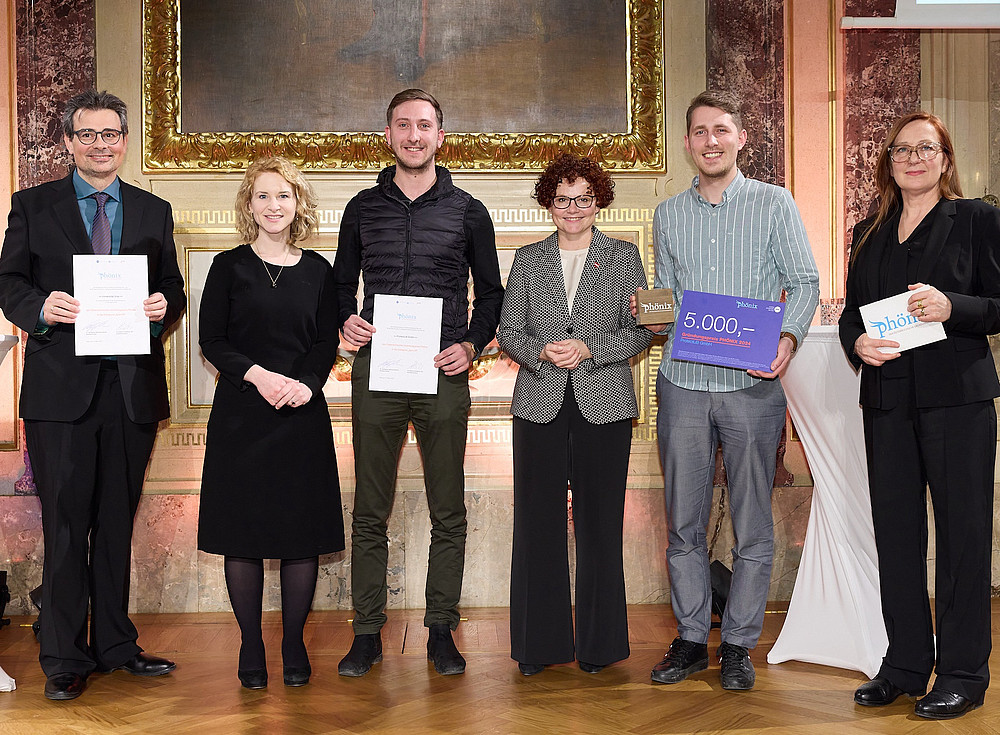
Sechs Personen auf eine Bühne ©Austria Wirtschaftsservice GmbH/APA-Fotoservice/Schedl

Chris Pichler (3rd from left) and Tobias Kopp (2nd from right) from ‘ProtectLib’ accepted the award. Eva-Maria Holzleitner, Federal Minister for Women, Science and Research, and NAWI Dean Klemens Fellner offered their personal congratulations. Foto: Austria Wirtschaftsservice GmbH/APA-Fotoservice/Schedl

A spin-off from the University of Graz has developed a compact system for recycling lithium-ion batteries from electric vehicles. The innovation enables the cost-effective and environmentally friendly recycling of valuable raw materials directly on site. This invention has now been awarded the PHÖNIX start-up prize.

University research is considered a guarantor of innovation. Many inventions from the laboratories find their way into the economy. Under the name ‘ProtectLiB’, Jürgen Abraham, Tobias Kopp and Chris Pichler developed a patented recycling process for batteries of electric cars – in the form of a compact recycling plant. This is the size of an ordinary container, so that vehicle batteries can be processed directly on site. On 12 March 2025, the invention was awarded the Austrian start-up prize PHÖNIX in the ‘Spin-offs’ category.
 

Electric cars are a central component of sustainable mobility. But what happens when an e-car is damaged or reaches the end of its useful life? While components such as the body, seats and fittings can be easily recycled, batteries pose a particular challenge. They power the vehicle for hundreds of kilometres, contain valuable raw materials, but are also prone to damage and can cause fires.

The solution lies in recycling – but that is easier said than done. Only a few disposal companies have the appropriate facilities for recycling lithium-ion batteries. In addition, secure transport is needed to get the old batteries there – a complex and costly process.


On-site recycling

Under the name ‘ProtectLiB’, Abraham, Kopp and Pichler developed a recycling plant the size of a container that can be used directly on site. ‘We can separate lithium, cobalt and nickel from the liquid electrolytes – without heat,’ Kopp explains. This brings a decisive advantage for customers: since the residual materials are no longer hazardous, both further processing and transport are considerably cheaper.


Prototype in the centre of Graz

The first prototype is located on the university campus and is ready for use. The founders are currently focusing entirely on batteries from the automotive sector. Mobile phone or laptop batteries are out of the question for the time being, because each battery has a different chemical composition. ‘A single solution for all is not so easy to implement,’ explains Kopp.

A first customer has already been acquired in the south of Graz. Kopp: ‘Battery prototypes for transport are being developed there. In the future, the company wants to recycle these directly on site using ProtectLib technology.’ A first step towards the sustainable recycling of batteries from the automotive sector.

The PHÖNIX award is organised by Austria Wirtschaftsservice GmbH (aws) in cooperation with the Federation of Austrian Industries (IV) and the Austrian Research Promotion Agency (FFG). A jury of experts selected the winners from 12 projects submitted in 2024, with 11 teams going into the final. The award was presented in four categories.
 

More information about the spin-off:

www.protectlib.at


Information about the PHÖNIX start-up prize:

www.gruendungspreis-phoenix.at


created by Roman Vilgut & Konstantin Tzivanopoulos

Related news

Long Night of Research: How many languages are there in the world?

From a linguistic perspective, there are worlds of difference between Bern, Berlin and Vienna. A dialect impersonator will demonstrate live just how varied German can sound. How many languages are there in the world? What are their distinctive features? Which of these are spoken in Austria? These and other questions will be answered during the Long Night of Research at the University of Graz: on Friday, 24 April 2025, from 5 pm to 11 pm, in the University Library. Visitors can immerse themselves in the diversity of languages without travelling far by taking part in a quiz at the station.

Dual role: Researchers show that platelets can worsen disease

Platelets are best known as rapid responders in the event of injury. They stop bleeding and are indispensable for wound healing. “However, thrombocytes can also aggravate diseases, especially when inflammatory processes are involved,” explains Marion Mußbacher, a pharmacist at the University of Graz. She investigated the “dual role” of platelets in relation to fatty liver disease, a condition closely linked to obesity and type 2 diabetes.

Forscher:innen entdecken natürlichen Wirkstoff zum Schutz vor Lebererkrankungen

Die Leber leidet still. „Fetteinlagerungen, strukturelle Zerstörung des Gewebes oder mutierende Tumorzellen – all das fliegt eine Weile unter dem Radar. Begleitet werden diese Veränderungen oft von leichten, jedoch chronischen Entzündungen“, erklärt Andreas Koeberle, Pharmazeut an der Universität Graz. Er hat mit seinem Team und Kolleg:innen der Universität Innsbruck den Wirkstoff Mitrephoron B untersucht, der neue Behandlungsansätze ermöglicht. Die Ergebnisse der Studie wurden kürzlich in der Open-Access-Fachzeitschrift „Theranostics“ veröffentlicht.

Climate at the cliffs: Researchers unravel the evolution of the Greenland ice margin

Vertical ice walls, up to 40 metres high: in "Game of Thrones" they were dramatised as fortifications; during the Cold War, they were studied with great interest. How these imposing walls along Greenland’s 80,000-kilometre-long ice margin formed, how they are evolving, and what impact they have on the climate is not yet fully understood. Researchers from the Universities of Graz and Innsbruck have come one step closer to solving the mystery. The results of their latest study have been published in the journal The Cryosphere.

Begin of page section:
Additional information:

University of Graz
Universitaetsplatz 3
8010 Graz
Austria
  • Contact
  • Web Editors
  • Moodle
  • UNIGRAZonline
  • Imprint
  • Data Protection Declaration
  • Accessibility Declaration
Weatherstation
Uni Graz

End of this page section. Go to overview of page sections

End of this page section. Go to overview of page sections

Begin of page section:

End of this page section. Go to overview of page sections


