



Begin of page section:
Page sections:

  • Go to contents (Accesskey 1)
  • Go to position marker (Accesskey 2)
  • Go to main navigation (Accesskey 3)
  • Go to sub navigation (Accesskey 4)
  • Go to additional information (Accesskey 5)
  • Go to page settings (user/language) (Accesskey 8)
  • Go to search (Accesskey 9)

End of this page section. Go to overview of page sections

Begin of page section:
Page settings:

English en
Deutsch de
Search
Login

End of this page section. Go to overview of page sections

Begin of page section:
Search:

Search for details about Uni Graz
Close

End of this page section. Go to overview of page sections


Search

Begin of page section:
Main navigation:

Page navigation:

  • University

    University
    • About the University
    • Organisation
    • Faculties
    • Library
    • Working at University of Graz
    • Campus
    Developing solutions for the world of tomorrow - that is our mission. Our students and our researchers take on the great challenges of society and carry the knowledge out.
  • Research Profile

    Research Profile
    • Our Expertise
    • Research Questions
    • Research Portal
    • Promoting Research
    • Research Transfer
    • Ethics in Research
    • Commission for Scientific Integrity
    Scientific excellence and the courage to break new ground. Research at the University of Graz creates the foundations for making the future worth living.
  • Studies

    Studies
    • Prospective Students
    • Students
  • Community

    Community
    • International
    • Location
    • Research and Business
    • Alumni
    The University of Graz is a hub for international research and brings together scientists and business experts. Moreover, it fosters the exchange and cooperation in study and teaching.
  • Spotlight
Topics
  • Sustainable University
  • Researchers answer
  • Work for us
Close menu

End of this page section. Go to overview of page sections

Begin of page section:
You are here:

University of Graz News Uni Graz: Erfolgreiches Netzwerkevent „Bridging the gap between Technology and Society”

End of this page section. Go to overview of page sections

Wednesday, 21 June 2023

Uni Graz: Erfolgreiches Netzwerkevent „Bridging the gap between Technology and Society”

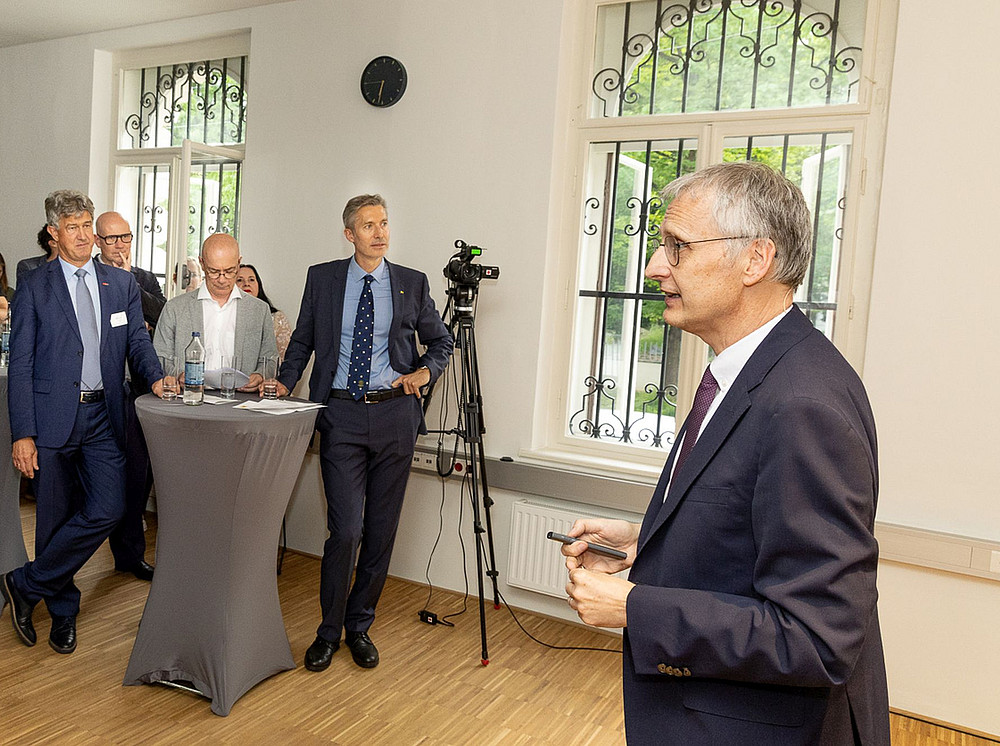
Viktor Mayer-Schönberger beim Netzwerk-Event "Bridging the gap between Technology and Society"

Viktor Mayer-Schönberger beim Netzwerk-Event "Bridging the gap between Technology and Society". Foto: Uni Graz

Mitte Juni 2023 fand das Netzwerkevent im IDea_Lab der Universität Graz unter dem Titel "Bridging the gap between Technology and Society" statt, zu dem Rektor Peter Riedler und Vizerektor Markus Fallenböck eingeladen hatten. Die Veranstaltung brachte renommierte Expert:innen, führende Persönlichkeiten und innovative Denker:innen aus den Bereichen Technologie, Wissenschaft, Wirtschaft, Gesellschaft sowie Kunst zusammen, um über die aktuellen Herausforderungen der digitalen Transformation zu diskutieren. Der Schwerpunkt lag dabei auf den Themen Big Data und Künstliche Intelligenz (KI).

Einer der Höhepunkte der Veranstaltung war die Keynote von Viktor Mayer-Schönberger, Professor für Internet Governance an der Universität Oxford und Honorarprofessor an der Universität Graz. Er sprach über die Bedeutung der Zusammenarbeit zwischen menschlicher und künstlicher Intelligenz und betonte die besondere Kreativität des Menschen durch „zielgerichtetes Träumen“, die Fähigkeit in die Zukunft zu planen.

Harald Leitenmüller, CTO Microsoft Österreich, gab den Teilnehmer:innen einen Einblick in die Zukunft von OpenAI und ChatGPT innerhalb der Produkte des Konzerns. Er präsentierte die Rolle von „Co-Piloten“ in verschiedenen Programmen und erläuterte, wie sie unseren Arbeitsalltag unterstützen können. Leitenmüller prophezeite eine „A New Future of Work“. Wobei er doch betonte: „KI nimmt Ihnen nicht Ihre Arbeit weg, aber Menschen mit KI werden es tun!“

Abgerundet wurde das Event mit der Präsentation der digitalen Werke des Künstler:innen-Duos Suzanne Anker (NYC) und Mathias Kessler (Wien/NYC) unter dem Titel "Vanitas in a petri dish". Die Anwesenheit der beiden Kunstschaffenden sowie der verantwortlichen Professorin Sabine Flach trug zu einer inspirierenden Atmosphäre bei und verdeutlichte die Verbindung zwischen Kunst und Technologie.

Ein weiterer Höhepunkt der Veranstaltung war die Vorstellung des IDea_Lab, des Interdisziplinären digitalen Labors der Universität Graz. Das IDea_Lab ist ein hochinnovatives Zentrum, das sich mit den Fragen der digitalen Transformation, insbesondere von Künstlicher Intelligenz und Big Data, befasst. Das Labor arbeitet über Fakultätsgrenzen hinweg und untersucht die Auswirkungen der digitalen Transformation in Bereichen wie Ethik, Wirtschaft oder Recht. Die Forscher:innen arbeiten interdisziplinär zusammen, um aktuelle und zukunftsorientierte Themen zu analysieren und nachhaltige Lösungen zu erarbeiten.

Rektor Peter Riedler betonte in seinen Grußworten die Bedeutung der Universität als Ort der Begegnung: „Das Netzwerkevent war ein großer Erfolg und hat gezeigt, dass der Austausch zwischen Wissenschaft und Wirtschaft von entscheidender Bedeutung ist.“ Vizerektor Markus Fallenböck lud mögliche Partner:innen aus Gesellschaft und Wirtschaft ein, sich auch aktiv einzubringen: „Das IDea_Lab dient als ein Ort, an dem die neuesten Technologien auf die aktuellsten Forschungsergebnisse treffen und bei Bedarf in Labor-ähnlichen Bedingungen erprobt werden können. So können zukünftige Partner:innen ihre eigenen Projekte sowie Produkte weiterentwickeln und von den in IDea_Lab vorhandenen Ressourcen profitieren.“

created by Roman Vilgut

Related news

Around the world in eight stops: the Long Night of Research at the University of Graz

On 24 April from 5 pm, you can take a short trip around the globe at the University of Graz, discovering pecularities of foreign countries or new local features in the entrance hall of the University Library. The itinerary takes you through introduced animal species, political attitudes and the omnipotence of algorithms. There will also be a programme in the historic reading hall, as well as at the UniGraz@Museum and the University Archive.

Studying at the University of Graz: How to enrol

Ready for a new chapter in your life with the start of your studies at the University of Graz in the winter semester 2026/27? Here you will find information on deadlines, admission procedures, registration, and everything else you need to successfully start your studies in the fall.

Interpreting data: Why studies sometimes get it wrong

Hilmar Brohmer and Ziva Korda from the Institute of Psychology, together with 500 international colleagues, have re-evaluated a hundred scientific publications and have often come to different conclusions.

Crystal-clear: AI method revolutionises solar observation

The Sun makes life on Earth possible. However, its magnetic fields can also cause massive disruption. This makes it all the more important to gain a better understanding of the processes taking place on our nearest star. A research team from the University of Graz and the High Altitude Observatory in Boulder (USA) has succeeded in doing just that. The astrophysicists have developed an AI-supported method that makes even the smallest structures on the Sun visible. The scientists are convinced that this will bring about a lasting change in solar observation and that the new method can be used for the planned European Solar Telescope.

Begin of page section:
Additional information:

University of Graz
Universitaetsplatz 3
8010 Graz
Austria
  • Contact
  • Web Editors
  • Moodle
  • UNIGRAZonline
  • Imprint
  • Data Protection Declaration
  • Accessibility Declaration
Weatherstation
Uni Graz

End of this page section. Go to overview of page sections

End of this page section. Go to overview of page sections

Begin of page section:

End of this page section. Go to overview of page sections

