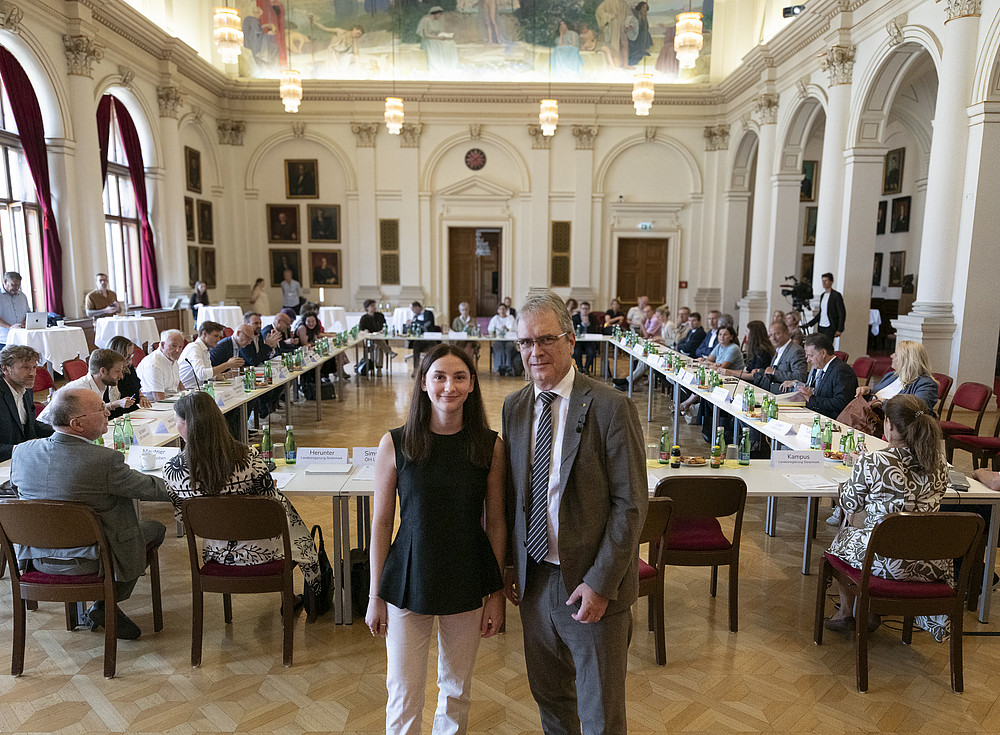
Styria is one of Europe’s most successful regions in the fields of science, research and innovation. This success is no coincidence. It is the result of decades of investment in excellent teaching, internationally recognised research, dedicated individuals and exemplary collaboration between the five Styrian universities and their partners from business, research and society. A funding shortfall at the universities, such as the one currently under discussion, would hit Styria particularly hard. It would have a significant impact on university research, on study and teaching, on the quality of student support and study conditions, and on the breadth of the range of degree programmes on offer. On the initiative of the University of Graz, leading figures from the worlds of politics, academia and business have come together to discuss how university funding can be structured for the forthcoming performance agreement period 2028–2030.
The five Styrian universities – the University of Graz, Graz University of Technology, Medical University of Graz, University of Music and Performing Arts Graz and Montanuniversität Leoben – see an urgent need for dialogue and action. They will certainly make their contribution to the necessary consolidation of public finances, but at the same time face the challenge of maintaining their capacity for research, teaching, innovation and the training of urgently needed skilled workers in southern Austria.
The planned cuts would, in any case, represent a massive blow to the future of young people – the next generation – and would, of course, also affect the university cities of Graz and Leoben. The Styrian capital is home to 50,000 students, a sixth of the population. The approximately 3,000 students in Leoben account for more than ten per cent of the population. What few people realise is that young people not only shape the cityscape, they are also a key economic factor. Around three-quarters of them work alongside their studies; they are reliable tenants and, last but not least, they visit local pubs and restaurants and shop in local shops.
University of Graz: Half stay in Graz after graduation
The importance of students to the city is also demonstrated by a survey of the career paths of University of Graz graduates. Of the more than 5,000 young people who will be starting a degree at the University of Graz in the winter semester, 49 per cent come from Styria. However, after graduating, 58.1 per cent of graduates remain in the region and contribute their expertise to the Styrian labour market. These figures also show that, three years after completing their Master’s degree, 84 per cent of graduates were in employment. The five most significant sectors are social services (12 per cent), public administration (7 per cent), education and teaching (5 per cent), tertiary/post-secondary education (5 per cent), and auditing and tax consultancy (4 per cent).
Universities generate added value far beyond the campus
For Styria as a centre of science, business and culture, cuts to research, teaching and support for early-career researchers would be immediately felt. “Styrian universities generate 1.25 billion euros in value creation every year and secure around 20,000 jobs. The fact that Styria has Austria’s highest research intensity at 5.3 per cent is no coincidence, but rather the result of this close integration: Eight of the fifteen Austrian COMET projects are led by a Styrian university institute, and the causality runs from the university to industry – research attracts businesses. However, the bulk of the benefits is not even reflected in these figures: three to ten per cent of real economic growth can be attributed to university research and teaching. “This is precisely why cuts in this area are so dangerous – even a five per cent reduction in the number of graduates would cost Austria 3.2 billion euros per year in the long term,” emphasises Monika Köppl-Turyna, Director of Eco Austria.
Styria currently accounts for more than a fifth of Austria’s total research and development output; around a quarter of this is attributable to public universities. Innovative companies, too, rely on the experts trained at these universities. At the same time, the University of Graz, Graz University of Technology, the Medical University of Graz, the University of Music and Performing Arts Graz and the Leoben University of Mining and Technology are key employers, educational institutions, cultural hubs and research partners in the region. They make a significant contribution to Styria’s innovative strength and international competitiveness and shape the cityscape.
Funding must be transparent and realistic
For the new funding period 2028–2030, the Austrian University Conference (uniko) and the universities have, with a view to the future, calculated a funding requirement of 18 billion euros – a figure that is already tight. The federal government, however, continues to assume a roll-over of the previous university budget totalling 16.5 billion euros for Austrian universities and, based on current information, has included in this figure expenditure of around 1 billion euros, which have not previously been funded directly by the universities but via other budgetary sources. In short, this budgetary approach would result in a total funding shortfall of 2.5 billion euros for Austrian universities over the next funding period.
It is therefore crucial for the Styrian universities to first establish a common understanding of the actual scale and structure of the university budget for the coming funding period. In doing so, those costs which, according to the government’s plans, are currently being factored into the university budget must also be taken into account and reported transparently. By the end of October, the federal government must have set the course for the universities’ next three-year funding period, 2028–2030.
“We are aware that we are living in challenging times in terms of the budget. The crucial question is not whether universities can make savings. They can, and they will. What is crucial is that austerity measures do not damage the structures that have been built up with great effort and that we as a society need for the future. For, in addition to traditional vocational training and excellent research, a comprehensive university brings together different disciplines. This enables it to address the key issues of the future in their full social context, ranging from climate change and healthy ageing, through digitalisation, AI and ethics, to democracy, sustainability, inclusion and early childhood education. “This breadth is not a luxury, but a prerequisite for the future viability of our society,” emphasises Peter Riedler, Rector of the University of Graz, thanking the ÖH-Uni Graz for this joint round-table initiative, which was implemented promptly and on an equal footing.
“Education is a human right and the key to a self-determined life. Yet it is precisely here that massive cuts are now to be made! Anyone making cuts to Styrian universities is not simply saving money, but is undermining the future of around 60,000 students in Styria, jeopardising equal opportunities and weakening our democracy. Above all, the diversity of degree programmes – as we have here at the University of Graz – is essential for creating the space for critical thinking, fact-based discussions and open exchange in the first place. In times of multiple crises and increasing social division, this is precisely why fully funded universities are more important than ever. “Cuts jeopardise the future prospects of us students and early-career researchers and send a disastrous signal to society as a whole,” says Valentina Simschitz, Chair of the Austrian National Union of Students (ÖH) at the University of Graz, summing up the concern.
Making savings without jeopardising future prospects
As has been explained in detail on numerous occasions, particularly in recent months, Styrian universities are committed to the responsible use of public funds. Opportunities for efficiency and organisational structures are continually being developed. In Styria in particular, the universities began focusing intensively on collaboration more than twenty years ago (e.g. NAWI Graz, BioTechMed-Graz, Kunst-TU, iHub Graz, Gründungsgarage, teacher training). Through the jointly created infrastructures (e.g. GCP, Cori Building, Geozentrum), they demonstrate how institutions can collectively strengthen their position and pool their resources.
Since May, the universities and the Austrian National Union of Students have been issuing a united warning against making short-term savings at the expense of long-term follow-on costs. Without financial security, it is virtually impossible to undertake cost-intensive investments in technical facilities for natural science studies. Furthermore, around 85 per cent of university funding is allocated to staff, who, on the one hand, train the experts of the future and, on the other, ensure research of the highest standard. Cuts in this area weaken international competitiveness when it comes to attracting the best researchers and students. This also makes it more difficult to secure EU funding or establish co-funded research collaborations, leading to a decline in the relevant university and location rankings.
Shared responsibility for the future
The round table is intended to contribute to an objective, collaborative and solution-oriented discussion. The aim is to create a sound basis for further negotiations on the 2028–2030 performance agreements for Styrian universities and to jointly develop prospects for the future of Styria as a region of knowledge.
The round table therefore looks beyond individual institutions and short-term budgetary issues. The focus is on shared responsibility for Styria as a strong centre for science and business, and specifically for the two university cities of Graz and Leoben.
Mario Kunasek, Governor of Styria:
“According to the plans of Minister for Science Eva-Maria Holzleitner, Styrian universities are to make savings of 500 million euros. As Governor of Styria, I say quite clearly: this is a direct attack on our position as a centre for science and business! These drastic cuts will lead to a decline in the quality of our research and teaching; our students will face poorer student-tutor ratios; and 1,000 jobs at our universities are under serious threat – 500 at Graz University of Technology alone. Anyone who withholds half a billion euros from our universities is destroying future prospects, wiping out jobs and deliberately weakening Styria as a centre of excellence. I therefore urge the federal government to abandon these plans, and I call in particular on the SPÖ’s Minister for Science to reconsider her position and, in this crucial sector for the future, to invest in Styria and Austria as a whole rather than weaken them. This is what Austria needs, this is what the region needs, and above all, this is what Styria needs.”
Elke Kahr, Mayor of the university city of Graz:
“Graz is a city in which universities, research and educational institutions play a vital role. Economic and demographic development is closely linked to the universities. Positive development of the central Styrian region and its diverse economy is inconceivable without a financially secure education policy. That is why sustainable funding is also of the utmost importance for the Styrian capital.”
Kurt Wallner, Mayor of the university town of Leoben:
“For Leoben, the Montanuniversität is far more than just a university – it is a central part of our town and closely linked to industry, the economy and the labour market. Anyone who cuts back on research, teaching and young talent therefore weakens not only a university, but the entire economic and innovation hub. Of course, public funds must be managed responsibly. But particularly in economically challenging times, we must safeguard those structures that train skilled workers, enable innovation and thus shape our future.”
Further statements >> here
Detailed information on universities as an economic factor >> here
Information on the budget situation of the Styrian universities >> here
Translatet with DeepL