Begin of page section:
Page sections:

  • Go to contents (Accesskey 1)
  • Go to position marker (Accesskey 2)
  • Go to main navigation (Accesskey 3)
  • Go to sub navigation (Accesskey 4)
  • Go to additional information (Accesskey 5)
  • Go to page settings (user/language) (Accesskey 8)
  • Go to search (Accesskey 9)

End of this page section. Go to overview of page sections

Begin of page section:
Page settings:

English en
Deutsch de
Search
Login

End of this page section. Go to overview of page sections

Begin of page section:
Search:

Search for details about Uni Graz
Close

End of this page section. Go to overview of page sections


Search

Begin of page section:
Main navigation:

Page navigation:

  • University

    University
    • About the University
    • Organisation
    • Faculties
    • Library
    • Working at University of Graz
    • Campus
    Developing solutions for the world of tomorrow - that is our mission. Our students and our researchers take on the great challenges of society and carry the knowledge out.
  • Research Profile

    Research Profile
    • Our Expertise
    • Research Questions
    • Research Portal
    • Promoting Research
    • Research Transfer
    • Ethics in Research
    • Commission for Scientific Integrity
    Scientific excellence and the courage to break new ground. Research at the University of Graz creates the foundations for making the future worth living.
  • Studies

    Studies
    • Prospective Students
    • Students
    • Registration for Study Programme (Winter semester 2026/27)
    • Welcome Weeks for First Year Students
  • Community

    Community
    • International
    • Location
    • Research and Business
    • Alumni
    The University of Graz is a hub for international research and brings together scientists and business experts. Moreover, it fosters the exchange and cooperation in study and teaching.
Topics
  • Sustainable University
  • Researchers answer
  • Work for us
Close menu

End of this page section. Go to overview of page sections

Begin of page section:
You are here:

University of Graz News University of Graz makes the top 500 in the Shanghai Ranking

End of this page section. Go to overview of page sections

Tuesday, 18 August 2026

University of Graz makes the top 500 in the Shanghai Ranking

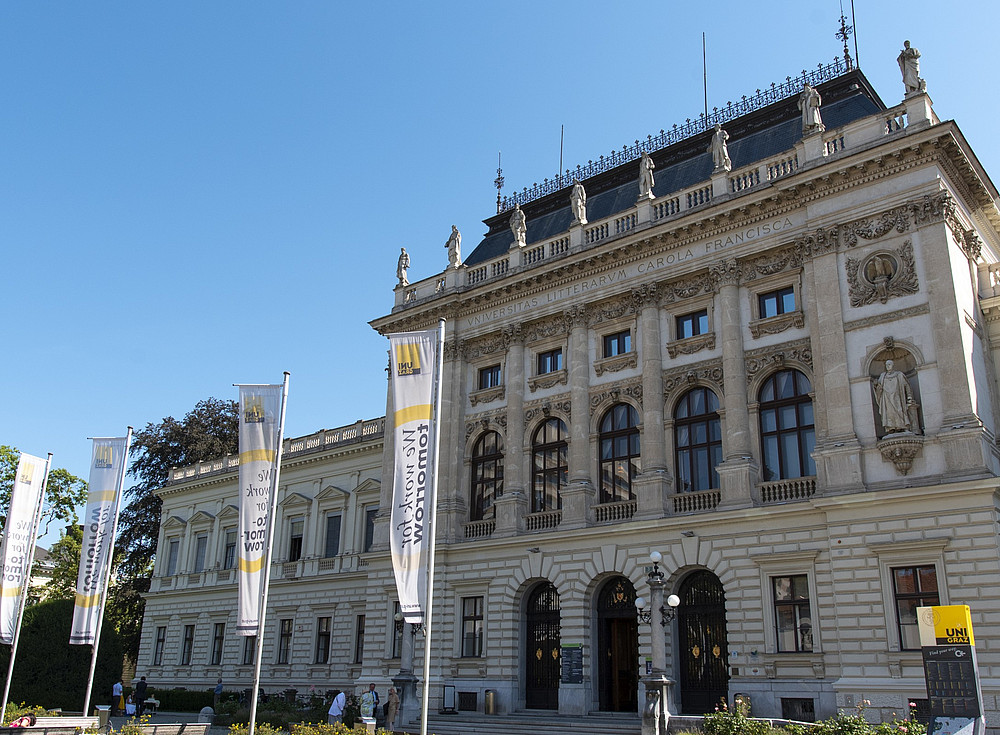
A monumental building dating from the late 19th century, with tall windows and a large entrance gate. ©Universität Graz
©Universität Graz

The University of Graz has improved its position in a key ranking. Photo: University of Graz/Raggautz

The University of Graz has moved into the top 500 in the Shanghai Ranking published on 15 August 2026, placing it amongst the top two per cent of around 25,000 higher education institutions worldwide. In light of this improvement, Rector Peter Riedler emphasises that such successes require long-term financial security in order to maintain standards.

The Shanghai Ranking, compiled by the consultancy firm ShanghaiRanking Consultancy, is one of the most important university rankings, with a strong focus on the natural sciences, and plays a key role in joint research projects, particularly in Asia. Making it into the top 500 in this ranking is a major achievement, particularly for a broad-based university. 

As in previous years, the ranking is led by the US universities Harvard, Stanford and the Massachusetts Institute of Technology (MIT). The highest-ranked European university is the University of Cambridge in the UK, in fourth place. Generally speaking, Anglo-Saxon universities dominate the top ranks. The French University of Paris-Saclay, in 13th place, is the first from a non-English-speaking country. Of the seven Austrian universities that have made it into the top 1,000, the University of Graz is in fifth place, ahead of the medical universities of Innsbruck and Graz and behind the Vienna University of Technology, the Medical University of Vienna, the University of Innsbruck and the University of Vienna.

This improvement in the rankings pays off twice over for the University of Graz. It boosts its international visibility and thus makes it more attractive for international academic collaborations. Students looking for a suitable Master’s programme also use international rankings as a guide. For the University of Graz, the focus is currently primarily on the Leiden Ranking, which will be published in September.

“Success in international rankings is only possible if we, as a university, have long-term financial security. We must be able to offer an attractive package for top researchers, and that includes budgetary resources,” says Peter Riedler, Rector of the University of Graz. It is not only the university itself that benefits from cutting-edge research; it is also an economic driver for the entire region. “If we want to further improve this position, we need additional resources. However, the federal government is currently planning the opposite,” says Riedler.

Translated with DeepL.

created by Roman Vilgut

Related news

Surprise, spectacle, science: Astrophysicists observed a partial solar eclipse

The star of the show was the sun, and the programme featured a natural spectacle: the partial solar eclipse on the evening of 12 August 2026 drew crowds to Graz’s Schloßberg. The ‘sun-downer’ was accompanied by a dash of science from astrophysicists at the University of Graz.

Discussions on Europe’s digital future are taking place in Graz

Exactly three months before the event, the Technology Impact Summit (TIS) team is unveiling the programme for this year’s think tank event.

Preserving cultural heritage: Graz researchers make Roman inscriptions legible again

Researchers from the University of Graz and Graz University of Technology are working to save inscriptions carved in stone in Styria during Roman times from disappearing. They have developed a simple and cost-effective method to make inscriptions on tombs and votive altars – which have been weathered or damaged – legible again. They are currently testing the method on Roman stones at several sites across Styria. The aim is to provide other historians with a tool to preserve cultural heritage when expensive research equipment is not available. The method was recently published in the research journal Heritage Science.

When the sun goes dark: Enlightening for science and the people of Graz

When the moon partially passes in front of the sun in Graz on 12 August 2026, the event will once again captivate many people. This includes Manuela Temmer, an astrophysicist at the University of Graz. The scientist confirms that this celestial phenomenon offers significant value for research: “During a solar eclipse, the corona can be observed more clearly than with any instrument.”

Begin of page section:
Additional information:

University of Graz
Universitaetsplatz 3
8010 Graz
Austria
  • Contact
  • Web Editors
  • Moodle
  • UNIGRAZonline
  • Imprint
  • Data Protection Declaration
  • Accessibility Declaration
Weatherstation
Uni Graz

End of this page section. Go to overview of page sections

End of this page section. Go to overview of page sections

Begin of page section:

End of this page section. Go to overview of page sections