Begin of page section:
Page sections:

  • Go to contents (Accesskey 1)
  • Go to position marker (Accesskey 2)
  • Go to main navigation (Accesskey 3)
  • Go to sub navigation (Accesskey 4)
  • Go to additional information (Accesskey 5)
  • Go to page settings (user/language) (Accesskey 8)
  • Go to search (Accesskey 9)

End of this page section. Go to overview of page sections

Begin of page section:
Page settings:

English en
Deutsch de
Search
Login

End of this page section. Go to overview of page sections

Begin of page section:
Search:

Search for details about Uni Graz
Close

End of this page section. Go to overview of page sections


Search

Begin of page section:
Main navigation:

Page navigation:

  • University

    University
    • About the University
    • Organisation
    • Faculties
    • Library
    • Working at University of Graz
    • Campus
    Developing solutions for the world of tomorrow - that is our mission. Our students and our researchers take on the great challenges of society and carry the knowledge out.
  • Research Profile

    Research Profile
    • Our Expertise
    • Research Questions
    • Research Portal
    • Promoting Research
    • Research Transfer
    • Ethics in Research
    Scientific excellence and the courage to break new ground. Research at the University of Graz creates the foundations for making the future worth living.
  • Studies

    Studies
    • Prospective Students
    • Students
  • Community

    Community
    • International
    • Location
    • Research and Business
    • Alumni
    The University of Graz is a hub for international research and brings together scientists and business experts. Moreover, it fosters the exchange and cooperation in study and teaching.
  • Spotlight
Topics
  • Sustainable University
  • Researchers answer
  • Work for us
Close menu

End of this page section. Go to overview of page sections

Begin of page section:
You are here:

University of Graz News Twitter-Mite

End of this page section. Go to overview of page sections

Monday, 22 March 2021

Twitter-Mite

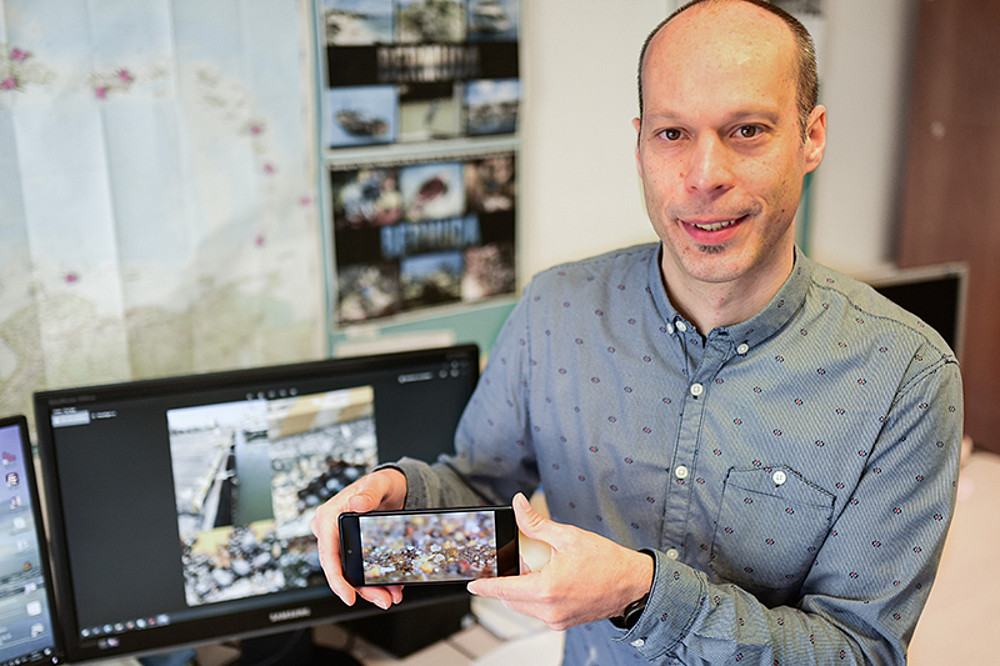
Uni Graz biologist Tobias Pfingstl identified a new species of mite that became public on Twitter. Photo: Uni Graz/Tzivanopoulos

Uni Graz biologist Tobias Pfingstl identified a new species of mite that became public on Twitter. Photo: Uni Graz/Tzivanopoulos

Biologist Tobias Pfingstl identifies new species via social media

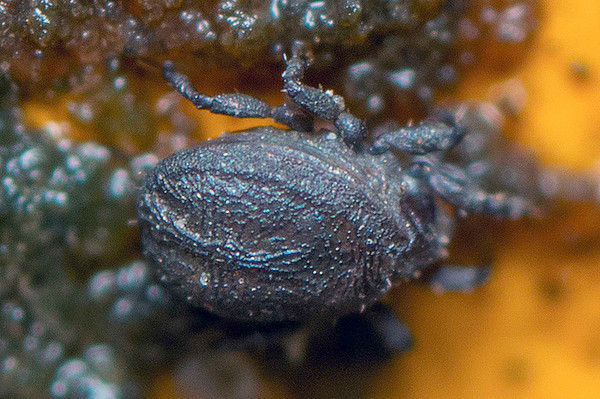
No, it’s not a miniature bug: Ameronothrus twitter is actually a previously unknown arachnid, which was identified by University of Graz biologist Tobias Pfingstl with the help of the messaging platform. The new mite is described in a paper published on 22 March 2021 in the specialist journal Species Diversity.
“Dozens of new mite species are discovered every year, but it’s unusual to hear about one via social media,” explains Pfingstl. In fact it’s thanks to the bad luck of a hobby fisherman and photographer that the new species was found: “The fish weren’t biting, so he was strolling along the harbour wall, where he took some photos and video footage of the tiny creature and published them on Twitter,” continues the biologist. Pfingstl’s Japanese research colleague noticed the Twitter post, contacted the author and was then actually able to find several of these mites at the same spot – some hundred kilometres east of Tokyo. Pfingstl identified these as new members of a family that he himself had first discovered in Japan in 2019.
“This is an oribatid mite, less than half a millimetre long, belonging to a family that is particularly well adapted to the cold. It is pretty surprising to find this type of mite in what is an almost subtropical climate,” explains the Graz biologist. So far these arachnids have not been found in their natural habitat – only on the harbour wall. However, the researchers believe this mite would normally live on rocks.

“Ameronothrus twitter is one of just a handful of species in the world that have been discovered via social media,” says the researcher. In the last few years, experts have identified a parasitic fungus on Twitter, a flesh-eating plant on Facebook and two new flies on the photo platform Flickr and on Instagram. “Our work shows that these platforms can make a real contribution to scientific research,” says Pfingstl; he is convinced that “this kind of networking will be increasingly important in the future.”

Publication:
Tobias Pfingstl, Shimpei F. Hiruta, Takamasa Nemoto, Wataru Hagino und Satoshi Shimano, Ameronothrus twitter sp. nov. (Acari, Oribatida) a New Coastal Species of Oribatid Mite from Japan, Species Diversity 26
DOI: 10.12782/specdiv.26
Video of the mite on twitter

Found by chance: the hitherto unknown mite Ameronothrus twitter; Photo: Takamasa Nemoto
created by Dagmar Eklaude

Related news

Cosmetics in the environment: University of Graz proves danger to ants

Titanium dioxide, which is found in cosmetics, for example, is increasingly entering the environment in the form of nanoparticles. This could also put insects at risk. If ants ingest the substance in combination with the pesticide glyphosate, it disturbs the development of their offspring. Scientists at the University of Graz are drawing attention to the negative consequences of this toxic cocktail.

How are tech companies changing democracy? Uni Graz designs exhibition for schools

Filtered information, conspiracy theories, fake news – certain groups and corporations are using social media and algorithms to try to influence public opinion in their favour. Their goal: to weaken fundamental rights and diversity of opinion and seize power. In a new exhibition, researchers at the University of Graz are working with pupils to explore the impact of social media and AI on democracy. In accompanying workshops, the scientists want to encourage young people to develop their own ideas for a socially and ecologically viable future and to actively help shape it. The exhibition, designed as a travelling exhibition for schools, will open on 9 March 2026 at the Dreihackengasse Gymnasium in Graz.

Step by step: What motivates Mireille van Poppel as a scientist and vice-rector

Improving people's health and eliminating inequalities: Mireille van Poppel pursues these goals both as a public health researcher and as vice-rector for Internationalisation and Equality. In both roles, she pays particular attention to individual needs.

Master's degree in psychotherapy in Graz: registration opens in March

Graz is becoming a hotspot for psychotherapy: from 2026, the University of Graz and the Medical University of Graz will jointly offer the new master's programme. Registration for the admission procedure for the 140 study places will start in March.

Begin of page section:
Additional information:

University of Graz
Universitaetsplatz 3
8010 Graz
Austria
  • Contact
  • Web Editors
  • Moodle
  • UNIGRAZonline
  • Imprint
  • Data Protection Declaration
  • Accessibility Declaration
Weatherstation
Uni Graz

End of this page section. Go to overview of page sections

End of this page section. Go to overview of page sections

Begin of page section:

End of this page section. Go to overview of page sections