




Begin of page section:
Page sections:

  • Go to contents (Accesskey 1)
  • Go to position marker (Accesskey 2)
  • Go to main navigation (Accesskey 3)
  • Go to sub navigation (Accesskey 4)
  • Go to additional information (Accesskey 5)
  • Go to page settings (user/language) (Accesskey 8)
  • Go to search (Accesskey 9)

End of this page section. Go to overview of page sections

Begin of page section:
Page settings:

English en
Deutsch de
Search
Login

End of this page section. Go to overview of page sections

Begin of page section:
Search:

Search for details about Uni Graz
Close

End of this page section. Go to overview of page sections


Search

Begin of page section:
Main navigation:

Page navigation:

  • University

    University
    • About the University
    • Organisation
    • Faculties
    • Library
    • Working at University of Graz
    • Campus
    Developing solutions for the world of tomorrow - that is our mission. Our students and our researchers take on the great challenges of society and carry the knowledge out.
  • Research Profile

    Research Profile
    • Our Expertise
    • Research Questions
    • Research Portal
    • Promoting Research
    • Research Transfer
    • Ethics in Research
    • Commission for Scientific Integrity
    Scientific excellence and the courage to break new ground. Research at the University of Graz creates the foundations for making the future worth living.
  • Studies

    Studies
    • Prospective Students
    • Students
    • Welcome Weeks for First Year Students
  • Community

    Community
    • International
    • Location
    • Research and Business
    • Alumni
    The University of Graz is a hub for international research and brings together scientists and business experts. Moreover, it fosters the exchange and cooperation in study and teaching.
Topics
  • Sustainable University
  • Researchers answer
  • Work for us
Close menu

End of this page section. Go to overview of page sections

Begin of page section:
You are here:

University of Graz News How do we turn taxes into profit?

End of this page section. Go to overview of page sections

Friday, 24 May 2019

How do we turn taxes into profit?

A carbon tax is an effective instrument to reduce greenhouse gas emissions. Photo: iStock.com/Olivier Le Moal ©Olivier Le Moal
©Olivier Le Moal

A carbon tax is an effective instrument to reduce greenhouse gas emissions. Photo: iStock.com/Olivier Le Moal

The Environmental Law Forum at the University of Graz is analysing ways to implement an environmentally friendly, socially and economically viable fiscal reform

Many experts conclude that carbon taxes and other taxes related to the environment are particularly powerful and cost-effective instruments for fulfilling the Paris Agreement climate objectives and the UN’s Sustainable Development Goals (SDGs). The general public, on the other hand, is less than enthusiastic about the idea of paying more taxes. “If it’s done in an intelligent way, a carbon tax can stimulate positive trends both in terms of social justice as well as economic prosperity”, notes the economist Karl Steininger. The Environmental Law Forum, which takes place at the University of Graz on 29 May 2019, will present examples of international best practices and paths towards an environmentally friendly, socially and economically viable fiscal reform, which can also be chosen in Austria.

As the name suggests, a carbon tax is an environmental tax on carbon dioxide and other greenhouse gases. As a result, goods which entail higher levels of emissions are more expensive. This price signal is designed as an incentive for companies and consumers to switch to more sustainable alternatives. Until now, politicians in Austria have been opposed to the introduction of a carbon tax. An argument: The public cannot be expected to pay additional taxes. Karl Steininger from the Wegener Center for Climate and Global Change at the University of Graz argues that a carbon tax doesn’t need to be a burden for households and the economy, citing examples from other countries.

The climate economist mentions Switzerland as a role model. “They introduced a carbon tax there in 2007, and the revenues are redistributed among the population, per capita, as a climate bonus. Employers receive part of it, which lowers their incidental wage costs. The rest of the funds are paid out to citizens through their social insurance provider”. Although consumers initially pay more for emission-intensive goods, at least they are refunded part of these costs. The amount of the climate bonus is the same for everyone. Those whose carbon expenses are less than the amount of the bonus actually make a profit.
Steininger uses this example to dismantle a stereotype: It is not necessarily those with a lower socioeconomic status who are punished by carbon taxes. “Our studies have shown that CO2 consumption per capita increases with income. Hence poorer households in Switzerland often receive more than they pay in”.

Another example of how effective a carbon tax can be without curtailing economic growth comes from a Scandinavian country. “Since the introduction of a carbon tax in 1991, Sweden has reduced its emissions, measured in CO2 equivalents, by 26 percent. At the same time, its economy has grown more than Austria’s, and it has been in the direction of a sustainable structure. Here in Austria, however, our emissions have increased”, says Steininger. At the same time, the researcher notes that the laws of economics cannot be ignored. “To remain internationally competitive, Sweden’s export-oriented and emission-intensive economy is exempt from the carbon tax”.

This is just one of many international experiences that will be shared at the Environmental Law Forum on 29 May 2019 at the University of Graz. The event is under the scientific direction of climate researcher Gottfried Kirchengast, environmental lawyers Gerhard Schnedl and Eva Schulev-Steindl as well as Karl Steininger. They are also addressing the question of how a carbon tax could benefit Austria.
“Austria has overlooked this option in the recent tax reform”, regrets Steininger. “Although the tax on petroleum is relatively high here, it still can’t cover all the costs that arise in connection with transport: everything from maintaining roads to health and the environment”. This is why Steininger feels an additional carbon tax is necessary. It would also make sense for heating, farming and waste management.

“A price regulation would provide key players with more leeway than demands and bans would. It would allow companies and individuals to make the adjustments they can implement most easily, depending on their situation”, says Steininger, which is why he argues in favour of environmental taxes. It is important to always see things from a holistic perspective. “The taxes have to be introduced in a way that all 17 SDGs, including those of a social and economic nature, can be achieved”.
>> Environmental law forum

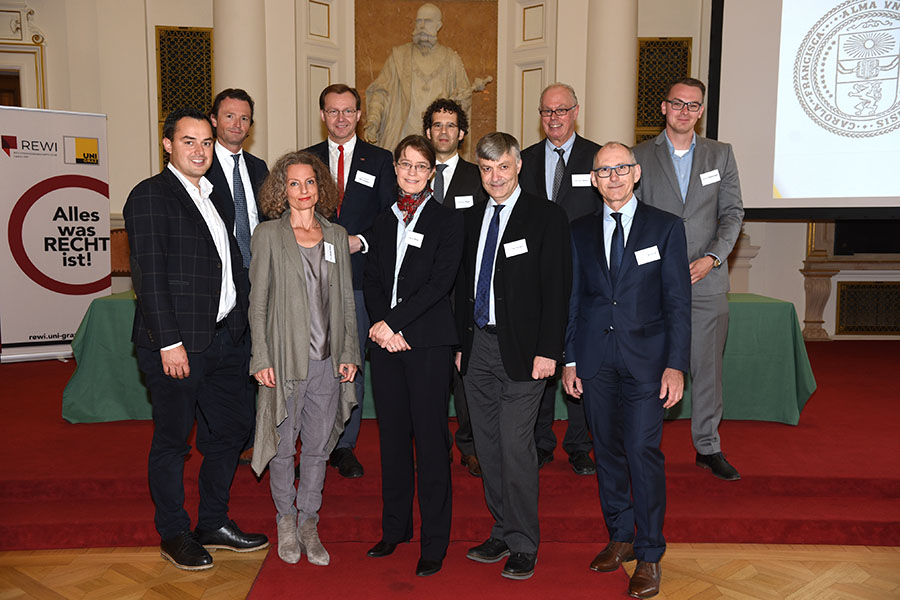
Environmental Law Forum 2019 (f.l.): a person who does not want to be mentioned, Johannes Zollner, Tina Ehrke-Rabel, Gottfried Kirchengast, Karen Pittel, Florens Flues, Karl Steininger, Richard Sturn, Gerhard Schnedl, Robin Damberger. Photo: Uni Graz/Pichler
Environmental Law Forum 2019 (f.l.): person does not want to be mentioned, Johannes Zollner, Tina Ehrke-Rabel, Gottfried Kirchengast, Karen Pittel, Florens Flues, Karl Steininger, Richard Sturn, Gerhard Schnedl, Robin Damberger. Photo: Uni Graz/Pichler
created by Gudrun Pichler

Related news

Jurassic Sounds: Biologist reconstructs insect songs from 165 million years ago

It was apparently not just the roars of the dinosaurs that made up the soundscape of the animal world during the Jurassic period. Crickets and grasshoppers communicated through a variety of songs and high-pitched sounds, as Thorin Jonsson from the Institute of Biology at the University of Graz discovered together with colleagues from the universities of Lincoln, Bristol (UK), Beijing (China) and Tempe (USA). The findings on what are so far the oldest traces of sound on Earth have just been published in the journal PNAS.

EU funding boosts international exchange between universities

The University of Graz is further expanding its international study opportunities through the European university alliance Arqus and is taking the lead in two key projects. In future, students will benefit from even more joint degree programmes and from simplified recognition of academic achievements through the Joint European Degree Label.

Rescue and risks: Researchers have surveyed public perceptions of AI

The use of artificial intelligence has had to be made transparent since 2 August 2026. The EU’s AI Act, which has been in force since then, also sets out how risky an application is and which security measures apply as a result. However, the assessment of risks by the legislation differs in some cases significantly from the perceptions of the Austrian public. This is the finding of a representative study carried out by data scientist Stefan Thalmann from the University of Graz and his team.

The Healing Sea: Researchers discover new approaches to treating chronic inflammation in sponges

Chronic inflammation plays a key role in many diseases, ranging from metabolic disorders and cardiovascular diseases to tissue damage following injuries or infections. “Normally, the body is able to resolve inflammation on its own. If this process becomes unbalanced, immune cells remain permanently active and continue to drive negative changes in the tissue,” explains Andreas Koeberle, a pharmacist at the University of Graz.

Begin of page section:
Additional information:

University of Graz
Universitaetsplatz 3
8010 Graz
Austria
  • Contact
  • Web Editors
  • Moodle
  • UNIGRAZonline
  • Imprint
  • Data Protection Declaration
  • Accessibility Declaration
Weatherstation
Uni Graz

End of this page section. Go to overview of page sections

End of this page section. Go to overview of page sections

Begin of page section:

End of this page section. Go to overview of page sections


